The cryptocurrency market is currently witnessing a period of pronounced volatility for Ethereum (ETH), the world’s leading smart contract platform. As of October 10, 2026, Ethereum has faced a significant downward trajectory, shedding more than 7% of its value over the preceding seven-day period. This decline comes amidst a backdrop of cooling investor enthusiasm and a notable contraction in institutional demand for spot Ethereum Exchange-Traded Funds (ETFs), which have just recorded their most dismal weekly performance since the launch of the products earlier this year.
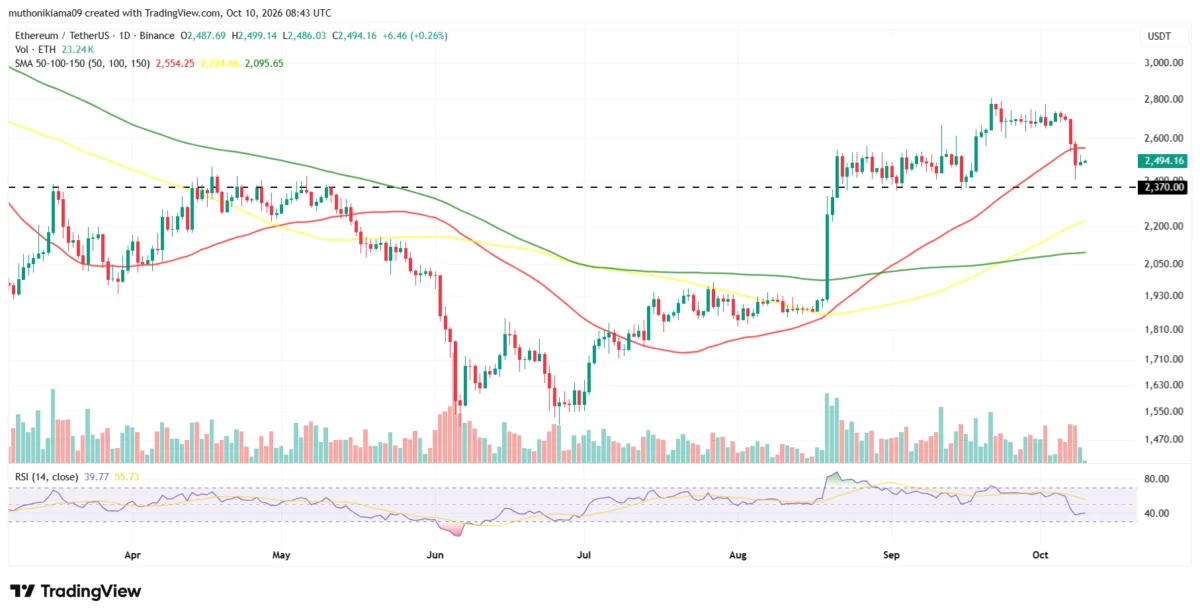
Currently trading at $2,491, ETH continues to struggle for momentum, having posted a marginal decline of 0.39% within the last 24 hours. Perhaps more concerning to market analysts is the sharp evaporation of liquidity; trading volumes have plummeted by 61%, resting at approximately $7.2 billion. This stagnation suggests that market participants are adopting a “wait-and-see” approach as bearish technical indicators begin to dominate the landscape.

The Institutional Retreat: A Chronology of ETF Outflows
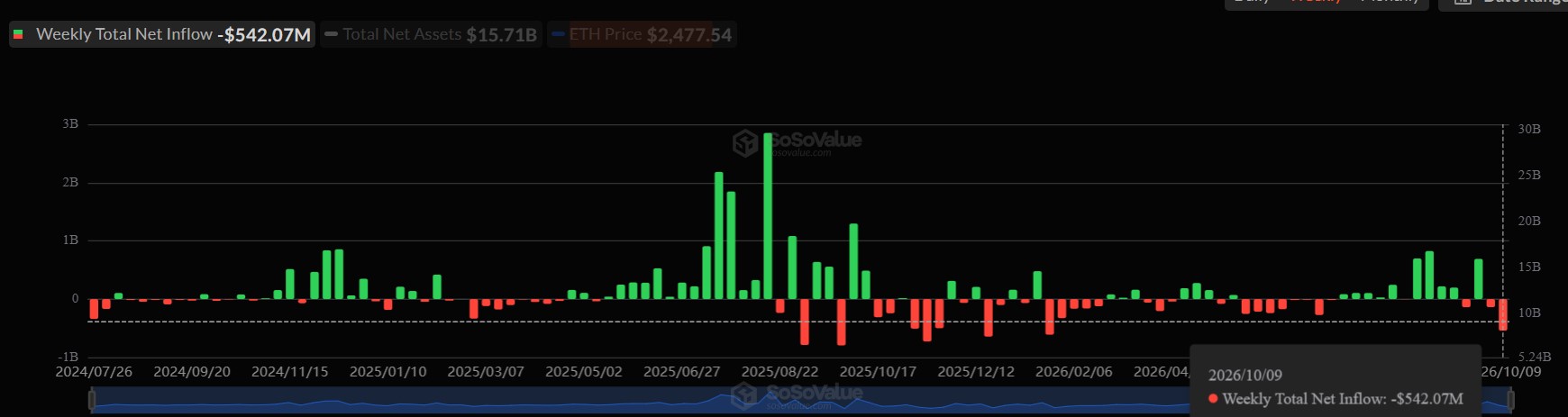
The narrative surrounding Ethereum’s recent price action is inextricably linked to the performance of US-listed spot ETH ETFs. According to comprehensive data provided by SoSoValue, the week ending October 9 proved to be a watershed moment for the wrong reasons. The aggregate outflows from these products reached a staggering $542 million—a figure that represents the most significant weekly exodus of capital since late January 2026.
The Timeline of the Downturn
- Early Q3 2026: Ethereum enjoyed a period of relative strength, significantly outperforming Bitcoin with a 70% gain. Market sentiment was high, driven by hopes of institutional adoption and broader blockchain utility.
- Late September 2026: As market conditions shifted, order book depth began to shrink, signaling an underlying fragility in the price recovery.
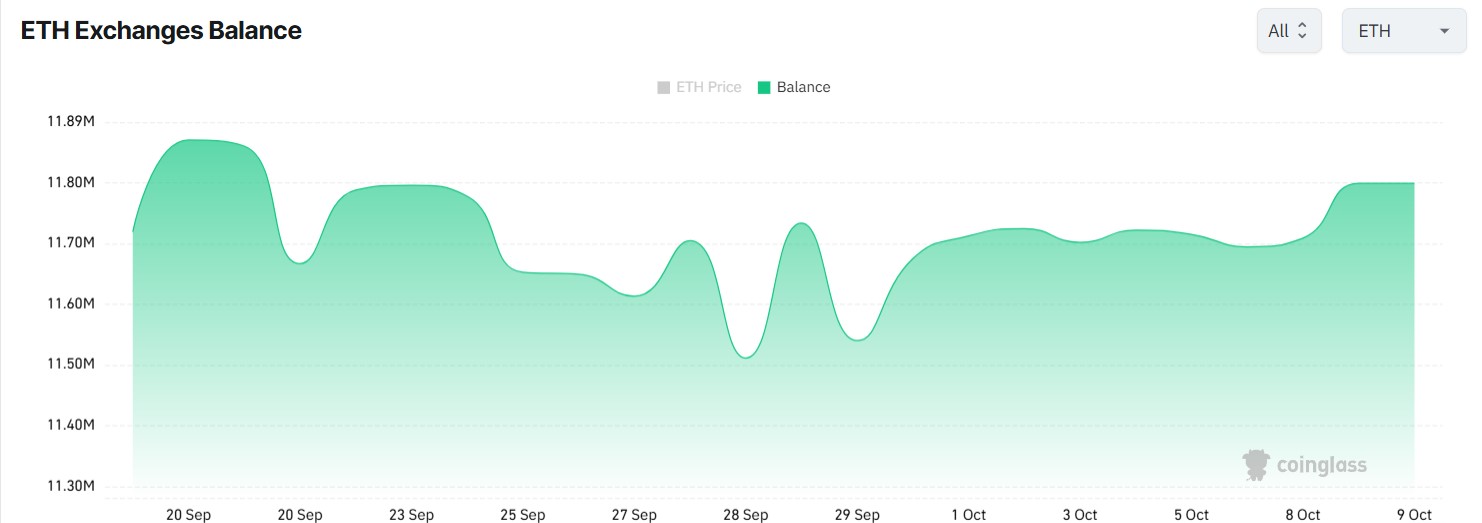
- October 8, 2026: Exchange balances for ETH began a rapid climb, rising from 11.71 million to 11.8 million in a matter of hours, indicating a shift from accumulation to distribution.
- October 9, 2026: The week closed with the $542 million outflow figure, confirming a broader market trend of risk-off behavior.
BlackRock’s iShares Ethereum Trust (ETHA) bore the brunt of this institutional cooling, accounting for a massive $477 million of the total outflows. For an asset class that relies on institutional inflows to validate its price discovery, such a withdrawal from a major market participant like BlackRock is a signal that professional investors are reallocating capital away from digital assets amid broader macroeconomic uncertainty.

Furthermore, the trend is not isolated to Ethereum. The broader US-listed crypto ETF market saw its highest weekly outflows since June, with Bitcoin ETFs recording $681 million in outflows, highlighting a systemic shift in appetite across the digital asset spectrum.
Analyzing the On-Chain Data: Deleveraging and Exchange Inflows
The correlation between institutional outflows and the behavior of retail and professional traders on exchanges is stark. Following the impressive Q3 performance, many investors appear to be engaging in "profit-taking," a classic market maneuver that inevitably leads to increased selling pressure.

The Rise of Exchange Balances
Data from CoinGlass reveals that exchange balances for ETH spiked significantly between October 8 and October 9, with 90,000 ETH tokens flowing into centralized exchanges in just 24 hours. When large amounts of an asset move onto exchanges, it is almost universally interpreted as a precursor to selling. Traders move these assets to order books to execute trades, effectively increasing the supply-side pressure.
The Liquidation of Futures Positions
The deleveraging process has not been limited to the spot market. Derivatives markets are also reflecting a lack of confidence. Ethereum’s Open Interest (OI)—the total number of outstanding derivative contracts—has dropped from 13.29 million ETH to 12.77 million ETH. This reduction indicates that traders are closing out their long positions, likely to avoid further losses or to secure remaining profits before the price slides further. This "flush" of leverage is often a necessary, albeit painful, stage of a market cycle that cleanses the system of excess speculative froth.
Technical Analysis: Bearish Indicators and Key Support Levels
From a technical standpoint, the outlook for Ethereum is increasingly bleak. The Relative Strength Index (RSI), a momentum oscillator used to gauge whether an asset is overbought or oversold, has fallen to 39. This is the lowest reading since June 2026, placing the asset firmly in a bearish zone.
The Breakdown of Technical Supports
Ethereum has decisively slipped below the 50-day Simple Moving Average (SMA), a critical indicator used by institutional traders to determine the medium-term trend. When an asset trades below this level, it is widely considered a "sell" signal by technical analysts.

Currently, the $2,500 level, which once served as a psychological bastion of support, has been breached. The market is now looking toward the 100-day SMA, which currently sits at approximately $2,200. Whether the price hits this floor depends heavily on its performance at the immediate support level of $2,370. Should this level fail to hold, the path of least resistance will undoubtedly be downward, potentially inviting a deeper correction as stop-loss orders are triggered.
Implications for the Broader Crypto Market
The current situation with Ethereum serves as a bellwether for the wider digital asset ecosystem. Several key implications arise from this data:

- Macro-Sensitivity: The decline in crypto ETFs mirrors a broader hesitancy in global markets. As geopolitical tensions fluctuate and inflation data remains a focal point, institutional investors are reverting to "safe-haven" assets, moving capital out of high-beta instruments like Ethereum.
- The End of the "Easy" Bull Market: The transition from the high-growth phase of Q3 to the current consolidation phase demonstrates that the market is no longer being carried by sheer speculative momentum. Future price increases will likely require genuine network utility, dApp growth, and clearer regulatory frameworks to regain institutional trust.
- The Role of ETFs in Price Discovery: The recent outflows have proven that spot ETFs are now a primary mechanism for price volatility. When these funds see sustained outflows, they create a feedback loop that exacerbates selling pressure in the underlying asset, making the crypto market more responsive to traditional financial institutional flows than ever before.
Conclusion: Navigating the Uncertainty
For market participants, the current environment necessitates caution. The combination of falling institutional demand, surging exchange balances, and a negative technical setup suggests that the immediate future for Ethereum remains challenging.
However, it is worth noting that market cycles are rarely linear. If Ethereum manages to defend the $2,370 support level and can subsequently reclaim the 50-day SMA, a potential pivot could emerge. The "leverage flush" currently underway, while painful for short-term holders, may ultimately create a more stable foundation for the next leg of growth. As geopolitical tensions ease and the market digests the current round of outflows, all eyes will be on whether the institutional buyers return to the table or if the current bearish sentiment persists through the remainder of the month.
Investors are advised to watch the $2,370 support level closely; a breach of this threshold will likely signal further downside, whereas a consolidation here could set the stage for a much-needed recovery. In this high-stakes environment, data-driven decision-making remains the only viable strategy for navigating the turbulence in the Ethereum market.