The cryptocurrency industry is reeling from a massive security failure that has stripped users of at least $91 million in assets. This incident, which has already claimed nearly 500 victim addresses, is not just another hack; it represents a fundamental breach of trust in the hardware wallet ecosystem—a sector long considered the gold standard for secure, self-custodial asset management.
As investigations deepen, the incident has been linked to potential supply chain tampering at a prominent third-party reseller, CryptoBilis. With assets being laundered through privacy mixers and exchange platforms, the crypto community is grappling with the uncomfortable reality that even the most "secure" offline devices can be compromised before they ever reach the user’s hands.
The Scope of the Disaster: A Multi-Chain Crisis
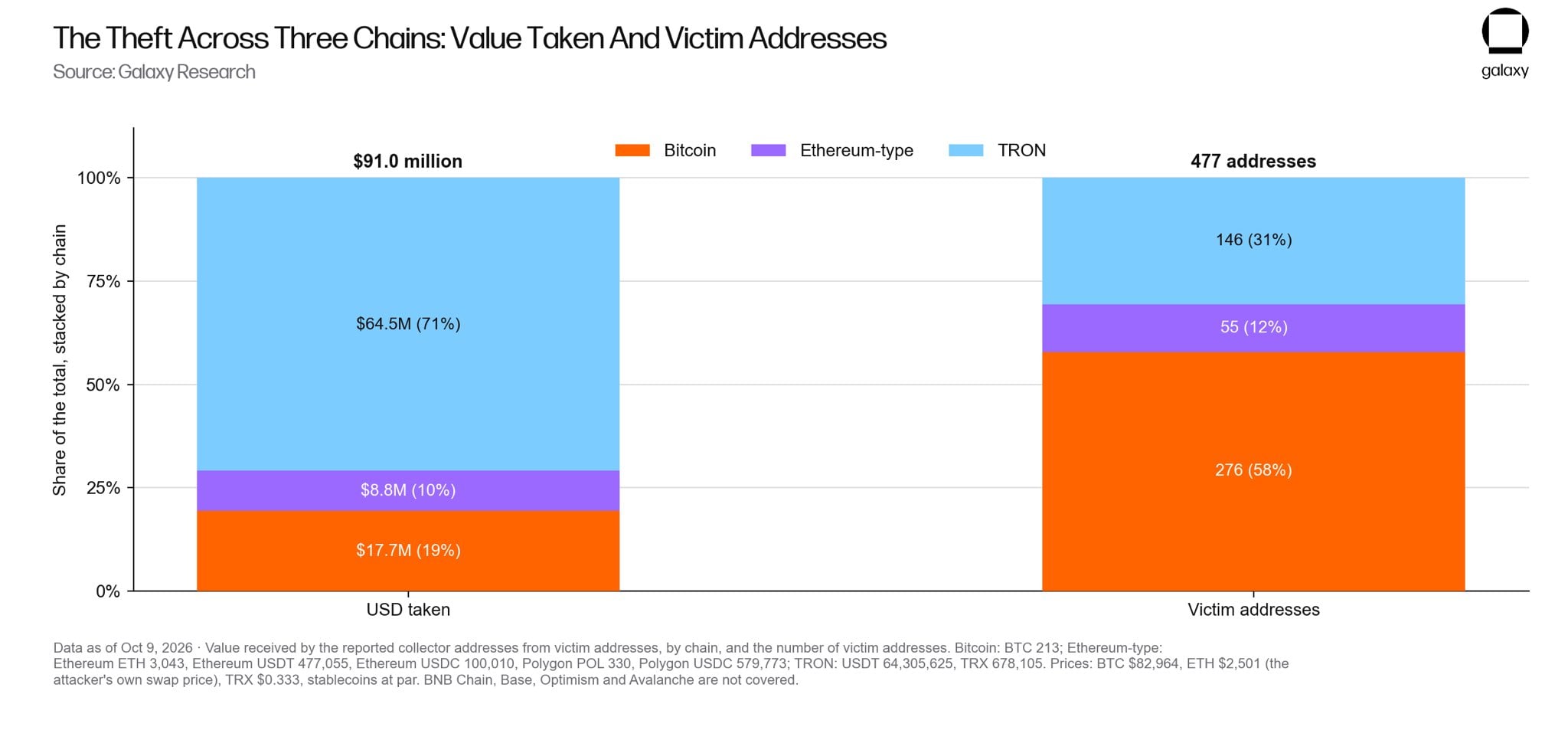
According to data compiled by Galaxy Research, the $91 million figure is currently viewed as a "floor"—a baseline estimate that is expected to climb as auditors finish tracing the full extent of the damage. The attack has been indiscriminate, targeting multiple blockchains and draining funds with alarming precision.
The Tron network has emerged as the primary casualty, with 276 addresses liquidated of approximately $64.5 million. Bitcoin (BTC) holders were the second most impacted, suffering $17.7 million in losses across 276 affected addresses. The Ethereum (ETH) ecosystem also faced significant exposure, with 55 addresses drained of $8.8 million.
Galaxy’s head of research, Alex Thorn, noted that these numbers are incomplete. Because the full impact on secondary chains—including the BNB Chain, Base, and Avalanche—has yet to be fully audited, industry experts anticipate that the final tally of stolen funds will significantly exceed the current $91 million estimate. This total is particularly devastating when viewed against the backdrop of the third quarter, which saw the industry struggle through a separate $114 million exploit involving Coldcard hardware wallets.

Chronology of the Breach: From Supply Chain to Laundering
The anatomy of this attack suggests a highly sophisticated, localized hardware tampering operation.
The Point of Failure
Initial investigations point toward the Southeast Asian reseller CryptoBilis. Reports indicate that Ledger Nano X and Ledger Nano S Plus hardware wallets sold through this vendor were compromised prior to delivery. These units were allegedly outfitted with specialized spyware components capable of intercepting and transmitting seed phrases to a remote server.
For the average user, the seed phrase is the "master key" to their digital wealth. By gaining access to these phrases, the attackers were able to bypass the physical security of the Ledger devices, effectively turning the "secure" hardware into a gateway for theft.
The Laundering Operation
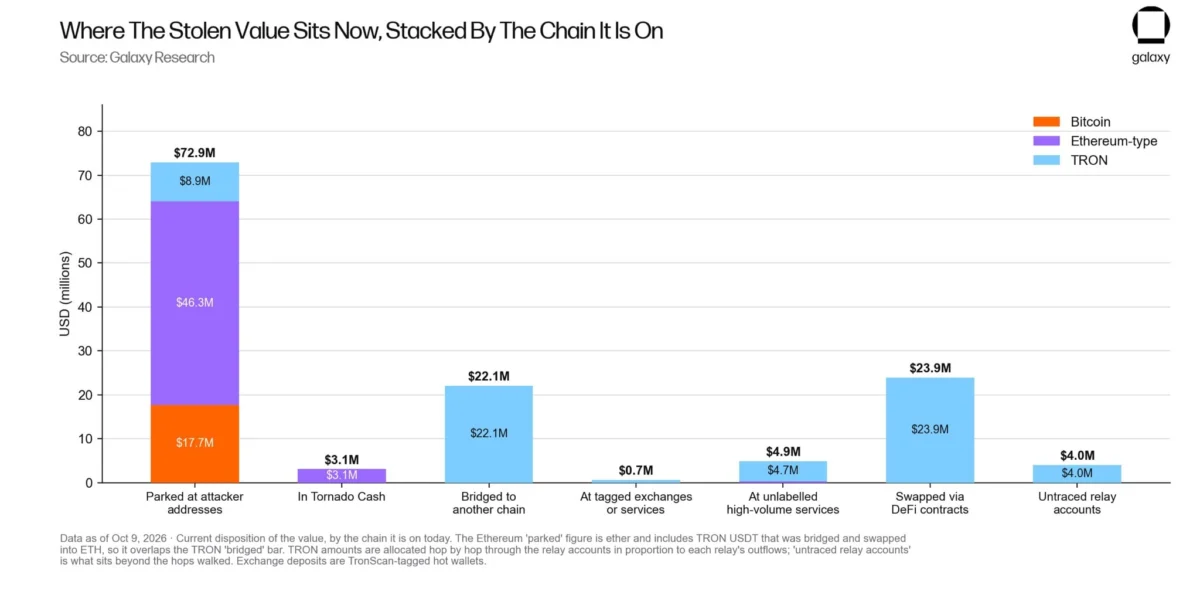
As of October 9, the situation took a turn toward professional money laundering. Approximately $73 million remains in attacker-controlled wallets across Bitcoin, Ethereum, and Tron. However, the movement of funds has already begun:
- Privacy Mixers: Roughly $3 million has already been funneled into Tornado Cash and similar relay accounts to obfuscate the transaction trail.
- Asset Conversion: The attackers converted portions of stolen Tether (USDT) into USDD, a stablecoin, moving approximately $13.65 million in the process.
- Exchange Infiltration: In a bold move, the hackers attempted to offload some of the stolen assets onto Binance, prompting an immediate outcry from security analysts and a desperate plea to the exchange to freeze the associated accounts.
Official Responses and the Quest for Accountability
The involvement of major centralized exchanges has become a focal point of the recovery effort. Both Binance founder Changpeng Zhao (CZ) and current CEO Richard Teng have pledged their support to assist in the tracing and potential recovery of the stolen funds.
"As investigations continue, the focus must be on supporting affected users, tracing funds, and assisting recovery efforts wherever possible," said Richard Teng in an official statement. "Security is a shared responsibility, and Binance stands ready to support the industry’s collective efforts."
While the industry appreciates these commitments, the reality of on-chain recovery remains bleak. Once funds enter privacy mixers or are fragmented across decentralized exchanges (DEXs), the possibility of restitution diminishes significantly.
The CryptoBilis Controversy
The most damning aspect of the incident involves the leadership of CryptoBilis. When users and investigators confronted Arravind Prabu, the CEO of the reseller firm, regarding the compromised hardware, Prabu offered a controversial defense: he claimed he was no longer associated with the company.
When pressed on why he failed to publicly disclose the sale of the firm to a Chinese buyer, Prabu cited a Non-Disclosure Agreement (NDA). Conveniently, this NDA was set to expire on October 19, 2026—just days after the massive theft was discovered. This timing has fueled widespread speculation regarding the legitimacy of the company’s internal controls and the potential for a "malicious exit" or a targeted supply chain attack.
The Future of Self-Custody: A Paradigm Shift
The breach has ignited a fiery debate regarding the viability of self-custody. For years, the mantra "not your keys, not your coins" has driven users away from centralized exchanges and into the arms of hardware wallet manufacturers. However, this incident demonstrates that the weakest link is often not the protocol itself, but the physical supply chain.
The "Reseller" Trap
The primary takeaway for the retail market is the extreme danger of purchasing hardware from third-party resellers. Even those with an "official" status can be compromised. Ark Invest’s head of crypto research, Lorenzo Valente, did not mince words regarding the severity of the situation: "This is a pretty wild story if confirmed, and it highlights two things: Never buy from a reseller, even if official. Self-custody will die very quickly if nothing is done."
The Need for Hardened Protocols
Security experts are now calling for a shift in how hardware wallets are manufactured and distributed. Potential solutions include:
- Direct-from-Manufacturer Purchasing: Ensuring that hardware wallets are shipped directly from the factory, with tamper-evident packaging that is verified upon arrival.
- Multi-Sig Requirements: Users are being urged to move away from single-signature setups. By using a multi-signature configuration, even if one device is compromised via spyware, the attacker cannot drain the funds without access to the secondary key held on a separate, uncompromised device.
- Enhanced Firmware Audits: The industry may need to adopt more rigorous, open-source auditing standards for firmware to detect unauthorized components or "backdoor" code that could communicate with external servers.
Implications for the Crypto Ecosystem
The $91 million Ledger theft is more than just a financial loss; it is a reputational blow to the self-custody movement. As the industry matures, it must reconcile the tension between the ease of buying hardware through regional resellers and the absolute necessity of supply chain integrity.
If users lose confidence in the very tools designed to keep their assets safe, the exodus back to centralized custodians could accelerate, potentially stifling the decentralized finance (DeFi) movement. Conversely, if the industry uses this moment to implement stricter hardware distribution standards and user education regarding the dangers of unauthorized resellers, it could lead to a more resilient, albeit more cautious, future for digital asset security.
For now, the focus remains on the investigation. As the audit continues and the stolen funds continue to move through the mixers, the victims are left waiting—not just for their money, but for a clear explanation of how such a critical breach of the "gold standard" of security was allowed to happen. The expiration of the CryptoBilis NDA on October 19 remains a date circled on the calendars of investigators, who hope it might finally shed light on the true origin of the malicious hardware.