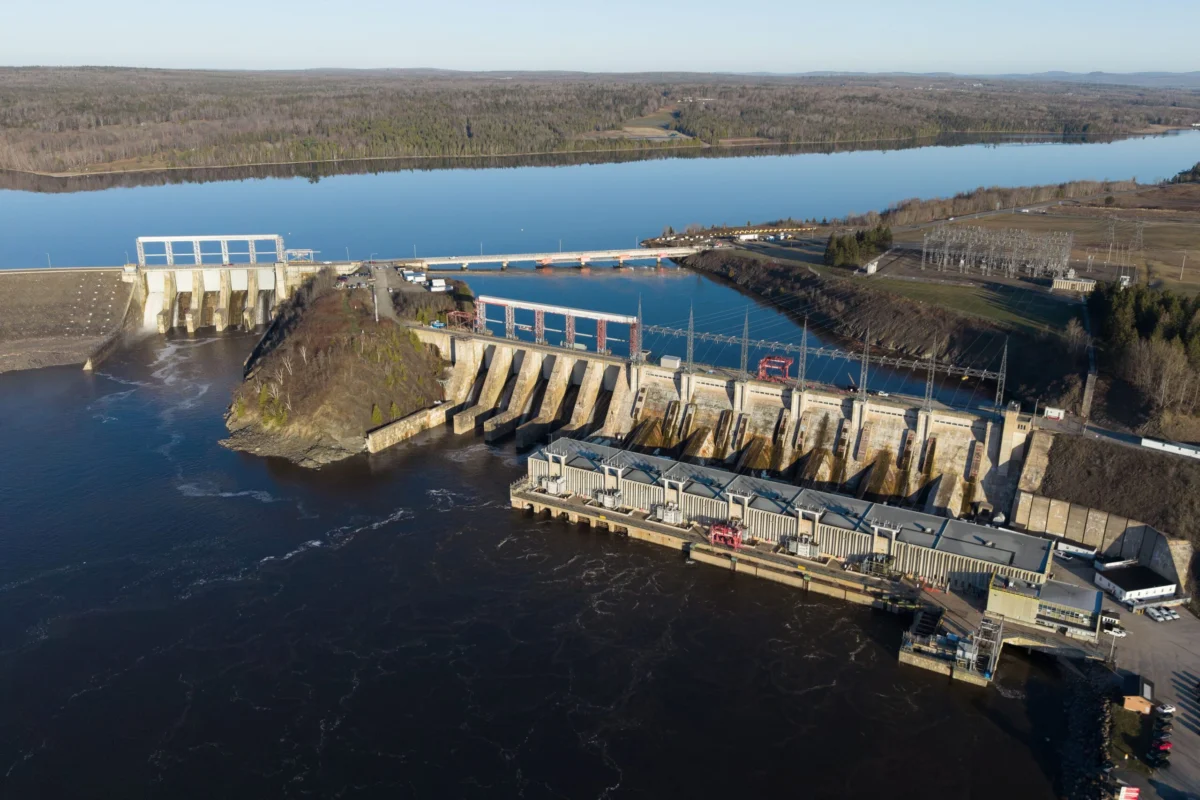
In the vast, rugged wilderness of northern British Columbia, the laws of geography seem to have become temporarily flexible. A sprawling, vegetated island, roughly the size of two football fields, has been spotted drifting through the Williston Reservoir—the seventh-largest reservoir on the planet—before inexplicably vanishing into the watery expanse. The sighting has sparked a blend of public intrigue and operational concern, leaving experts and local authorities to grapple with the mystery of a landmass that seemingly possesses a mind of its own.
The Sighting: A Floating Anomaly
The story broke earlier this month when local resident Rocky Avery shared video footage and photographic evidence of a massive, forested landmass drifting through the Williston Reservoir. The reservoir, currently at its highest water level in 14 years, provided a surreal backdrop for the island, which featured visible tree growth and substantial soil density.
Avery, acting with a sense of communal responsibility, shared the discovery not merely as a curiosity, but as a warning. “There was a big fishing derby coming up, so I wanted to make sure everybody was aware of what was going on,” Avery told CBC News. “And I wanted BC Hydro to know too that it was out there, just in case it was floating down their way.”
For the casual observer, the idea of a “wandering island” evokes images of folklore or fantasy. However, for BC Hydro, the entity responsible for the massive W.A.C. Bennett Dam that impounds the reservoir, the island represents a potential, albeit mobile, industrial hazard.
A Chronology of the Disappearance
The timeline of the island’s appearance and subsequent "disappearance" remains frustratingly brief.
- Early August 2024: Rocky Avery captures high-definition footage of the island, alerting the public and BC Hydro.
- Early August 2024 (Verification Phase): BC Hydro, initially skeptical of reports of a floating island, deploys satellite imagery to confirm the sighting. They verify the landmass, estimating its dimensions at approximately 70 meters wide by 140 meters long (roughly 230 by 460 feet).
- Mid-August 2024: Following the initial confirmation, the island drifts out of the range of consistent surveillance. Despite monitoring efforts, the landmass has not been sighted since August 3, 2024.
- Present Day: The island is considered “missing.” It has effectively slipped back into the vast, complex shoreline of the reservoir, leaving behind no trace of its current location.
The Anatomy of the Williston Reservoir
To understand the gravity of the situation, one must understand the sheer scale of the Williston Reservoir. Created by the construction of the W.A.C. Bennett Dam on the Peace River, the reservoir is a testament to mid-20th-century engineering. The dam itself is a towering earth-fill structure, and the Gordon M. Shrum Generating Station—the heart of the facility—boasts an annual generation capacity exceeding 13,000 gigawatt-hours (GWh).
This facility is the backbone of British Columbia’s power grid, supplying more than one-third of the province’s total electricity demand. At the time of its completion, the powerhouse was the largest of its kind in the world. Its massive scale makes it both a feat of human ingenuity and a difficult environment to manage. Covering such an enormous surface area, the reservoir is virtually impossible to patrol in its entirety, providing the perfect cover for a wandering landmass to navigate its currents unnoticed.
Why Do Islands Wander?
While the phenomenon seems mystical, it is a well-documented ecological occurrence in large, dammed water bodies. Floating islands, often composed of tangled mats of vegetation, peat, and soil, can break away from shorelines during periods of high water.
In the case of the Williston Reservoir, BC Hydro suspects that the island was dislodged during a period of intense water management. During June and July, the utility opened the W.A.C. Bennett Dam’s spillways to accommodate excess water resulting from a heavy winter snowpack and significant summer rainfall. The resulting increase in water flow and pressure likely acted as a catalyst, tearing the mass of earth and flora from its moorings.

Once a landmass of this size is adrift, it becomes subject to the prevailing winds and internal reservoir currents. Unlike a ship, it lacks a propulsion system and navigation, meaning its path is dictated entirely by the physics of the lake. It is likely that the island has since found a new, quiet corner of the reservoir—or perhaps a new shoreline—to "snuggle up to," effectively camouflaging itself against the existing landscape.
Implications for Hydroelectric Infrastructure
The presence of a massive, drifting island in a reservoir is not just a geological oddity; it is a significant operational concern. Floating debris is a constant challenge for hydroelectric facilities. While small logs and brush are easily managed by trash racks and booms, a landmass the size of two football fields could cause catastrophic damage if it were to drift into the vicinity of the W.A.C. Bennett Dam’s water intakes.
If such a mass were to collide with intake structures or block spillways during a period of high water, the resulting pressure could potentially damage the concrete and steel infrastructure. BC Hydro’s preference is clear: the island should remain as far away from the dam’s infrastructure as possible. The utility continues to rely on “eyes in the sky”—satellite and aerial surveillance—to monitor the reservoir for any signs of the island’s re-emergence.
Global Context: A Common, If Elusive, Phenomenon
The Williston incident is not an isolated case. Floating islands have been reported across the globe, from the marshes of Wisconsin to the massive man-made lakes of Africa. These islands often form when organic matter builds up in a marshy environment, eventually becoming buoyant enough to lift off the lakebed.
These "tussocks" or "floating meadows" can sustain trees and shrubs, provided they have access to enough moisture and nutrients. They are inherently unstable, often moving when the water levels shift or when strong winds push them across open water. Because they are rarely in the same place twice, they are notoriously difficult to track, often disappearing into remote bays or reeds, only to be rediscovered years later.
Conclusion: The Ghost of Williston
As of this writing, the mystery remains unsolved. The island is currently a ghost, a transient piece of land that highlights the sheer scale and untamable nature of the Williston Reservoir. For the residents of British Columbia, it serves as a reminder that even in an age of satellite imagery and advanced engineering, nature still holds the capacity to surprise us.
For BC Hydro, the search continues—not with panic, but with professional vigilance. Until the island is spotted again, it remains an elusive guest in one of Canada’s largest man-made systems, a floating testament to the hidden dynamics of our engineered world. As one might say, private islands are rarely around when you need them, and always in the way when you don’t. For now, the reservoir is quiet, the island is hidden, and the waters of the Peace River continue their steady flow toward the turbines of the Gordon M. Shrum station.
We have reached out to BC Hydro for further comment regarding their long-term surveillance strategy and the potential environmental impact of the island’s migration, and we await their response.