The Theban necropolis, a sprawling expanse of funerary architecture located on the west bank of the Nile near modern-day Luxor, has long served as a primary gateway for archaeologists seeking to decode the mysteries of ancient Egyptian life and death. With over 400 documented tombs, the region is a tapestry of history, yet a recent study published in the journal Frontiers in Environmental Archaeology suggests that we have only scratched the surface of how these sites functioned as dynamic, living spaces.
By applying an "integrated archaeothanatological approach" to Theban Tomb 209 (TT209), researchers have uncovered a complex narrative of shifting funerary trends. The study reveals that over the course of centuries, Egyptian burial customs underwent a radical transformation—moving away from the exclusive, individual interment in elaborate coffins toward a more communal, high-density reuse of sacred spaces. This discovery challenges the traditional view of tombs as static resting places, framing them instead as "dynamic mortuary environments" that evolved alongside the social and economic fluctuations of the first millennium BCE.
The Archaeology of a Complex Site
Theban Tomb 209 is a site of immense historical and logistical complexity. Located in the western necropolis and dating back to the early 25th Dynasty (754–656 BCE), the tomb was originally commissioned for a high-ranking official of Nubian origin named Nisemro. However, the site’s history was not one of simple preservation. Situated within an active drainage channel of the Wadi Hatasun, the tomb was subjected to repeated, destructive flash flooding throughout its history.
These environmental challenges, coupled with the tomb’s ultimate abandonment during the Ptolemaic period (305–30 BCE), created a chaotic archaeological record. To make sense of this, a research team from the University of La Laguna in Spain focused their efforts on "Side Chamber 3," a secondary area of the tomb that remained relatively undisturbed compared to the main galleries. Their methodology—which synthesized osteological analysis with data on body orientation, coffin preservation, and stratigraphic positioning—allowed them to reconstruct a chronological biography of the tomb’s use.
A Chronology of Communal Rest
The findings from Side Chamber 3 paint a vivid picture of changing ritualistic priorities. The researchers excavated 16 mummified individuals, represented by 1,444 bones, alongside a mummified dog. Furthermore, a separate section of the chamber contained the disarticulated remains of at least four additional individuals, totaling over 1,775 bone fragments.
The team identified distinct phases in the usage of the chamber:
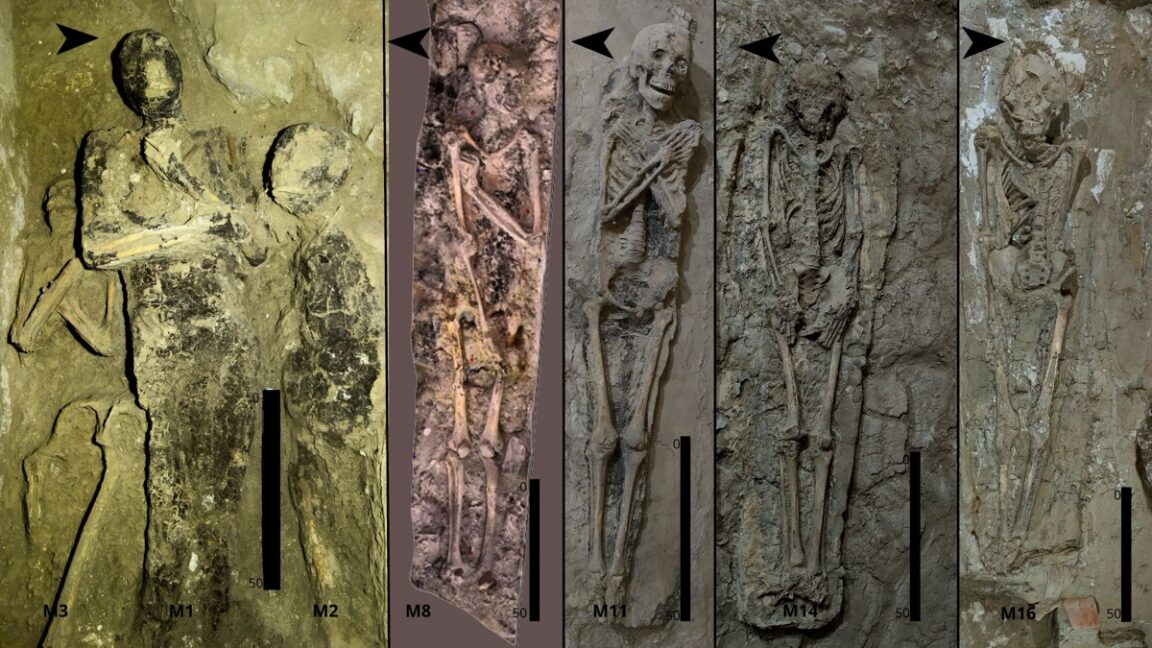
- The Early Phase (25th Dynasty): The earliest burials followed a model of individual respect. Mummies (identified as individuals 13 through 17) were interred separately, often with men and women separated. These burials were characterized by the use of elaborate, individual coffins and a high concentration of burial goods, including Phoenician amphorae, incense cups, amulets, and beads. At this stage, the tomb functioned as a private, high-status sanctuary.
- The Intermediate and Late Phases (Late 25th Dynasty through Persian Period): As time progressed, the burial strategy shifted toward high-density deposition. New bodies were placed directly into areas already occupied by previous interments. This resulted in the "superposition" of remains—a practice where multiple bodies were layered vertically rather than laid out horizontally. During this period, the use of coffins declined sharply; many were dismantled or allowed to degrade, suggesting that the symbolic importance of the container was being eclipsed by the integrity of the body itself.
Supporting Data: The Anatomy of Reuse
The research team’s meticulous analysis of the 1,444 bones found in the chamber provides the data necessary to support these conclusions. The shift in limb positioning is particularly telling: early burials featured arms stretched alongside the body, a hallmark of traditional, high-status mummification. Later burials, however, frequently displayed folded arms, reflecting a change in ritual formatting.
Evidence of "funerary memory" was also observed. The researchers noted that new depositions were not merely dumped into the space; they were placed with a spatial logic that respected the existing remains. This indicates that the individuals responsible for the interments maintained a ritualized, if utilitarian, relationship with their ancestors.
Furthermore, the environmental analysis revealed a site in flux. The accumulation of silts, gravels, and limestone blocks—some of which were clearly human-introduced to level the floor for new burials—demonstrates how the tomb was constantly being renovated. One specific chamber yielded evidence of a high-heat fire, with remains subjected to temperatures reaching 550°C (1,022°F), causing severe damage to crania and limbs. Whether this was an accidental event or a ritualized destruction of remains remains a point of intense study.
Official Perspectives: The "Accumulative Biography"
Co-author Jared Carballo-Perez emphasizes that these findings debunk the idea of a "chaotic accumulation" of bodies. "The detailed study of the bodies indicates neither chaotic accumulation nor a loss of the original ritual over time," Carballo-Perez stated. "Rather, there was a spatial logic in which each new deposition was adapted to the presence of previous bodies—a kind of funerary memory in the processes of reuse."
This sentiment is echoed by fellow researcher Miguel Ángel Molinero Polo, who highlights the shifting social status of those interred in the later phases. "The earliest individuals buried here appear to have been of high social standing… The bodies buried in vertical superposition did not have coffins but were carefully mummified. They also can be associated with upright jars that point to a specific ritual not found in the earlier phases of the tomb’s use."
For the research team, the tomb is a "funerary space with an accumulative biography." It is a place where the physical act of burial transformed the architecture of the tomb itself. As the space grew denser, the role of the coffin as an "organizing frame" vanished, replaced by a focus on the body and the ongoing ritual continuity of the space.

Broader Implications: Reconfiguring Egyptian Funerary Systems
The study of TT209 is not merely an isolated case study; it aligns with broader trends identified across the Theban necropolis. Archaeological surveys suggest that approximately 80 percent of first-millennium BCE tombs in the region contain remains from multiple, distinct time periods, often exhibiting evidence of reused materials and modified burial practices.
The implications of this research are twofold. First, it demonstrates that Egyptian burial practices were not stagnant; they were fluid, adaptable systems that responded to changing economic conditions, population density, and social values. The decline in coffin use and the rise of vertical superposition suggest that the availability of space and the cost of elaborate funerary materials likely necessitated a "democratization" or at least a simplification of burial rites over time.
Second, the study highlights the importance of environmental and stratigraphic data. By treating the tomb as a "dynamic mortuary environment" rather than a container for artifacts, the researchers were able to interpret the accumulation of silt, the presence of displaced ceramics, and the positioning of bones as intentional components of the funerary process.
As we continue to analyze the remaining hundreds of tombs in the Theban necropolis, the findings at TT209 serve as a crucial framework. They remind us that for the ancient Egyptians, the tomb was not a finished product but a living, breathing history—a site of constant, respectful negotiation between the living and the dead. The "accumulative biography" of Theban Tomb 209 is, in effect, a biography of the society that built it: resilient, ritual-focused, and endlessly adaptable in the face of the shifting sands of time.