By Global Security Desk
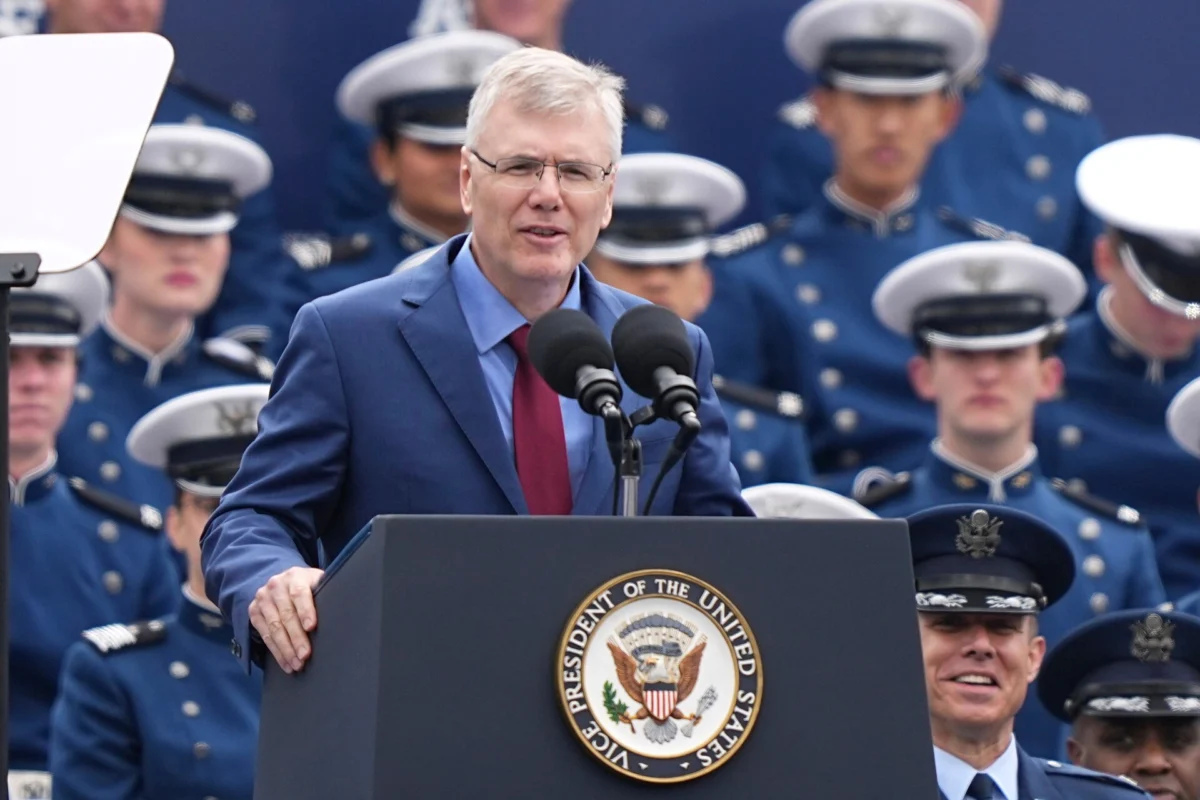
In a historic shift in military doctrine, the United States has officially confirmed the deployment of space-based offensive capabilities. Air Force Secretary Troy Meink, addressing an audience at a private defense conference yesterday, made the unprecedented acknowledgement that the U.S. Space Force has operationalized "on-orbit space control weapons." This declaration marks the first time Washington has publicly confirmed the existence of weapons systems stationed in space, signaling a new, more aggressive era of orbital competition.
Meink’s announcement, which was characterized by the Secretary as "very well thought out," serves as a stark departure from the long-standing ambiguity that has defined American space policy for decades. As the geopolitical landscape shifts toward a multi-polar space environment, the U.S. is signaling that its "High Frontier" is no longer a sanctuary, but a contested theater of war.
Main Facts: The New Orbital Reality
The confirmation from Secretary Meink underscores a fundamental change in the U.S. military posture. According to Meink, these weapons are designed specifically to "defend the joint force against hostile adversary action." While the Secretary remained tight-lipped regarding the specific technical nature of these assets during a follow-up Q&A session, the implications are profound.
The primary objective behind this disclosure is deterrence. By making the existence of these assets public, the Pentagon is attempting to communicate to peer rivals—specifically Russia and China—that the U.S. has the capability to neutralize threats in the orbital domain before they can be leveraged against American ground, sea, or air forces.
Analysts suggest that the systems are likely non-kinetic. Given the U.S. military’s strategic aversion to generating space debris—which would endanger not only enemy satellites but also the vast, lucrative network of commercial and military U.S. satellites—it is widely assumed that the "space control" weapons rely on electronic warfare, laser-dazzling, or cyber-intrusion capabilities. These "soft kill" methods allow the U.S. to "silence" or disable an adversary’s satellite without the permanent, destructive aftermath of kinetic impact.
Chronology: The Escalation to Orbit
The path to this moment has been paved by decades of rapid technological development and shifting international norms.
- 1967: The Outer Space Treaty is signed, prohibiting the placement of nuclear weapons or other weapons of mass destruction in orbit, while leaving the status of conventional weapons in space ambiguous.
- 2007: China demonstrates a kinetic anti-satellite (ASAT) test, destroying its own defunct weather satellite, creating a massive debris field and signaling the start of a new arms race.
- 2019: The United States formally establishes the Space Force as the sixth branch of the armed forces, reflecting the growing importance of the domain.
- 2022–2024: Intelligence reports emerge regarding Russia’s "satellite-killer" program, including the development of co-orbital inspection satellites capable of maneuvering dangerously close to U.S. assets.
- 2025: High-level U.S. lawmakers raise alarms regarding Russia’s intent to deploy a nuclear-armed anti-satellite weapon, a move that would represent a direct violation of the 1967 treaty.
- 2026: Secretary Troy Meink confirms the deployment of U.S. "on-orbit space control weapons," marking the first official acknowledgment of a U.S. offensive space posture.
Supporting Data: The Strategic Necessity
The pressure to militarize space has intensified alongside the increasing reliance of modern militaries on satellite infrastructure. Today, space-based assets are the nervous system of the U.S. military. From GPS-guided munitions to satellite communications and real-time intelligence, surveillance, and reconnaissance (ISR), there is no theater of operation where space is not a critical enabler.
According to the Center for Strategic and International Studies (CSIS), the number of satellites in orbit has increased by over 300% in the last decade. As this congestion grows, so does the "attack surface."
The Threat Landscape
The rationale for the U.S. deployment is rooted in the "denial of access" doctrine. Peer adversaries have spent years developing systems that could potentially "blind" U.S. forces in the early stages of a conflict.
- Electronic Warfare: The ability to jam GPS and communication signals, currently a staple of the conflict in Eastern Europe.
- Co-orbital Threats: Small, maneuverable satellites that can shadow, inspect, or potentially disable a target from a close proximity.
- Kinetic Weapons: Missiles capable of physical destruction, which remain the "nuclear option" of space warfare due to their indiscriminate nature.
By deploying its own defensive and counter-offensive capabilities, the U.S. is seeking to maintain a balance of power where no single adversary feels they can secure a "quick win" by knocking out U.S. orbital assets.
Official Responses: The Silence of the Pentagon
Following the initial announcement, the Pentagon has maintained a stance of calculated ambiguity. When pressed on whether the deployment constitutes a violation of the spirit—if not the letter—of the Outer Space Treaty, military spokespeople have pointed to the language of the treaty itself, which does not explicitly forbid conventional, non-nuclear weapons in orbit.
"Our goal is not to initiate a conflict in space," a Pentagon spokesperson noted in a follow-up statement. "Our goal is to ensure that space remains an environment where the United States can operate freely and securely, and to deter those who would seek to deny that freedom."
Critics, however, argue that this public admission marks the end of a decades-long effort to keep space as a "peaceful commons." Arms control advocates warn that by officially acknowledging an offensive space presence, the U.S. has provided the necessary justification for adversaries to accelerate their own programs, leading to a "security dilemma" where each side feels compelled to build more, leading to greater instability.
Implications: A New Era of Deterrence
The implications of this development are vast, touching upon international law, global security, and the future of commercial space flight.
Destabilizing Nuclear Deterrence
Perhaps the most concerning implication is the effect on nuclear deterrence. Satellites are not merely for navigation and communications; they are the eyes and ears of early-warning systems. If a nation’s early-warning satellites are jammed or disabled, the ambiguity surrounding an incoming missile attack increases significantly. If a country cannot see an attack coming, the temptation to launch a preemptive "second-strike" increases. By making satellites a target, the U.S. and its rivals are arguably making the global nuclear situation more fragile.
The Commercial Impact
For the booming private space industry, the prospect of orbital warfare is a nightmare scenario. Companies like SpaceX, Amazon (Project Kuiper), and various satellite imagery providers now have billions of dollars in assets in orbit. If the "High Frontier" becomes a shooting gallery, insurance premiums for commercial launches could skyrocket, and the potential for "accidental" interference with commercial constellations becomes a real economic threat.
The Diplomatic Fallout
The U.S. will likely face intense pressure at the United Nations to clarify the nature of these systems. Russia and China, despite their own well-documented space-weapon programs, are likely to use this announcement to portray the U.S. as the primary instigator of space-based instability. Washington will have to work hard to frame its new capability as a purely defensive, deterrent measure.
Conclusion: The Pandora’s Box of Orbital Defense
The confirmation that the U.S. has placed "on-orbit space control weapons" in the heavens is a watershed moment in human history. For sixty years, the space race was defined by exploration and the pursuit of technological superiority. Now, it is defined by the grim requirements of defense and the cold calculation of deterrence.
As Secretary Meink noted, the phrasing of his announcement was "very well thought out." Whether that calculation will lead to a more stable, deterred world or one defined by constant, shadow-like conflict in the silent vacuum above remains to be seen. What is certain, however, is that the era of space as a peaceful, civilian-dominated domain has effectively come to an end. The eyes of the world are now fixed on the stars—not for the wonder of discovery, but for the flickering, silent signs of a weaponized orbit.