

In the modern digital landscape, the email dashboard is often a source of quiet anxiety for founders. You open your marketing platform and are immediately confronted with a barrage of data: open rates, bounce rates, click-to-open ratios, and unsubscribe percentages. For most, the routine is identical: glance at the numbers, feel a momentary surge of satisfaction or a prickle of concern, and return to the daily grind of running a business.
However, the reality is that most of these metrics are noise. In the pursuit of growth, many entrepreneurs fall into the trap of “vanity metrics”—data points that look impressive on a spreadsheet but fail to provide actionable intelligence. To truly scale an email program, one must distinguish between the signals that drive revenue and the background hum of digital clutter.
The Evolution of Email Marketing Metrics
To understand how we manage email today, we must look at how the industry has shifted. For nearly two decades, the "Open Rate" was the North Star of email marketing. It was a simple, elegant way to measure audience interest. If 30% of your list opened your email, you were doing something right.
That changed fundamentally in 2021 with the introduction of Apple’s Mail Privacy Protection (MPP). By pre-loading emails on devices, Apple inadvertently inflated open rates across the board, rendering the traditional "open" a relic of a simpler time. This shift forced a reckoning in the industry: how do you measure success when your primary thermometer is broken?
The Metrics That Actually Matter: A Taxonomy of Signals
1. Click Rate: The Truth-Teller
If the open rate is a compromised metric, the click rate is the gold standard of honesty. A click is an intentional, deliberate act. It is not triggered by privacy bots or background processes; it is a manifestation of subscriber intent.
- Click Rate (CR): Calculated by dividing total clicks by the number of emails delivered. This is your primary measure of how well a campaign performs in the wild.
- Click-to-Open Rate (CTOR): This is the diagnostic tool for your creative team. By dividing clicks by the number of unique opens, you isolate the effectiveness of your content.
When analyzed together, these two metrics provide a perfect diagnostic. If you see a low CR but a healthy CTOR, your content is likely excellent, but your subject lines are failing to drive interest. Conversely, if you have high opens but abysmal CTOR, your subject lines are writing checks your content cannot cash.
2. Revenue Per Email (RPE): The Bottom Line
Engagement is a prerequisite for a business, but it is not a business model in itself. Revenue Per Email (RPE) is the metric that bridges the gap between marketing effort and financial reality. By calculating the total revenue generated by a campaign and dividing it by the number of emails delivered, you gain a comparable unit of measurement.
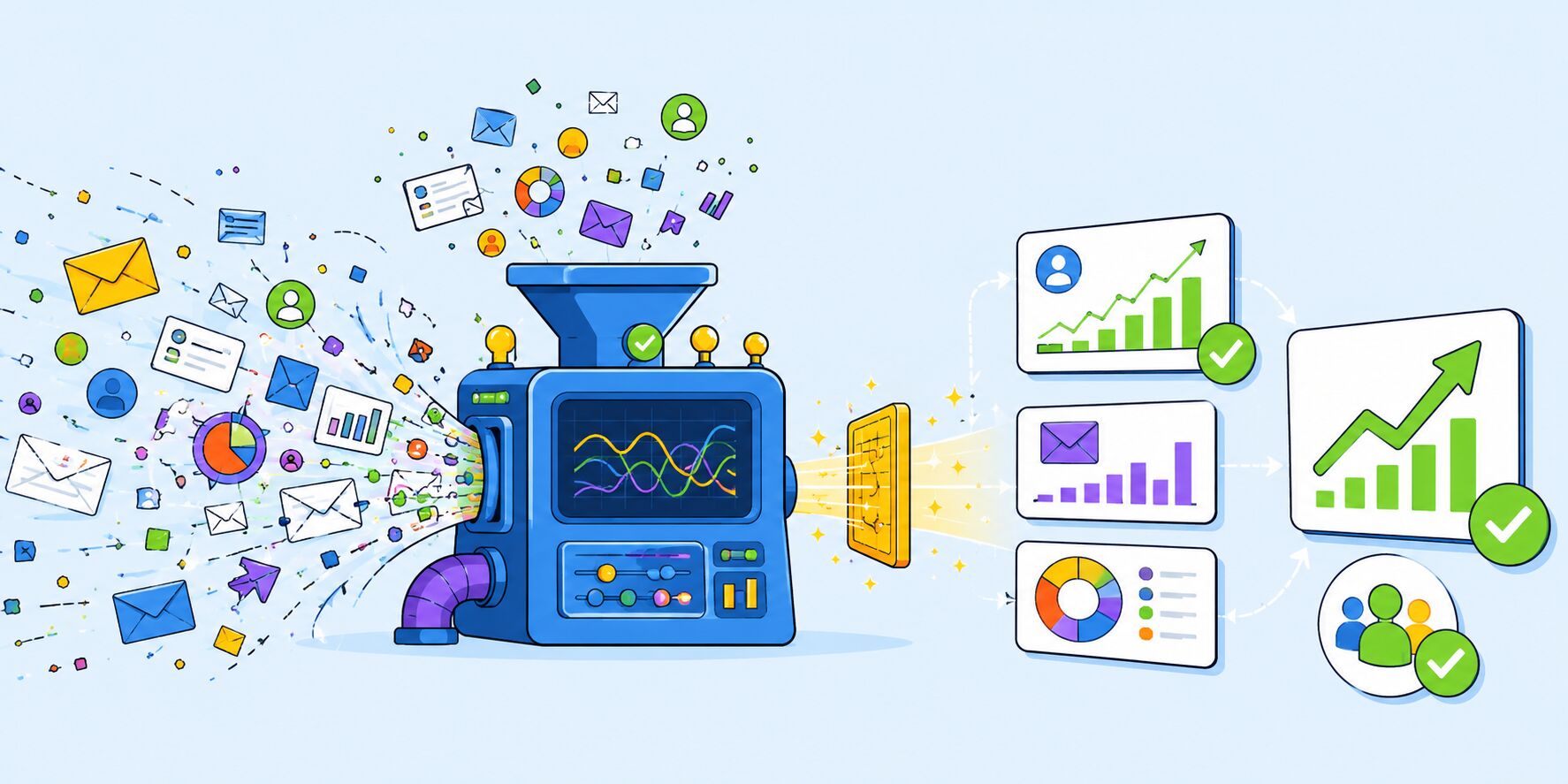
This metric is essential for objectivity. It often reveals that the "clever" newsletter you spent three days crafting underperformed compared to a simple, automated "abandoned cart" email. RPE forces you to prioritize what works over what feels creative.
3. The Smoke Detectors: Health Metrics
Some metrics are not meant for daily optimization but for system safety.
- Bounce Rate: A high hard bounce rate is a red flag indicating poor list hygiene. If you aren’t suppressing invalid addresses, your sender reputation will eventually suffer, causing your emails to land in the junk folder of even your most loyal customers.
- Unsubscribe Rate: A common misconception is that a 0% unsubscribe rate is ideal. In reality, a steady, low-level churn (0.2% to 0.5%) is healthy; it represents the natural pruning of your list. A spike in unsubscribes, however, is a direct signal that your audience is unhappy with your content, frequency, or relevance.
- Spam Complaints: The ultimate threat. Anything above 0.1% can trigger negative reactions from inbox providers. This is almost always a symptom of poor frequency management or irrelevant messaging.
The Fifteen-Minute Monthly Ritual
The greatest failure in data analytics is the assumption that observing data is the same as managing it. To turn your email program into a growth engine, you must implement a disciplined, time-boxed review process.
The Four-Question Framework:
- Which campaigns generated the highest RPE? Identify the common threads—was it a specific offer, a specific design, or a specific segment?
- Which campaigns had the best CTOR? Analyze the content that resonated most deeply with your active audience.
- What is the quarterly trend? Are your opens, clicks, and unsubscribes trending up or down over a 90-day window?
- How are the automations performing? Automated flows (Welcome, Abandoned Cart, Post-Purchase) should consistently outperform manual broadcasts. If they aren’t, they need immediate optimization.
The Rule of One: Once you have identified your areas for improvement, choose only one change to make. Whether it is refining your welcome sequence, testing a new subject line style, or adjusting your send frequency for a specific segment, the goal is to isolate variables. This scientific approach prevents the chaos of "scattershot" marketing.
Leveraging Technology for Decision-Making
To move from "spreadsheet archaeology" to strategy, you need a platform that connects the dots. Modern tools, such as Omnisend, have shifted the paradigm by integrating revenue attribution directly into the campaign dashboard.
When your platform allows you to view automated flows and manual campaigns side-by-side, the "Fifteen-Minute Ritual" becomes possible. It allows founders to see not just what happened, but why it happened, enabling them to pivot from reactive behavior to proactive strategy.

Implications for Future Growth
As email marketing continues to evolve, the distinction between high-performing brands and those that stagnate will be defined by their ability to interpret data. The industry is moving away from broad-blast, high-volume tactics toward precision, segmented, and automation-heavy strategies.
For founders, the implication is clear: stop looking at your dashboard as a report card and start looking at it as a roadmap. When you treat clicks as truth, revenue as your benchmark, and complaints as your smoke detector, you stop "sending" emails and start "steering" a customer journey.
Key Takeaways for Implementation:
- Prioritize RPE: If an action doesn’t contribute to revenue or long-term brand equity, it is likely a distraction.
- Automate, Then Optimize: Your automated flows are the backbone of your revenue. Ensure they are firing correctly before focusing on your weekly newsletter.
- Protect Your Reputation: Keep your bounce and spam rates low. A clean list is the most valuable asset you own.
- Iterate Constantly: By changing only one variable at a time, you gain clear insights into what your audience actually values.
Ultimately, your email analytics should be a tool for argument. Challenge your assumptions, test your theories against the data, and refine your approach until your inbox metrics reflect the health of a scaling, profitable business.
Foundr readers can take advantage of a specialized offer to streamline their analytics: use code FOUNDR50 to receive 50% off your first three months with Omnisend. For those switching platforms, the migration team will handle the heavy lifting of moving your flows, lists, and templates, ensuring that your transition is as seamless as your new data-driven strategy.