By Financial Analysis Desk
Updated: January 9, 2026
The release of the December 2026 employment report has provided a sobering look at the trajectory of the American labor market as the nation heads into the new year. While the headline unemployment rate saw a slight decline, the underlying data points to a broader trend of stagnation and recalibration. For policymakers, investors, and labor analysts, the latest Bureau of Labor Statistics (BLS) data serves as a critical indicator that the post-pandemic hiring frenzy has firmly transitioned into a period of moderated growth and persistent structural challenges.
Main Facts: A Disappointing Close to 2026
The December report painted a picture of an economy struggling to maintain momentum. The headline non-farm payroll number arrived slightly below analyst expectations, failing to provide the year-end boost many market observers had hoped for. Perhaps more concerning than the December figures themselves were the substantial downward revisions to the previous two months.
Combined, October and November job growth figures were revised downward by 76,000 positions. These revisions are not merely statistical noise; they suggest that the labor market was softer throughout the fourth quarter than previously understood. Despite this weakness in total job creation, the official unemployment rate ticked downward to 4.4%. This movement, however, must be viewed through the lens of labor force participation and the specific dynamics of the working-age population.

Chronology of the December Employment Cycle
To understand the current state of the labor market, one must look at the progression of key metrics over the final quarter of 2026:
- October and November: Initial reporting suggested a steady, if modest, pace of hiring. However, subsequent data collection and seasonal adjustments revealed that these gains were overestimated. The 76,000-job revision highlights the difficulty in gauging real-time economic activity in a shifting labor landscape.
- December Mid-Month: Data collection for the December survey period occurred during a time of increased scrutiny on retail and seasonal staffing.
- January 9, 2026: The official release of the December report confirmed the cooling trend, with key indicators showing that while the economy continues to add jobs, the velocity of growth has significantly decelerated compared to the robust activity witnessed in 2024 and early 2025.
Supporting Data: Peeling Back the Layers
A headline unemployment rate of 4.4% tells only part of the story. To gain a comprehensive view, we must examine the specific segments of the workforce that drive economic stability.
The Prime-Age Participation Puzzle
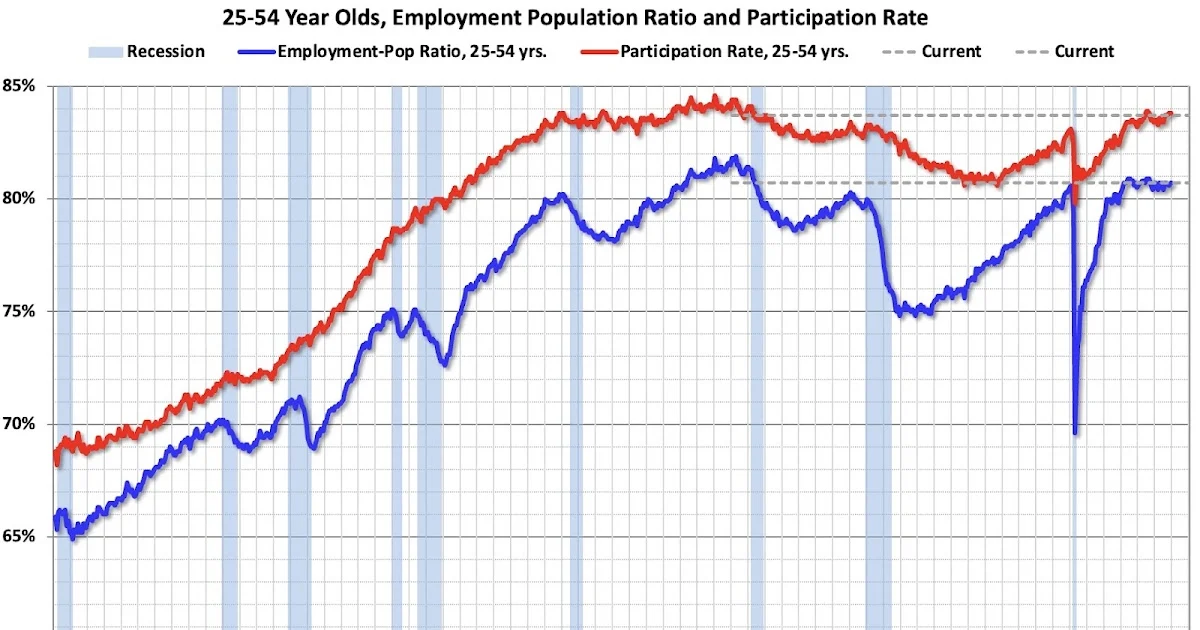
The "prime-age" demographic—individuals between 25 and 54 years old—remains the gold standard for measuring the health of the labor market. In December, the participation rate for this group remained stalled at 83.8%, identical to the November figure. While this rate remains near the highest levels seen this millennium, the lack of growth suggests that the pool of available workers is not expanding, potentially capping the ceiling for economic output.
Conversely, the employment-population ratio for the same group saw a marginal uptick, rising from 80.6% in November to 80.7% in December. While these figures remain historically strong, they are down from their recent peaks, indicating that the surge in prime-age workforce re-entry has likely peaked.

Wage Growth and Inflationary Pressures
Average Hourly Earnings (AHE) data provides a window into the inflationary environment. After reaching a peak of 5.9% year-over-year in March 2022, wage growth has been on a long-term downward trend. December saw a slight uptick to 3.8% year-over-year, up from 3.6% in November.
This current level of wage growth reflects a market that is still adjusting to the distortions caused by the pandemic. The initial spike in early 2020 was a statistical artifact—a result of lower-paid workers being disproportionately let go. As the economy normalized, that spike reversed. Now, the 3.8% figure suggests a labor market that is no longer aggressively bidding up wages to attract talent, yet still facing enough tightness to prevent a return to pre-pandemic wage growth norms.
Labor Underutilization and Part-Time Employment
One of the most concerning metrics is the number of people working part-time for economic reasons. This figure stood at 5.34 million in December. While this represents a slight decrease from the 5.49 million recorded in November, it remains well above pre-pandemic levels and sits near the highest levels seen since the summer of 2021.
These individuals, who desire full-time work but are confined to part-time hours, are a primary component of the U-6 unemployment rate. The U-6, which is the broadest measure of labor underutilization, fell to 8.4% in December from 8.7% in November. While this is a significant improvement from the 22.9% peak in April 2020, it remains notably higher than the 7.0% recorded in February 2020. The gap between current figures and pre-pandemic norms suggests that a "hidden" slack remains in the economy.

Long-Term Unemployment
The number of Americans unemployed for 27 weeks or more—a critical indicator of structural labor market issues—rose to 1.95 million in December, up from 1.91 million in November. This figure is significantly higher than pre-pandemic baselines. While it remains far below the post-pandemic peak of 4.17 million, the recent upward drift is a signal that displaced workers are finding it increasingly difficult to re-enter the workforce, a phenomenon that could lead to permanent skill erosion if left unaddressed.
Official Responses and Economic Commentary
The consensus among market observers and economists is that this is a "weak" report. Analysts at Calculated Risk and other leading economic forums have emphasized that the combination of lower-than-expected payrolls and downward revisions signals a genuine fatigue in the hiring cycle.
While the Federal Reserve has remained guarded in its outlook, the persistence of underemployment and the slow growth in payrolls provide evidence for those who argue that interest rate policy may be beginning to bite. The shift from an "overheated" labor market to one that is "cooling" has been the stated goal of monetary policy; however, the fear among some analysts is that the pendulum may be swinging toward an environment where job creation is insufficient to absorb new entrants to the workforce.
Implications for the Future
As we look toward the remainder of 2026, the implications of this report are threefold:

- Monetary Policy Uncertainty: The Federal Reserve is now faced with a dual reality: inflation metrics that remain stubborn and a labor market that is losing its capacity to sustain growth. If the job market continues to soften as indicated by the revisions, the pressure to pivot toward accommodative policies will increase.
- Consumer Spending Resilience: Wage growth at 3.8% is sufficient to support some level of consumer activity, but it is not explosive. Combined with a plateauing participation rate, this suggests that consumer spending—the engine of the U.S. economy—may begin to moderate as households feel the weight of a less certain employment future.
- Structural Economic Shifts: The persistent gap in the U-6 underutilization rate and the number of long-term unemployed suggests that the pandemic caused fundamental changes in the labor market. The skills mismatch and the demographic shifts toward an aging population mean that the labor market of 2026 is structurally different from that of 2019.
In conclusion, the December employment report is a clarion call for caution. The labor market is not collapsing, but it is undoubtedly losing its vigor. With hiring slowing, revisions dragging down previous momentum, and structural underutilization remaining stubbornly high, the U.S. economy enters the new year in a state of delicate transition. The focus for the coming months will be on whether the current cooling represents a soft landing or the precursor to a more sustained period of economic stagnation.