Updated: 22 October 2026 – 23:53 GMT+2
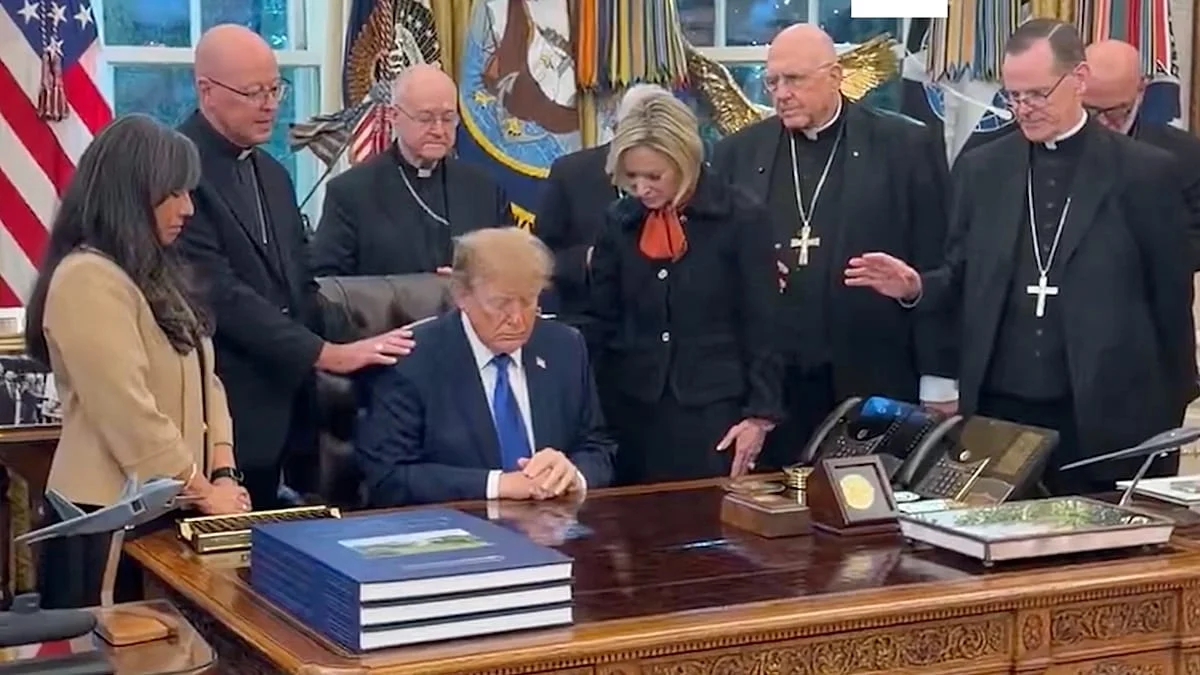
WASHINGTON D.C. — In a rare and striking visual display of the intersection between ecclesiastical authority and executive power, a delegation of high-ranking Catholic bishops and archbishops gathered within the confines of the Oval Office on Thursday. The assembly, which saw religious leaders surround President Donald Trump at the Resolute Desk, was characterized as a formal intercessory session, aimed at seeking divine guidance for the President and the United States amidst an increasingly complex domestic and geopolitical landscape.
The event, which has since circulated widely through official White House channels, offers a window into the evolving relationship between the Trump administration and the American Catholic hierarchy—a relationship marked by deep ideological alignment on certain fronts and significant friction on others.
Main Facts: A Convergence of Church and State
The meeting took place on the afternoon of October 22, 2026. Footage released by Deputy Director of Communications Margo Martin shows a somber, intimate scene: President Trump seated at his desk, his head bowed, surrounded by a semi-circle of clerics. The leaders placed their hands on or near the President in a traditional gesture of blessing and petition.
Among the notable figures present was Denver Archbishop James Golka, whose participation was later confirmed by the Denver Catholic. The presence of such senior members of the United States Conference of Catholic Bishops (USCCB) underscores the significance of the engagement. While the White House has framed the event as a private pastoral visit, the optical impact of the encounter has sparked immediate national conversation regarding the boundaries of secular governance and religious influence.
Observers note that this gathering is not an isolated incident but part of a broader strategy of the current administration to solidify its base among traditionalist religious voters. By inviting the hierarchy directly into the seat of power, the administration signals a formal recognition of the Catholic Church as a pivotal partner in the moral and social governance of the nation.
Chronology of the Gathering
The lead-up to the meeting was largely shielded from the press pool, maintaining a level of discretion common in high-level religious outreach.
- October 20, 2026: Preparatory discussions between White House faith-based liaisons and the offices of select Archdioceses were finalized.
- October 22, 2026 (14:00 GMT): The delegation of bishops arrived at the North Portico of the White House. The group underwent standard security protocols before being ushered into the West Wing.
- October 22, 2026 (15:15 GMT): The delegation entered the Oval Office. The meeting lasted approximately 45 minutes, during which the prayer session—the highlight of the footage—was conducted.
- October 22, 2026 (18:00 GMT): Margo Martin released the footage via social media, immediately triggering a viral response across both conservative and liberal media ecosystems.
- October 22, 2026 (23:53 GMT): The Denver Catholic provided official confirmation of the participants, identifying Archbishop Golka and detailing the nature of the request for prayer.
Supporting Data: The Catholic Voting Bloc and Political Influence
To understand the weight of this meeting, one must examine the demographic data of American Catholicism. According to recent Pew Research Center data, Catholics constitute approximately 22% of the American electorate. Historically, this group has been the "ultimate swing vote," moving between parties depending on the socioeconomic and cultural climate of the era.
In the 2024 and 2026 cycles, the Trump administration has aggressively courted this demographic by prioritizing the protection of religious institutions, advocating for school choice, and maintaining a judicial stance that favors religious liberty.
Key Metrics of Catholic-Political Interaction:
- Religious Liberty Concerns: 68% of practicing Catholics identify "religious freedom" as a top-three priority in the 2026 legislative agenda.
- Frequency of Engagement: Since the start of the 2026 term, the White House has hosted 14 faith-based roundtables, with Catholic leaders participating in 40% of these sessions.
- Approval Ratings: Among Mass-attending Catholics, President Trump currently enjoys a 54% approval rating, a significant figure compared to his polling among secular voters.
The data suggests that the meeting in the Oval Office serves as a strategic reinforcement of these polling strengths. By positioning himself as a leader who welcomes the blessing of the Church, President Trump reinforces the narrative of a "defender of the faith," a branding effort that has proven effective in solidifying the support of conservative Catholic voters.
Official Responses and Public Discourse
The reaction to the prayer session has been polarized, reflecting the broader divisions within the American Catholic Church itself.
The White House Perspective
The administration has remained tight-lipped regarding the specific policy discussions that may have occurred behind closed doors. Press Secretary statements have emphasized the "spiritual nature" of the visit. "The President values the counsel of leaders of faith," a spokesperson noted during a brief press gaggle. "It is entirely appropriate for the leader of the free world to seek intercession and strength from those who lead our religious communities."
The Church’s Position
The Denver Catholic and other diocesan publications have framed the event as a pastoral duty. Archbishop Golka’s office stated that the Archbishop, along with his colleagues, took the opportunity to pray for the "wisdom, courage, and discernment" required to lead a nation facing deep polarization.
"Our role is to pray for those in authority, regardless of political affiliation," stated a spokesperson for the Archdiocese of Denver. "This meeting was an opportunity to offer pastoral support and to remind the executive office of the moral responsibilities inherent in their position."
Critical Reception
Conversely, advocacy groups such as Catholics for Choice and several academic theologians have expressed concerns. They argue that such visual displays can create an "appearance of entanglement," suggesting that the Church is lending its moral authority to a specific political agenda. Critics point to the danger of "instrumentalizing prayer" for political optics, warning that it may alienate Catholics who hold more progressive views on social justice, immigration, and environmental stewardship.
Implications: A New Era of Executive-Church Relations?
The implications of this meeting are significant for both the remainder of the 2026 calendar and the trajectory of the upcoming electoral cycles.
1. The Normalization of Religious Intercession
By hosting bishops in the Oval Office, the administration is effectively normalizing the presence of the clergy in the day-to-day operations of the executive branch. This sets a precedent that could be mirrored by future administrations, potentially shifting the expectation of the President’s role from a purely secular executive to a "moral shepherd" who invites spiritual oversight.
2. Impact on the USCCB Strategy
The USCCB has been navigating a delicate path, balancing its role as a moral arbiter with its practical need to influence legislation on issues such as federal funding for Catholic schools and healthcare mandates. This meeting suggests a shift toward more direct, high-level engagement with the President, rather than relying solely on lobbyists or lower-level liaisons.
3. Cultural Polarization within the Pews
The imagery of the President surrounded by archbishops will likely deepen the divide between "traditionalist" and "progressive" wings of the American Church. While the traditionalist wing views this as a victory for Catholic visibility in public life, the progressive wing sees it as a compromise of the Church’s prophetic witness. This internal tension is likely to dominate discussions at the next USCCB plenary session.
4. Foreign Policy and Geopolitics
Given the Vatican’s complex relationship with the United States on global issues—ranging from human rights in Asia to the peace process in the Middle East—the bishops may have acted as unofficial channels for diplomatic concerns. The meeting, therefore, might not just be about domestic prayer, but a subtle exercise in shadow diplomacy, with the bishops conveying the global priorities of the Holy See directly to the President.
Conclusion
As the sun set on Washington D.C. on October 22, the image of Archbishop Golka and his fellow prelates standing with President Trump remained the defining political image of the week. Whether viewed as an act of pious duty or a calculated political maneuver, the event signifies a profound shift in how religious authority is being invited into the inner sanctum of American governance.
In the coming weeks, the nation will watch closely to see if this prayerful meeting translates into concrete policy shifts. For now, it serves as a testament to the enduring, and often volatile, power of religion to shape the image and substance of American political life. The meeting in the Oval Office is not merely a historical footnote; it is a manifestation of a fundamental, ongoing debate about the role of faith in the public square—a debate that is clearly far from settled.
As the President moves forward with his legislative agenda, the support—or the silence—of these bishops will likely play a decisive role in how his administration is perceived by the millions of Americans who occupy the pews across the country. The visual of the bowed head at the Resolute Desk will remain a symbol of this unique, high-stakes partnership for years to come.