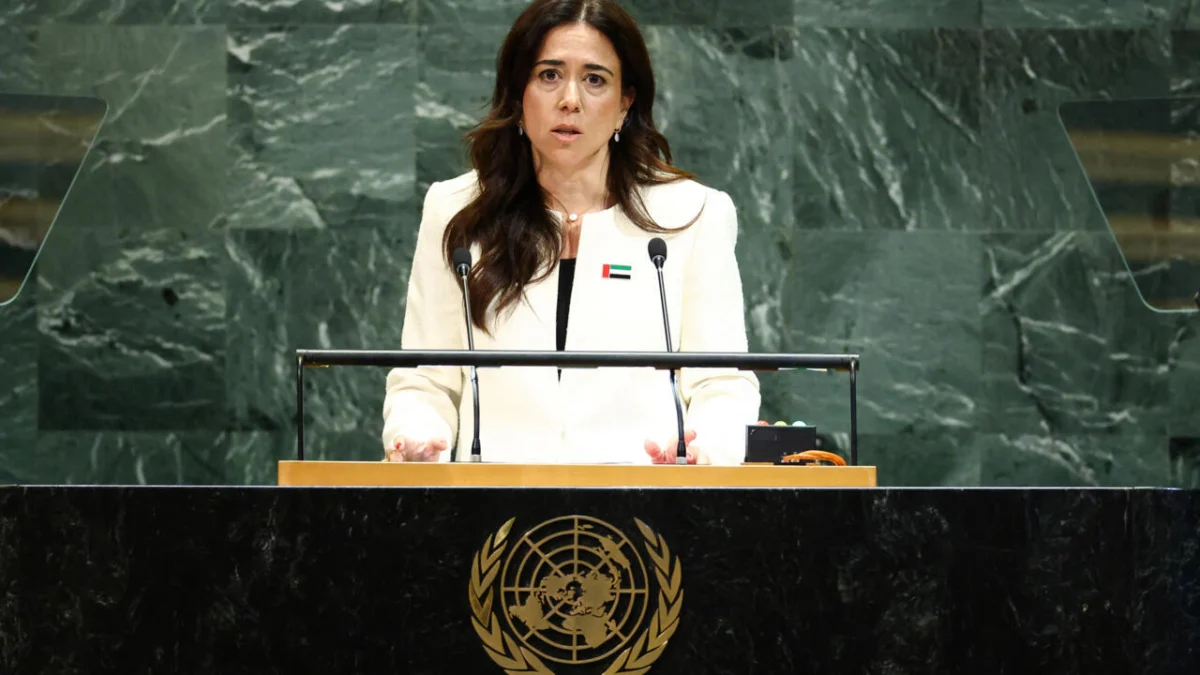
In a move that has sent ripples through the corridors of the United Nations headquarters in New York, the United Arab Emirates (UAE) has officially nominated Lana Nusseibeh, the Minister of State in the UAE’s Ministry of Foreign Affairs, to succeed António Guterres as the next Secretary-General of the United Nations. The announcement, confirmed by the Emirates News Agency (WAM) and further substantiated by communications from the PR firm Teneo, marks the entry of a high-profile, influential diplomat into an already volatile selection process.
As the term of the current Secretary-General, António Guterres, draws to a close on December 31, 2026, the global body faces an urgent deadline. The selection of his successor is not merely a bureaucratic appointment; it is a geopolitical litmus test that will define the UN’s ability to navigate an increasingly fractured international order.
The Nomination: A Strategic Entry
The nomination, personally submitted by UAE President Sheikh Mohammed bin Zayed al-Nahyan, cites Nusseibeh’s "deep experience of the United Nations, her judgment in addressing the ongoing international challenges, and her record of constructive work."
Nusseibeh, who served as the UAE’s first female ambassador to the UN from 2013 to 2024, is a seasoned veteran of the Security Council. Her candidacy comes at a moment of profound uncertainty for the UN, which has struggled to maintain relevance in the face of escalating conflicts in Sudan, Gaza, and beyond. In her vision statement, Nusseibeh strikes a balance between diplomatic realism and optimistic resolve. "The Charter gives the Secretary-General no army and no vote," she writes. "But the position, held well, entails a different kind of power. Her independence empowers her to bring others to agreement… I will be the stubbornly optimistic, relentless diplomat I have always been."
To focus entirely on her bid, Nusseibeh has taken a formal leave of absence from her government post, signaling the seriousness of her commitment to the grueling selection process.
Chronology of the 2026 Succession Race
The quest to replace Guterres has been ongoing for roughly a year, characterized by high-stakes informal straw polls and public hearings in the General Assembly.
- Late 2025 – Early 2026: The official process begins, with regional blocks—specifically Latin America and the Caribbean—asserting that it is their "unofficial turn" to provide the next leader of the organization.
- September 2026: Michelle Bachelet, former President of Chile and a leading candidate, withdraws from the race following intense criticism from the United States regarding her past advocacy for women’s rights.
- October 16, 2026: The most recent straw poll reveals a deadlock. Candidates such as Rebeca Grynspan (Costa Rica), Carolyn Rodrigues Birkett (Guyana), and Rafael Mariano Grossi (Argentina) all faced "discourage" votes from members of the P5 (the five permanent members of the Security Council).
- October 21, 2026: The UAE formally announces Nusseibeh’s candidacy.
- Late October 2026: Sources indicate that a scheduled straw poll has been postponed to accommodate Nusseibeh’s integration into the field and her forthcoming interactive dialogue with the General Assembly.
The Mechanics of Power: Why Nusseibeh?
To secure the position, a candidate must win at least nine votes from the 15-member Security Council and avoid a veto from any of the P5 members (the US, China, Russia, Britain, and France).
Richard Gowan, an analyst with the International Crisis Group, observes that Nusseibeh’s entry is far from a spontaneous decision. "Her rollout has been pretty slick," Gowan notes. "UN insiders assume that she will have squared away the veto powers before going public. It feels like it may be a coronation."
Nusseibeh’s strengths are significant. She is widely viewed as a diplomat who can navigate the complex, often conflicting, interests of the P5. Her background—born in 1978, of Palestinian origin, yet representing a nation that pioneered the Abraham Accords—gives her a unique, albeit complicated, profile. Supporters like Brett McGurk, a former senior advisor to the Biden administration, praise her as a "diplomat who knows everyone and works with them to ‘Get S*** Done.’"
A Divided Legacy: Human Rights and Geopolitical Scrutiny
Despite the support of various Western figures, Nusseibeh’s path to the 38th floor of the UN Secretariat is paved with intense controversy. Critics, including humanitarian organizations and experts on international law, argue that her candidacy is fundamentally compromised by the UAE’s own actions on the world stage.
The Sudan Allegations
The most damning criticism centers on the ongoing conflict in Sudan. Independent UN panels of experts and reports by organizations such as Amnesty International have accused the UAE of arming and funding the Rapid Support Forces (RSF). The RSF has been linked to the brutal massacre in El Fasher, an event the UN has identified as bearing the "hallmarks of genocide."
Nathaniel Raymond of the Yale School of Public Health has been a vocal opponent of the nomination. "She has a dual loyalty, a conflict of interest, between the United Nations and a state which is credibly accused by the UN itself of directly aiding and abetting the massacre of El Fasher," Raymond stated. For many critics, the irony of appointing an official from a nation accused of fueling one of the world’s worst humanitarian crises to the highest post in the UN is, in their words, a "catastrophe."
Regional Human Rights Concerns
Beyond foreign policy, the UAE’s internal record remains a flashpoint. The 2026 Human Rights Watch report highlights "severe restrictions on expression, association and assembly." As a potential Secretary-General, Nusseibeh would be expected to serve as the world’s moral conscience; critics question whether she can reconcile this role with her country’s domestic policies.
Implications for the UN and Global Governance
The entry of a new candidate has exacerbated tensions regarding regional representation. Countries in the Latin America and Caribbean (GRULAC) region, which had hoped for a clear run at the position, now face a crowded field. The failure of the Council to reach a consensus in six consecutive straw polls suggests a deep ideological rift within the P5 that may not be easily resolved by a single candidate.
The General Assembly, currently presided over by Khalilur Rahman, has promised that any new candidate will undergo the full rigor of the "interactive dialogues." This process, introduced in recent years to increase transparency, requires candidates to answer questions from UN member states and civil society organizations.
The Path Forward
The upcoming weeks will be decisive. If Nusseibeh is to succeed, she must navigate:
- The Veto Hurdles: Proving to Russia and China that she is an impartial broker, while maintaining the confidence of the US.
- The Moral Scrutiny: Addressing the "black marks" regarding the UAE’s role in Sudan and the wider Middle East.
- The Gender Ceiling: Becoming the first woman to lead the UN in its 81-year history. While the race was supposed to rectify this historic imbalance, the presence of multiple female candidates—including Maria Fernanda Espinosa and Ivonne A-Baki—means that the focus will remain on the specific policy platforms of the individuals rather than the symbolic victory of electing a woman.
As the international community watches, the UN stands at a crossroads. The selection of the next Secretary-General will either serve as a signal that the organization can adapt and find strong, unifying leadership, or it will deepen the perception that the UN remains a prisoner of the geopolitical interests of its most powerful members. For Lana Nusseibeh, the challenge is clear: she must convince a cynical world that she can transition from being a representative of a powerful, polarizing state to a truly independent champion of the United Nations Charter.