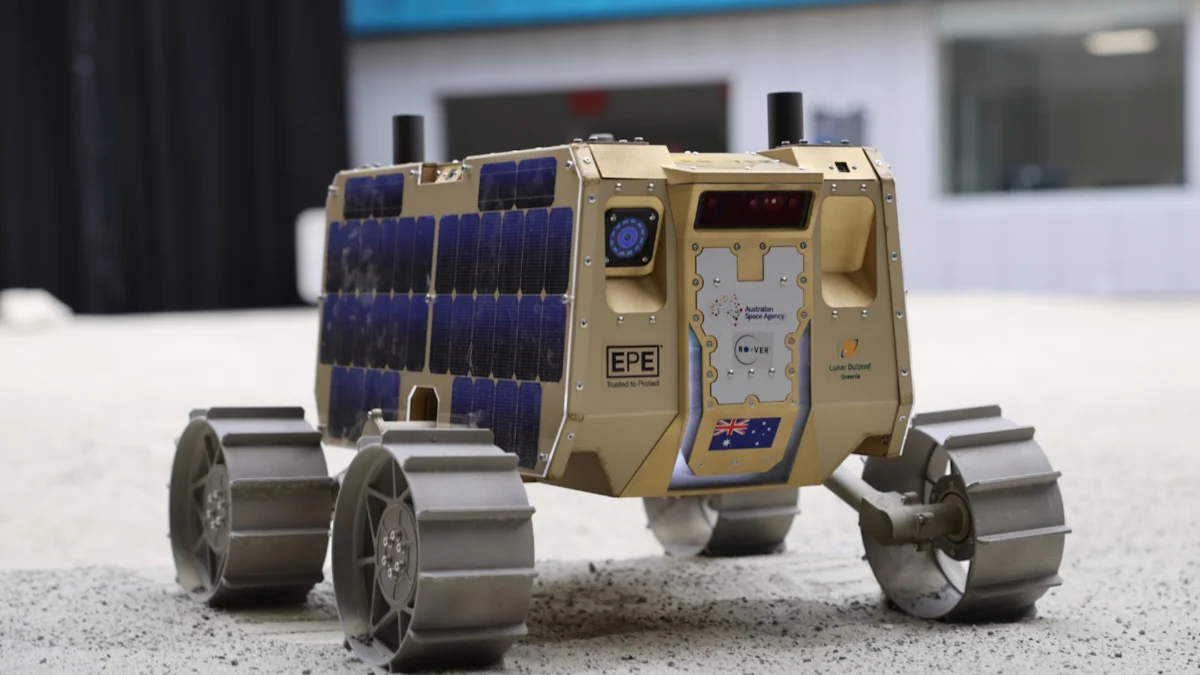
At first glance, it resembles a utilitarian hybrid of a backyard lawn mower and a sophisticated swimming pool cleaner. However, this unassuming aesthetic belies a piece of engineering so complex and resilient that it is destined to traverse the most inhospitable landscape humanity has ever dared to colonize.
The "Roo-ver," the flagship project of an Australian-led lunar exploration initiative, was officially unveiled this week at the Queensland University of Technology’s (QUT) Lunar Testbed and Space Lab. As the world celebrates World Space Week, this land drone represents far more than a mere mechanical curiosity; it is a $42 million statement of intent, signaling Australia’s maturation into a global leader in space robotics and autonomous resource processing.
The Mission: A High-Stakes Lunar Expedition
The Roo-ver is not designed for mere sightseeing. It is being engineered for the grueling terrain of the lunar South Pole—a region of profound interest to international space agencies due to its potential for housing water ice and other critical volatiles.
As part of a strategic partnership with NASA, the Roo-ver is slated for a 2030 launch. The vehicle’s primary objective is to collect lunar regolith—the fine, abrasive dust that blankets the Moon—and process it. This is a critical step in the "Moon to Mars" initiative, which aims to prove that humans can "live off the land" in space. By extracting oxygen from the regolith, the Roo-ver will serve as a proof-of-concept for the sustainable support of future human lunar bases and deep-space missions.
The challenge is atmospheric, or lack thereof. The rover must withstand a temperature range that would shatter conventional machinery: from a bone-chilling minus 246°C in the shadows to a blistering 121°C in direct sunlight. Furthermore, lunar dust is notoriously sharp, electrostatically charged, and adhesive—a nightmare for gears, joints, and sensors.
Chronology: From Concept to Lunar Testbed
The journey of the Roo-ver is a testament to the accelerated pace of the modern space economy.
- 2022–2023: The Australian Space Agency formalizes its commitment to the "Moon to Mars" initiative, allocating significant funding to foster local deep-tech capabilities.
- 2024: The ELO² consortium—a Brisbane-based powerhouse comprising EPE Oceania (project lead), Lunar Outpost Oceania (technical lead), and industry giants like BHP—is formed.
- 2025: Initial prototypes undergo "Earth-analogue" testing, where the rover is subjected to simulated lunar conditions in remote parts of Western Australia and Queensland.
- October 2026: The unveiling of the 2026 prototype at QUT. This version features refined chassis mechanics and enhanced autonomous navigation software.
- 2027–2029: Rigorous qualification testing, including radiation hardening and vacuum chamber trials to mimic the vacuum of space.
- 2030 (Projected): Launch via a NASA Commercial Lunar Payload Services (CLPS) mission, facilitated by Intuitive Machines.
Supporting Data: Engineering a Rugged Survivor
The $42 million investment by the Australian Space Agency is being funneled into a multi-disciplinary effort that bridges the gap between academic research and commercial mining expertise.
Technical Specifications
The Roo-ver relies on an advanced suite of sensors to navigate the lunar South Pole, where lighting conditions are perpetually low-angle, creating long, deceptive shadows. Its locomotion system is designed to traverse uneven, rocky terrain without bogging down in the powdery regolith.
- Weight: Engineered for a high power-to-weight ratio to maximize payload capacity for collected samples.
- Autonomy: The rover utilizes AI-driven navigation, allowing it to make real-time decisions without the three-second communication lag inherent in Earth-to-Moon signals.
- Consortium Power: The inclusion of BHP brings deep-tier mining expertise. The technology used to automate large-scale autonomous ore trucks in the Pilbara region of Australia is being adapted to assist in the precise, delicate excavation of lunar materials.
The Role of Intuitive Machines
NASA’s decision to select Intuitive Machines for the delivery of the Roo-ver highlights the reliance on the private sector. By outsourcing the transit logistics, NASA allows the ELO² consortium to focus entirely on the robotic performance of the rover itself, effectively lowering the cost of entry for international partners.
Official Responses: A New Era for Australian Industry
The unveiling was met with significant enthusiasm from both government officials and the scientific community.
"This is not just about a robot on the Moon; it is about the sovereign capability we are building right here in Australia," said a spokesperson for the Australian Space Agency during the unveiling. "The Roo-ver represents a convergence of mining, robotics, and advanced manufacturing. By solving the problem of lunar regolith, we are effectively positioning Australian companies to be the primary contractors for future planetary infrastructure."
Dr. Sarah Jenkins, a lead engineer at the QUT Space Lab, emphasized the difficulty of the project: "People see a mower, but we see a miracle of materials science. Keeping the electronics alive in these temperature swings while preventing the lunar dust from entering the sealed bearings is a feat that has never been achieved at this scale by an Australian entity."
BHP representatives noted that the transition from terrestrial mining to lunar mining is a natural evolution. "Our workers in the Pilbara operate machines via satellite from thousands of kilometers away. The Moon is simply the next frontier of remote operations. We are essentially exporting our expertise in autonomous systems to the lunar surface."
Implications: The Strategic Value of the Moon
The implications of the Roo-ver’s mission extend far beyond the immediate scientific data it will return.
1. The Gateway to Mars
The Moon is the proving ground. If the Roo-ver can successfully process regolith to produce oxygen, the blueprint for a Martian base becomes significantly more viable. The ability to extract resources on-site—In-Situ Resource Utilization (ISRU)—is the "holy grail" of space exploration, as it eliminates the need to launch every gram of fuel and air from Earth’s gravity well.
2. Economic Diversification
Australia’s economy has long been anchored by the resources sector. The Roo-ver initiative signals a pivot toward "space-mining," a burgeoning industry that could see Australia become a key exporter of robotic technology. By fostering a consortium that includes startups, universities, and mining giants, Australia is creating an ecosystem that ensures the intellectual property remains local.
3. Geopolitical Positioning
With the Artemis Accords and the increasing international interest in the lunar South Pole, the presence of the Roo-ver provides Australia with a seat at the table. It ensures that when the conversation turns to the legal and ethical frameworks of lunar resource extraction, Australia is not a spectator, but a primary stakeholder.
4. Technological Spillover
The technologies developed to protect the Roo-ver from radiation and thermal shock have direct applications on Earth. From enhanced battery storage solutions for extreme climates to better autonomous navigation for dangerous mine sites or disaster-response zones, the $42 million investment will likely yield significant dividends in terrestrial industries.
Conclusion: A Small Step for a "Roo-ver"
As the 2026 prototype undergoes its final series of tests, the global space community is watching closely. The Roo-ver is a symbol of a new era of space exploration—one where national space agencies collaborate with private industry to turn scientific aspiration into industrial reality.
While the "mower-like" appearance of the machine might invite humor, the stakes are undeniably serious. If the Roo-ver succeeds in 2030, it will prove that the dust of the Moon is not merely a challenge to be overcome, but a resource to be harvested. For Australia, the mission is clear: to be the nation that helps provide the oxygen and materials that will eventually allow humanity to call the stars its home.
As we look toward the 2030 launch, the Roo-ver stands as a testament to human ingenuity, bridging the gap between the red dirt of the Australian outback and the gray, silent expanse of the lunar South Pole. The backyard may be massive, but with the Roo-ver, Australia is ready to get to work.