By Laurent Warlouzet
October 9, 2026
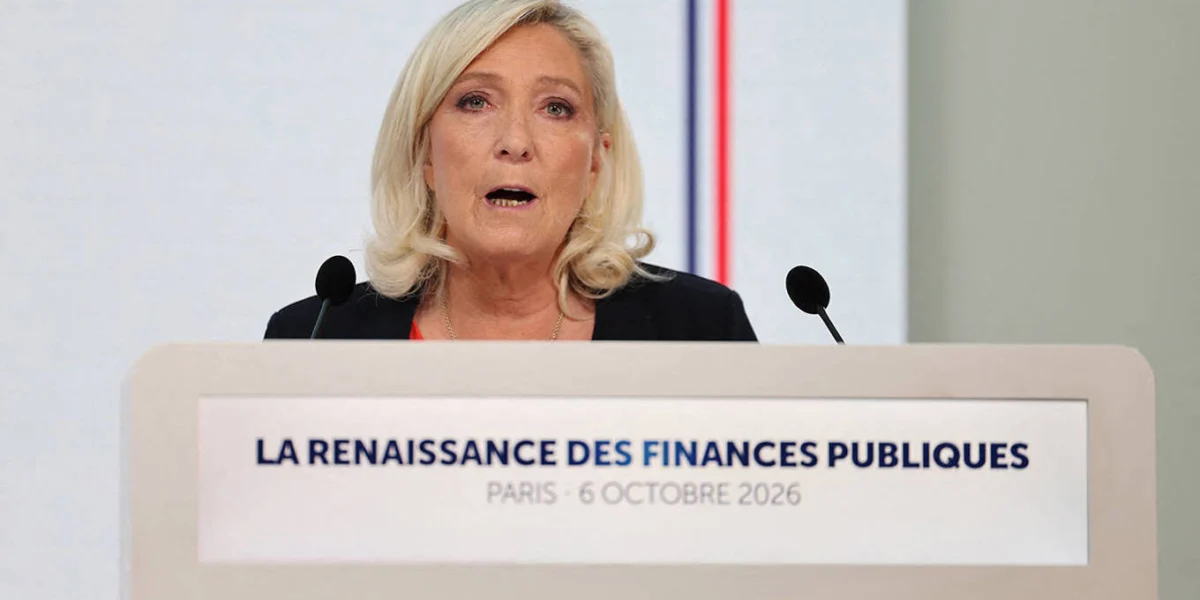
In the hallowed halls of French political discourse, the term "austerity" has long been a scarlet letter—a policy death knell that few politicians dare to embrace. Yet, in a striking address that has sent shockwaves through the corridors of the Élysée and the boardrooms of Brussels, Marine Le Pen, leader of the National Rally (RN), has unveiled an economic program that explicitly pivots toward rapid fiscal consolidation.
This move, which many analysts initially viewed as a tactical impossibility, marks a seismic shift for the far-right leader. By championing a platform of strict budgetary discipline, Le Pen is not merely tweaking her party’s rhetoric; she is attempting to reconcile the irreconcilable: the nationalist protectionism that built her base and the cold, hard mathematics of modern fiscal realism. Whether she can successfully navigate this paradoxical terrain will determine not only her own political longevity but potentially the trajectory of the nationalist right across the European continent.
The Main Facts: A Radical Reorientation
Marine Le Pen’s latest economic manifesto represents a fundamental departure from the National Rally’s historical reliance on anti-globalization rhetoric and state-led economic expansion. For decades, the RN’s economic identity was defined by "social patriotism"—a blend of protectionism, increased social spending, and hostility toward international financial institutions.
The new proposal centers on a "Grand Fiscal Reset." The core pillars include:
- Drastic Public Expenditure Cuts: A commitment to slashing the public sector wage bill by 15% over three years.
- The "Sovereignty Dividend": A plan to repatriate fiscal authority from the European Union, ostensibly to stabilize the French deficit without the oversight of the European Central Bank (ECB).
- Streamlined Bureaucracy: A pledge to abolish a tier of regional administrative bodies to eliminate "redundant layers" of government.
This is not the platform of a firebrand insurgent, but the pragmatic architecture of a leader preparing for the realities of governance. By pivoting toward fiscal consolidation, Le Pen is signaling to international markets—and the French middle class—that the National Rally is no longer an erratic fringe movement, but a "government-in-waiting" capable of managing the nation’s accounts.
Chronology: The Evolution of an Economic Pivot
The road to this fiscal pivot was neither sudden nor seamless. It is the culmination of a decade-long internal struggle within the National Rally.
- 2012–2017: The Populist Baseline. During this period, Le Pen focused heavily on "de-globalization," advocating for a return to the Franc and aggressive wealth redistribution. The economic platform was essentially a mirror image of the left-wing populist movements.
- 2022: The "Normalization" Phase. Recognizing that the fear of economic instability was the primary hurdle to her electoral success, Le Pen began softening her stance on the Euro, pivoting toward "economic sovereignty" rather than outright abandonment of the currency.
- 2025: The Catalyst of Crisis. Following a period of sluggish growth and rising bond yields for French debt, the French public began to voice acute concerns regarding the sustainability of the social model. Internal polling showed that voters were increasingly anxious about the rising cost of servicing the national debt.
- October 2026: The Formal Announcement. In her keynote address in Paris, Le Pen formally adopted the language of "fiscal consolidation," effectively co-opting the vocabulary of the traditional center-right.
Supporting Data: The Arithmetic of Discontent
Le Pen’s pivot is driven by the stark realities of the current French economy. According to recent data from the Institut National de la Statistique et des Études Économiques (INSEE), the French debt-to-GDP ratio currently hovers near 115%.
Debt Service vs. Public Infrastructure
The cost of servicing this debt has skyrocketed due to persistent inflationary pressures and higher interest rates. In 2025 alone, the French government spent more on interest payments than it did on the entire budget of the Ministry of Justice.
The Demographic Burden
Le Pen’s program also addresses the "grey squeeze." With the aging of the baby boomer generation, social security obligations are projected to balloon by 4% of GDP over the next decade. Her proposal suggests that without structural reform, the French state will face an "impossible choice" between default and total fiscal collapse—a narrative she is using to justify her austerity measures as a necessary sacrifice for "national survival."
Official Responses: A Divided Political Landscape
The reaction to Le Pen’s fiscal pivot has been polarized, reflecting the deep divisions within the French establishment.
The Government Perspective
The current administration, led by President Macron’s centrist coalition, has been quick to attack the proposal as "cynical." A spokesperson for the Ministry of Finance stated: "Ms. Le Pen is offering a masquerade. She speaks of fiscal consolidation, yet her party’s foundational support remains rooted in promises of unsustainable social spending. One cannot cut the state to the bone while claiming to protect the vulnerable."
The Markets’ Reaction
Interestingly, the initial reaction from international financial institutions has been one of cautious observation. Analysts at major investment banks, such as Goldman Sachs and BNP Paribas, noted that while the rhetoric is "encouraging" in its focus on fiscal discipline, the lack of a clear legislative path to achieve these cuts leaves a "credibility gap" that markets will be hesitant to ignore.
The Left-Wing Opposition
The coalition of the Left has characterized the program as a "betrayal of the working class." By adopting austerity, they argue, Le Pen is effectively "masking her true intentions to serve the interests of capital while wrapping it in the flag of sovereignty."
Implications: The Nationalist Right’s Identity Crisis
The implications of this shift extend far beyond France’s borders. For years, the European right—from the AfD in Germany to the Brothers of Italy—has struggled with the same tension: how to be both the party of the "forgotten man" and the party of fiscal order.
The "Orbánization" of Policy?
Le Pen seems to be looking toward Viktor Orbán’s Hungary as a model. Orbán has successfully maintained a nationalist, populist image while keeping a tight grip on the fiscal reins through centralized control. By mirroring this approach, Le Pen is attempting to create a template that other European nationalist parties can follow.
The Risk of Fragmentation
However, this pivot carries a significant risk: the alienation of her core base. If Le Pen succeeds in imposing austerity, she will inevitably face resistance from the very people who propelled her to national prominence. The "Yellow Vest" movement of the past decade serves as a warning of what happens when the working class feels betrayed by the state’s fiscal priorities.
If she fails to deliver the promised economic security, she risks losing the trust of the working-class voters who shifted from the Left to the Right precisely because they were promised protection from the "cruelty" of the market.
Conclusion: The Final Verdict
Marine Le Pen’s decision to embrace fiscal consolidation is a high-stakes gamble. It is a calculated move designed to strip away the "extremist" label that has kept her from the gates of power for over a decade. By moving the goalposts of the national economic debate toward austerity, she is forcing her opponents to define themselves against her new, "responsible" platform.
However, politics is rarely just a matter of arithmetic. It is a matter of trust. Le Pen is now caught in a classic political trap: she must persuade the French public that she is the only one capable of fixing the economy through tough love, while simultaneously ensuring that the "love" reaches those who have been most neglected by the current order.
As we look toward the next election cycle, the question is no longer just whether Le Pen can win. It is whether, in her attempt to become the savior of the French economy, she will destroy the very populist coalition she spent her life building. For Europe’s nationalist right, the experiment in Paris will serve as the ultimate litmus test. If she succeeds, the "Le Pen Model" will become the new standard for the European Right. If she fails, it may signal the beginning of the end for the nationalist wave that has reshaped the continent.