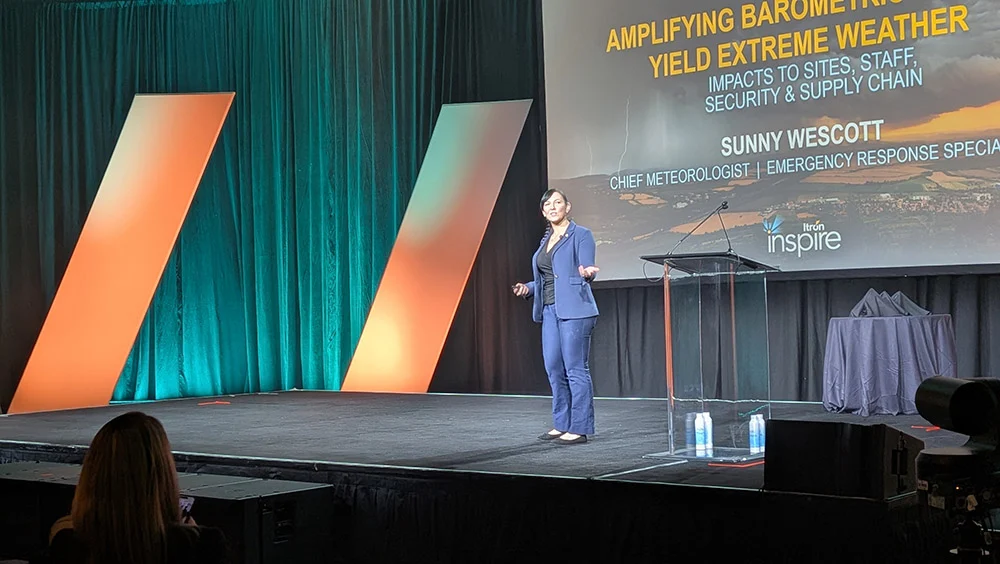
The traditional "four-season" model of grid planning is dead. As extreme weather events—from unprecedented Northeast wildfires to erratic, out-of-season storm cycles—become the norm rather than the exception, the energy sector is facing an existential reckoning. At the Itron Inspire 2026 conference, Chief Meteorologist and federal emergency response expert Sunny Wescott delivered a sobering keynote that served as both a warning and a roadmap for the future of utility infrastructure.
For the power industry, the era of relying on historical weather data to forecast future risk is over. Today, Wescott and other industry leaders are pushing for a transition toward a proactive, data-driven, and hyper-localized approach to grid hardening.
Main Facts: The End of Predictability
The core challenge identified by Wescott is that climate volatility has decoupled from its traditional geographical and seasonal anchors. We are witnessing "weather whiplash"—a phenomenon where areas previously considered safe from natural disasters are now facing severe, compounding threats.
The primary facts underpinning this shift include:
- Geographic Displacement: Wildfire risk is no longer confined to the American West; it has migrated into the Northeast and other regions historically buffered by humidity or moderate temperatures.
- Operational Instability: Shifts in temperature and precipitation are directly compromising the integrity of physical assets, from the curing time of concrete in new substation construction to the structural fatigue caused by increasingly dense, high-velocity hail.
- The Data Gap: Standard meteorological models, which are predicated on multi-decadal historical averages, are increasingly failing to predict the "black swan" events that define our current climate reality.
- Resource Competition: The rise of massive data centers, coupled with water and energy constraints, is creating a new tier of stress on the grid that demands cross-departmental coordination that simply did not exist a decade ago.
A Chronology of Climate-Driven Utility Disruption
To understand how we reached this inflection point, one must look at the rapid acceleration of environmental stressors over the last several years.
2023–2024: The Realization Phase
During this period, utilities began to observe that "outlier" events were recurring with greater frequency. The industry shifted from viewing severe storms as one-off insurance liabilities to recognizing them as systemic operational risks.
2025: The Infrastructure Stress Test
Extreme heat domes across the Midwest and unprecedented ice storms in the Appalachian Mountains forced operators to reconsider the materials used in grid infrastructure. It became clear that legacy assets, designed for a more temperate climate, were not built to withstand the thermal expansion and contraction cycles of the mid-2020s.
2026: The Paradigm Shift (Itron Inspire)
The current year marks a transition from acknowledgment to integration. At Itron Inspire 2026, Wescott emphasized that we have moved into an era where "real-time operational data" must replace historical archives. Utilities are now being urged to move away from reactive "break-fix" models toward a strategy of predictive hardening, utilizing high-resolution topographic mapping to identify micro-level vulnerabilities before they result in catastrophic failure.
Supporting Data: Why Historical Models Fail
Wescott’s keynote highlighted specific environmental anomalies that demand immediate attention from engineering and planning departments.
The Appalachian Case Study
The Appalachian region, historically a bastion of stable, predictable weather, is currently experiencing frost and ice conditions at temperatures previously unseen. These shifts have forced grid operators to abandon static, legacy maps in favor of dynamic, topographic-based operational tools. By integrating real-time climate telemetry with GIS data, utilities can now visualize exactly where moisture accumulation will lead to line icing, allowing for targeted preventative maintenance.
The "Workforce Safety" Variable
Environmental stressors extend beyond the grid to the human element. The increasing prevalence of heavy wildfire smoke and airborne particulate matter has introduced new health and safety regulations for field crews. In some regions, labor availability has dropped by as much as 15% during peak wildfire seasons, directly impacting the speed of emergency response and restoration efforts.

The Material Science Crisis
The chemical composition and structural integrity of grid components are being tested. Data indicates that shifting precipitation cycles—characterized by periods of intense drought followed by extreme flooding—are altering soil stability around utility poles. When combined with increased hail density, the physical load-bearing capacity of existing infrastructure is being pushed to its "absolute limit," according to Wescott.
Official Responses and Strategic Pivots
The industry response is beginning to take shape through three distinct pillars: Collaboration, Data Integration, and Regulatory Advocacy.
The Shift Toward Cross-Sector Collaboration
Wescott underscored that utilities can no longer operate as islands. "The way we’ve always done it" is a liability in a landscape where tornado corridors are shifting and flood zones are expanding. Collaboration with peer utilities and international partners who have successfully navigated similar climate transitions is now essential. Sharing "lessons learned" regarding material resilience and emergency response protocols is reducing the cost of innovation for individual utilities.
Data-Driven Resilience
Rather than spending years developing internal, proprietary forecasting models, Wescott urged leadership to utilize the vast wealth of existing environmental data. By leveraging high-resolution satellite imagery and localized weather sensors, utilities can create "digital twins" of their service territories. These models allow for simulated "stress testing" of the grid against theoretical extreme events, providing a quantitative basis for capital expenditure that regulators can actually support.
The Regulatory Argument
One of the most difficult hurdles for utility leaders is justifying massive grid-hardening expenditures to boards and regulators who are accustomed to traditional ROI metrics. Wescott suggests a shift in narrative: leaders must stop framing these investments as "upgrades" and start framing them as "avoided cost" initiatives. By quantifying the economic damage of a single major outage—including lost commercial productivity, emergency response costs, and potential legal liability—the financial case for proactive resilience becomes undeniable.
Implications: The Future of the Grid
The implications of Wescott’s analysis are clear: the energy sector is no longer just in the business of power delivery; it is in the business of environmental risk management.
Short-Term Implications
Over the next 12 to 24 months, we should expect a surge in utility investment toward:
- Vegetation Management 2.0: Moving beyond simple trimming to AI-driven, site-specific monitoring of tree health and wildfire fuel loads.
- Hardening against Heat: Replacing standard transformers and conductors with high-temperature-tolerant alternatives.
- Integrated Resource Planning: Aligning data center expansion, water resource availability, and grid capacity into a single, unified development strategy.
Long-Term Implications
Looking further ahead, the grid of the 2030s will be defined by its agility. Decentralized, micro-grid architectures will likely become the standard, not just for sustainability, but for survivability. If a main transmission line goes down due to a new, unpredictable climate hazard, localized systems will be the difference between a minor disruption and a cascading, multi-day blackout.
A Closing Call to Action
The "unpredictable" is now the only predictable aspect of our climate. For utility leaders, the path forward is not found in the rear-view mirror of historical averages, but in the rapid adoption of real-time intelligence. As Wescott noted during the conference, the risks—from shifting tornado paths to the mundane but hazardous presence of wildlife in flood-ravaged infrastructure—are real, and they are here to stay.
The industry has the tools, the data, and the professional expertise to harden the grid against this new reality. What is required now is the institutional courage to break with the past and build a system that is as dynamic and unpredictable as the climate it must withstand.
To learn more about how to prepare for the next storm and redefine grid resilience, watch the full conversation from the Itron Inspire 2026 conference here.