In the modern digital ecosystem, a silent war is being waged behind the scenes of every web page. While internet users interact with sleek, conversational AI interfaces like ChatGPT, Claude, and Gemini, a massive, automated infrastructure is working tirelessly to ingest the entirety of the human-authored web. For website publishers, this has created an increasingly hostile environment: AI platforms are scraping content at an unprecedented scale, yet the promised "referral traffic"—the lifeblood of the digital publishing economy—remains elusive.
New internal data from our team provides a candid look at this lopsided dynamic. By tracking AI bot activity on our own properties, we’ve uncovered a troubling reality: AI systems are consuming our content at a rate over 200 times higher than they are sending visitors back to our site. As the "Great Blogging Collapse" looms, this study offers a critical look at the sustainability of the current AI-search model.
Main Facts: The 4.45 Million Scrape Reality
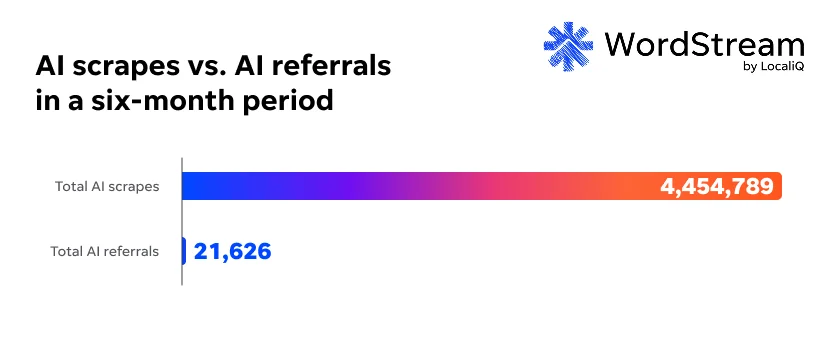
The headline figure is as stark as it is unsustainable: over the course of just six months, AI crawlers accessed our domain more than 4.45 million times. To put this in perspective, our analysis calculated a "scrape-to-referral" ratio of 201:1. For every 201 times a bot hit our servers to ingest data, we received a single solitary visit from an AI-referred user.
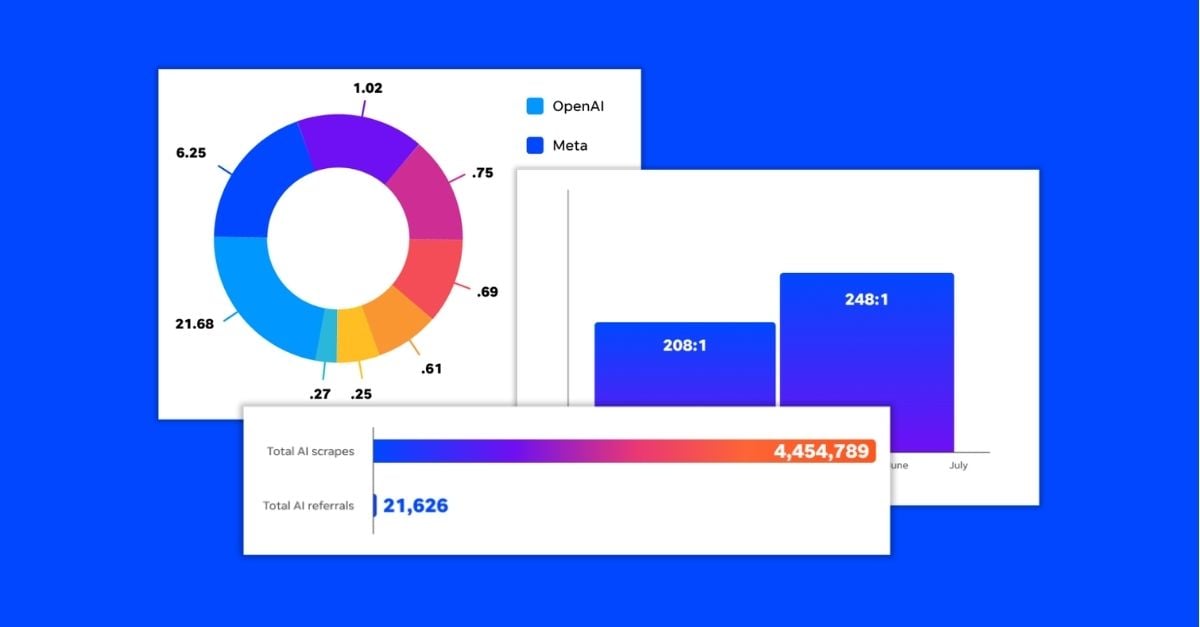
This data exposes a fundamental flaw in the value exchange between AI developers and content creators. AI platforms require high-quality, human-generated data to train their models and provide up-to-date answers in AI Overviews. However, by providing those answers directly within the chatbot interface, these platforms remove the necessity for the user to ever click through to the original source. The result is a system that extracts massive value from publishers while providing negligible return, all while increasing the technical costs associated with server bandwidth and infrastructure management.
Chronology: The Evolution of the "Bot Surge"
The rise of the AI scraper has been meteoric, fundamentally shifting the composition of web traffic over the past 24 months.
- Early 2024: The industry observed a steady increase in bot traffic, but it remained largely categorized under "search crawlers" (like Googlebot) or "malicious bots."
- Late 2024 – Mid 2025: A rapid proliferation of "RAG" (Retrieval-Augmented Generation) bots began. These bots were designed specifically to index pages for LLM training and real-time query responses.
- Early 2026: We began noticing a severe degradation in referral quality. As AI platforms refined their "answer-first" models, the scrape-to-referral ratio began to skew sharply negative.
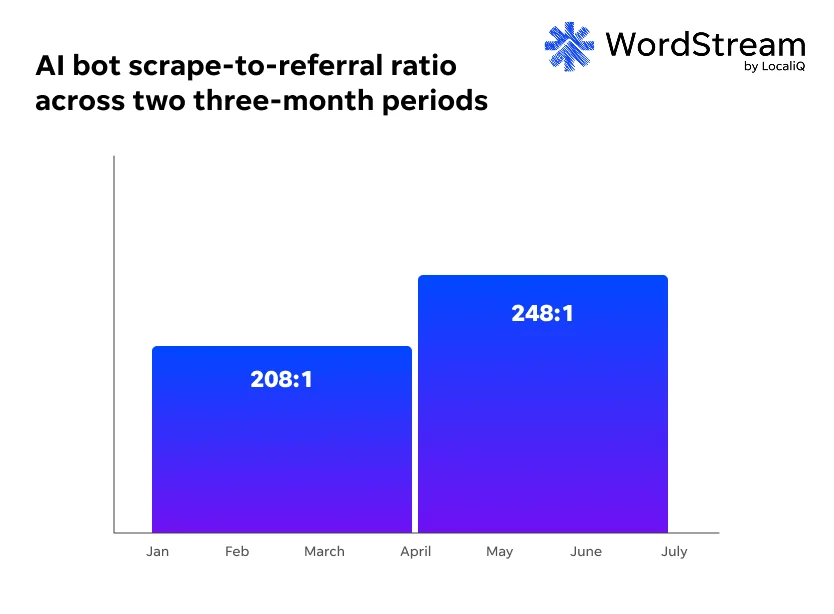
- Current State: Today, we are seeing a 19.2% worsening of this ratio in just the last three months alone, as AI platforms move toward "zero-click" search experiences, where the need for a user to visit a website is effectively designed out of the search journey.
Supporting Data: What AI Bots Are Actually Eating
Our analysis revealed that AI crawlers are not passive observers; they have distinct "tastes." When we mapped our most-scraped pages, a clear pattern emerged: AI bots have an insatiable hunger for first-party data, statistical benchmarks, and definitive research.
The Anatomy of a Targeted Page
The pages most frequently hit by scrapers—including our Google Ads and Facebook Ads benchmarks—are the ones that require the most human investment. These pages represent hundreds of hours of data cleaning, expert outreach, and design work.
| Page Type | Scrape Frequency | Referral Rate |
|---|---|---|
| Data Benchmarks | Extreme | Low |
| Definitions/Guides | High | Low |
| Interactive Tools | Low | High |
Interestingly, our most-visited pages—the ones that actually drive business value—are often interactive tools (like our Keyword Research Tool or Performance Grader). Because these tools cannot be easily "summarized" by a text-based AI model, they remain somewhat insulated from the trend of declining traffic. Conversely, pages that provide quick, factual answers—such as "Social Media Image Sizes"—suffer from a staggering scrape-to-referral ratio, sometimes exceeding 27,000:1.
The "Stalker" Effect: Top Scrapers
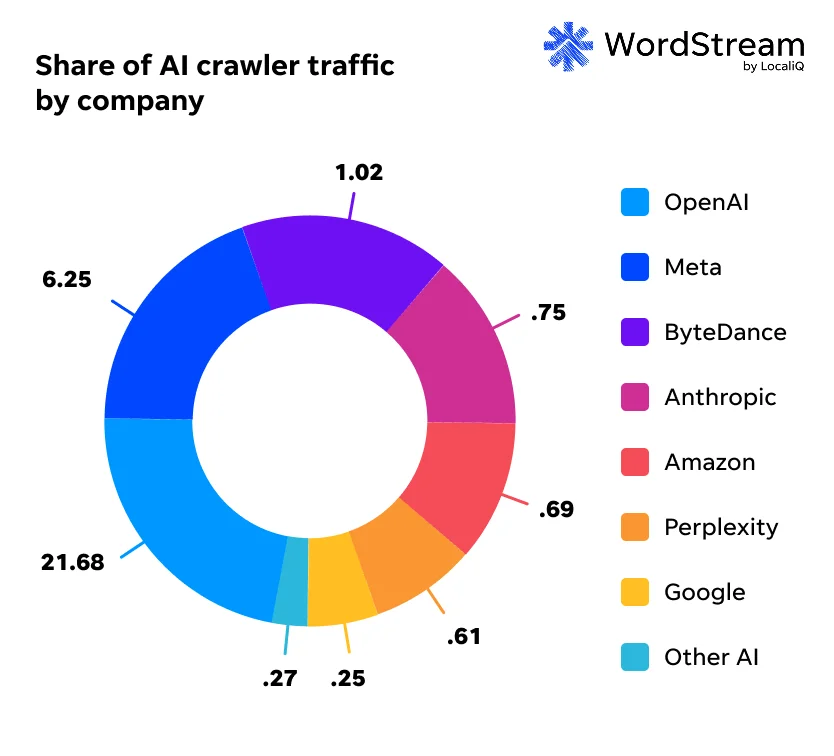
When breaking down traffic by entity, one name stands above the rest: OpenAI. Our data confirms that OpenAI’s crawlers are responsible for nearly three times the volume of scrapes compared to Meta’s AI bots. This aligns with OpenAI’s dominant market share in the chatbot space. Perhaps more surprising is the presence of companies like ByteDance, which, despite their social-media focus, are aggressively indexing the web to power their own generative search initiatives.
Official Responses and Industry Sentiment
The professional community is growing increasingly vocal about this imbalance. Justin Al-Qudah, director of web strategy and growth for LocaliQ, highlights the technical burden this places on businesses. "It used to be easier to classify the bots visiting our sites," Al-Qudah notes. "We’ve seen a massive increase in the number of bots hitting our sites, and with that increase, the majority have an unknown classification. This means more time reading up on the purpose of the bots and determining whether we block their crawls."
This sentiment is echoed by broader industry discourse. The "Great Blogging Collapse," a term coined to describe the plummeting organic traffic experienced by independent publishers, has sparked a debate over whether sites should block AI crawlers entirely using robots.txt files or "noindex" tags. While some argue that blocking is necessary for survival, others fear that being excluded from the training data of tomorrow’s AI will lead to total irrelevance in a search-first future.
Implications: The Future of the "Search" Paradigm
The implications of this study are profound for any organization that relies on organic search for growth.
1. The Death of the "Click"
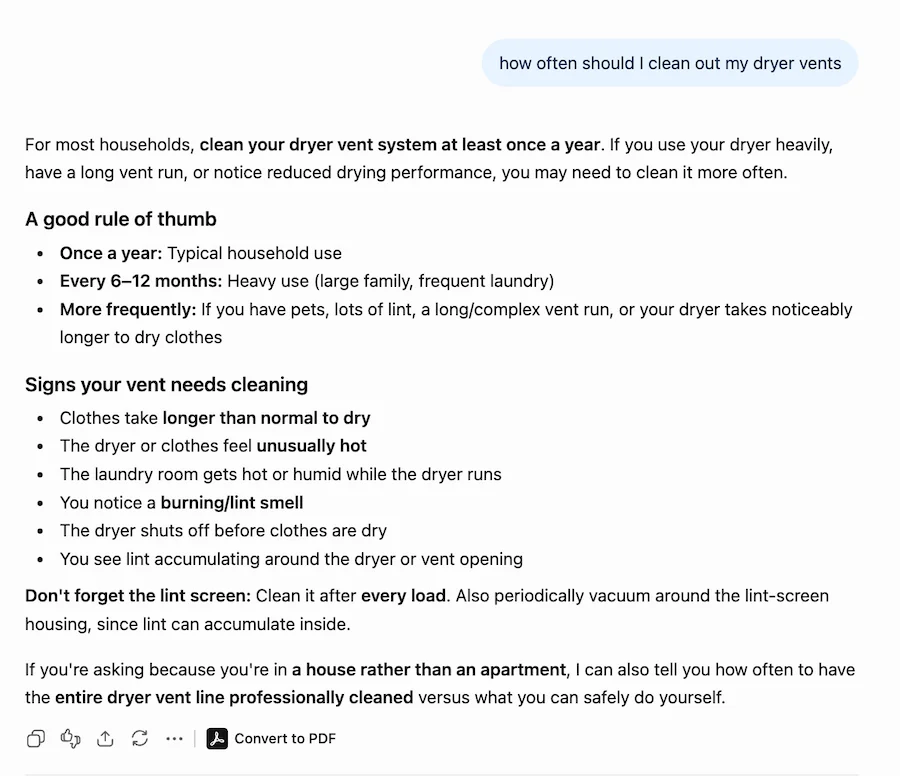
We are witnessing a transition from a "Search-to-Web" model to a "Search-to-Answer" model. As Google and other platforms integrate more AI Overviews, the incentive to click through to a source is diminishing. Our data suggests that searchers are becoming increasingly comfortable with unverified, summarized answers, which removes the publisher’s opportunity to capture that user’s attention or convert them into a lead.
2. The ROI of Content Creation
If content is scraped to train a model that then serves as a competitor to the original site, the return on investment for high-quality content decreases. Companies must now grapple with a new reality: is the goal of content to provide value to the reader, or to provide data for the AI? The two are increasingly becoming mutually exclusive.
3. A Pivot to "AI-Proof" Content
The future of content strategy will likely shift toward formats that AI cannot easily replicate. This includes:
- Proprietary Interactive Tools: Calculators and graders that require real-time user input.
- Opinionated, Expert-Led Analysis: Content that relies on nuance, personal experience, and human perspective—things LLMs still struggle to synthesize authentically.
- Community and Experience: Fostering spaces where users come for human connection, not just information.
Conclusion: Adapting to the New Reality
The data is clear: the current trajectory of AI scraping is fundamentally extractive. While we acknowledge that AI search is a permanent fixture of the modern digital landscape, publishers can no longer afford to be passive participants in their own obsolescence.
Moving forward, our strategy is not to abandon content creation, but to pivot toward value that AI cannot replace. We will continue to monitor the scrape-to-referral ratio, using it as a diagnostic tool to understand where our content is being cannibalized and where it is still capable of generating meaningful human engagement. The bots may be hungry, but they cannot replace the necessity of a human connection. As we navigate this shift, the priority remains clear: optimize for the humans who visit, not the bots that scrape.