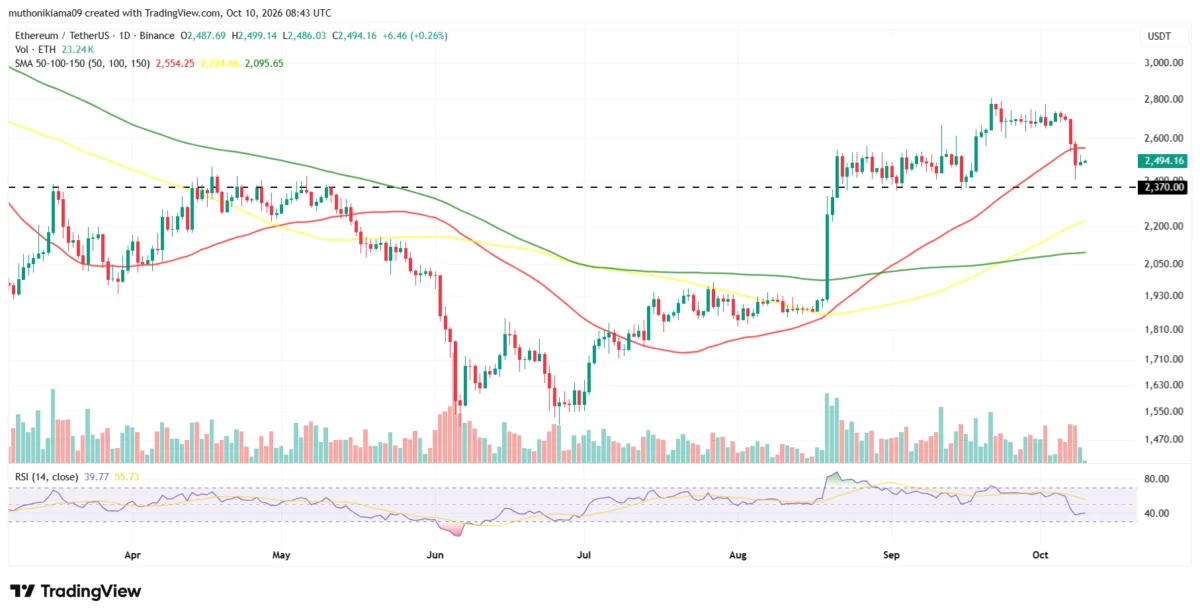
The cryptocurrency market, often characterized by its inherent volatility, has recently experienced a seismic shift that has left investors reeling. The anticipated “Uptober” rally, a period historically associated with bullish momentum for digital assets, has instead transformed into a theater of financial attrition. Over the course of October 7th and 8th, the crypto market witnessed a staggering $1.707 billion in long liquidations, marking a definitive end to the speculative optimism that had defined the late summer.
This massive purge of leveraged positions is not an isolated incident but rather the culmination of a broader macroeconomic tightening cycle. As Bitcoin (BTC) struggles to maintain its footing near the $80,000 threshold, the market is grappling with a dual reality: a persistent inflation problem and a Federal Reserve that appears increasingly unwilling to pivot.
Main Facts: The Anatomy of a Market Correction
The liquidation event on October 7-8 was particularly brutal for traders who had positioned themselves for a sustained breakout. By wiping out $1.707 billion in long positions, the market essentially "flushed" the excess leverage that had built up during the mid-August to early October rally.
This trend of punishing leveraged participants has been a recurring theme in the 2026 cycle. In August, the market saw $1.259 billion in short liquidations, and by September 21st, another $924.8 million in short positions were liquidated. These "short squeezes" were the primary engine of the summer rally, but as the price approached the $80,000 resistance level, the momentum stalled.

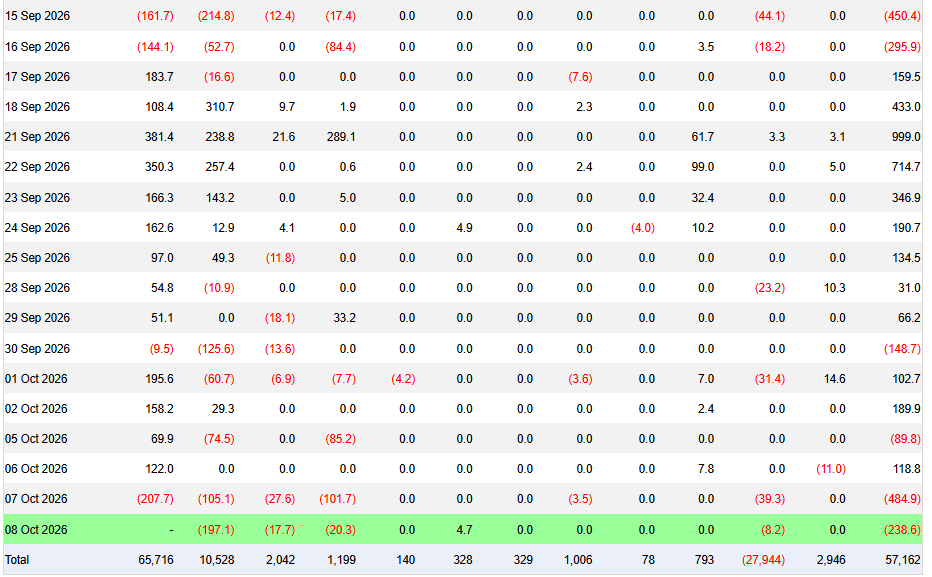
Current data from Farside Investors paints a somber picture for institutional interest: Bitcoin Spot ETF flows have turned negative, with $401.9 million in outflows for October. This shift suggests that the "smart money"—the institutional allocators who fueled the earlier part of the year—is hitting the pause button, waiting for clarity on interest rates and inflation data.
Chronology of the Decline
The current market environment can be traced back to a series of escalating events that have dampened risk appetite:
- Mid-August: A period of aggressive accumulation began, marked by significant short liquidations that drove BTC prices upward.
- September 15-16: The Federal Open Market Committee (FOMC) convened to discuss monetary policy, ultimately deciding on a 25 basis point (bps) interest rate hike.
- Early October: The market attempted to sustain its momentum, but a combination of weakening ETF inflows and looming FOMC meeting minutes created a "wait-and-see" atmosphere.
- October 7-8: The release of the FOMC minutes triggered a sell-off, resulting in the $1.707 billion liquidation event.
- Post-Minutes Period: Bitcoin prices, which had hovered near $83,400, succumbed to pressure, dipping to $82,800 within 10 hours as the market digested the hawkish reality.
Supporting Data: Why Sentiment Has Soured
The technical and on-chain indicators currently flashing red suggest that the path of least resistance for Bitcoin is currently downward.
The Federal Reserve’s Inflation Outlook
The primary catalyst for the current malaise is the September FOMC minutes. The Fed’s justification for the 25 bps hike was clear: inflation remains stubbornly above target, and progress in cooling the economy has been insufficient. More concerning for the markets is the internal projection from Fed staff, which suggests that inflation may not return to the 2% target until 2029. By raising the inflation forecast for the 2026–2028 window, the Fed has signaled that "higher for longer" is not just a slogan, but a concrete strategy.
The Bitcoin Regime Score
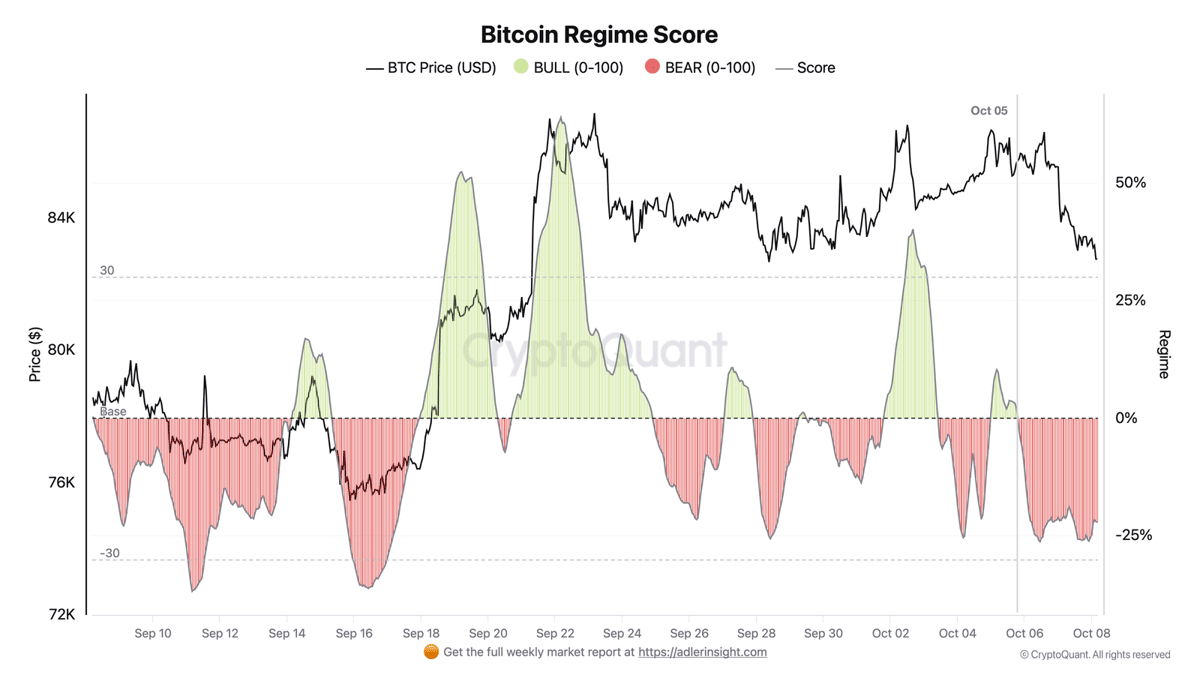
Crypto analyst Axel Adler Jr. monitors the "Bitcoin Regime Score," a metric that identifies whether the market environment favors bulls or bears. Currently, the score sits at -22. While this is already in negative territory, the critical threshold to watch is -30. Should the score breach this level, it would confirm a structural shift in favor of sellers, potentially signaling a deeper, more prolonged drawdown rather than a mere correction.
Derivatives Market Behavior
The state of the derivatives market further validates the bearish shift. Data from CryptoQuant, highlighted by analyst ArabChain, reveals that the Bitcoin Funding Rate on Binance has plummeted to -0.00215—a level not seen since January. When funding rates turn negative, it indicates that short sellers are paying long traders to maintain their positions, a clear sign that the market is leaning heavily into a downward trend. When compared to the 30-day moving average of +0.00458, the disparity is stark, illustrating a fundamental change in participant behavior.
Official Responses and Macro Implications
The Federal Reserve’s commitment to a tightening stance has created a disconnect between traditional "risk-on" assets and the reality of liquidity in the banking system. By choosing to prioritize the fight against inflation over market stability, the Fed has effectively signaled that it will not provide the "pivot" that crypto markets have been craving.
For investors, the implications are twofold:
- Increased Volatility: As long as the funding rates remain negative and the Regime Score threatens the -30 level, traders should expect high volatility. The market is currently in a state of price discovery, and without a clear catalyst for a reversal, downside risk remains elevated.
- Institutional Reticence: The reversal in Spot ETF flows suggests that institutional players are not immune to the macro environment. If the cost of capital remains high, the incentive to hold non-yielding assets like Bitcoin diminishes, leading to the current outflow trend.
The Path Forward: Can "Uptober" Recover?
Despite the bearish technicals, it is important to note that the long-term thesis for Bitcoin remains largely intact. There is evidence of continued whale accumulation, suggesting that large-scale investors are using the current price dips to add to their positions, likely viewing the $80k level as a long-term value zone.
However, the short-term bias is undoubtedly bearish. The market is currently grappling with a "FUD" (Fear, Uncertainty, and Doubt) cycle driven by the realization that interest rates are not going down anytime soon. To recover, Bitcoin would need to see a significant shift in two areas:
- ETF Inflows: A return to positive net flows in Spot ETFs would provide the necessary liquidity to absorb the selling pressure.
- Macro Relief: Any data suggesting that inflation is cooling faster than the Fed’s current (pessimistic) projections would instantly recalibrate market expectations and potentially lead to a rapid short-covering rally.
Conclusion
The events of early October have served as a harsh reminder of the symbiotic relationship between cryptocurrency and global macroeconomic policy. While the industry often prides itself on its decentralization, it remains tethered to the liquidity cycles controlled by central banks. The $1.707 billion liquidation event was a painful clearing of the decks, but it has left the market in a precarious position.
As we progress through the remainder of the month, market participants will be looking closely at the Bitcoin Regime Score and the funding rate differentials for signs of stabilization. Until then, the "Uptober" dream remains on hold, replaced by a cautious, defensive posture in a market that is learning to live with the reality of persistent inflation and a hawkish Federal Reserve. Investors should brace for continued turbulence, as the battle between long-term accumulation and short-term macro-driven selling continues to unfold.