In a week that has sent shockwaves through the digital asset markets, spot exchange-traded funds (ETFs) tracking both Bitcoin and Ethereum have faced a period of intense selling pressure. The recent exodus of capital from these financial vehicles marks one of the most challenging periods for institutional crypto-exposure since the market recovery began earlier this year. As liquidity evaporates from these products, the underlying assets have faced significant downward pressure, leading to a broader correction that has left traders and analysts questioning the short-term trajectory of the bull market.
Main Facts: A Convergence of Selling Pressure
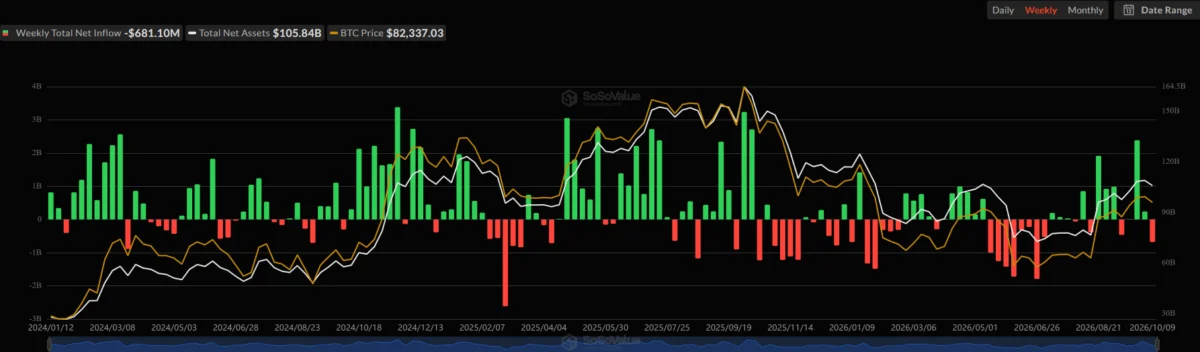
The week was characterized by a distinct lack of appetite for institutional crypto-products. Spot Bitcoin ETFs, which have served as the primary bridge for traditional capital into the ecosystem, suffered their worst performance since the final week of June. With net outflows totaling $681.10 million for the week, the cumulative net inflow for these products dipped from $57.79 billion to $57.11 billion.
Ethereum ETFs, however, have painted a more concerning picture. While the sheer volume of Bitcoin outflows appears larger in nominal terms, Ethereum has suffered a sustained, multi-week drought. The second-largest cryptocurrency has not seen a single "green day"—a day of net positive inflows—since September 28. This persistent trend of withdrawals suggests a deeper lack of institutional confidence in the current Ethereum market structure, contrasting sharply with the sporadic, albeit volatile, inflows seen in Bitcoin’s vehicle.
Chronology: A Week of Market Turbulence
The trading week commenced with immediate volatility. On Monday, Bitcoin ETFs saw a net outflow of nearly $90 million. This exodus coincided with a brutal rejection of Bitcoin’s price at the $87,000 resistance level. The correlation was immediate: as institutional investors moved to trim their exposure, the spot price of Bitcoin shed over $2,000 in value within hours.
Tuesday provided a brief, albeit misleading, glimmer of hope. Inflows turned positive, with $118.86 million pouring into the funds, allowing the underlying asset to recover some of its lost ground. However, this optimism was short-lived.
By Wednesday and Thursday, the selling intensified. Wednesday saw a staggering $487.07 million in net outflows, followed by an additional $244.13 million on Thursday. This mid-week collapse served as the catalyst for a major market nosedive, with Bitcoin dropping to a two-week low of $80,400. The correlation between the ETF outflows and the asset’s price decline underscored the degree to which these institutional products have become the primary drivers of market momentum.
Friday witnessed a modest return of capital, with $21.13 million entering the funds. While this prevented the week from being a total washout, it was insufficient to offset the damage done by the midweek sell-off.

For Ethereum, the narrative was consistently grim. Starting the week with $50.76 million in outflows, the selling pressure only accelerated. Tuesday saw $201.89 million exit, followed by $160.77 million on Wednesday. By the end of the week, total outflows for the ETH products continued to mount, with Thursday and Friday contributing an additional $72.54 million and $56.10 million, respectively.
Supporting Data: The Quantitative Impact
The data provided by platforms like SoSoValue paints a vivid picture of the current liquidity crunch. For Bitcoin, the $681.10 million in weekly outflows represents a significant deviation from the trend of sustained accumulation seen throughout the summer. The cumulative total net inflow, which acts as a proxy for the total institutional capital locked in these products, has now retreated, suggesting that "smart money" is currently in a defensive posture.
The Ethereum situation is perhaps more illustrative of a structural shift in investor sentiment. Following nine consecutive days of outflows—dating back to September 28—the cumulative net total for Ethereum ETFs has plummeted from $13.95 billion to $13.26 billion.
The price action of the underlying assets mirrors these flows. Ethereum, having struggled to maintain momentum after hitting a $2,800 ceiling, saw its support at $2,700 collapse mid-week. The resulting slide to $2,400 was a painful reminder of the asset’s sensitivity to institutional flows. While it has since managed a modest recovery to the $2,500 range, the technical damage to the chart remains significant.
Official Responses and Expert Commentary
Market analysts have pointed to a variety of factors contributing to this trend. Some attribute the outflows to profit-taking following a period of rapid appreciation, while others suggest that macroeconomic uncertainty—specifically regarding Federal Reserve interest rate policies—has led institutional allocators to pivot toward safer, high-yield traditional assets.
"The correlation between ETF flows and price action is no longer a coincidence; it is the dominant market narrative," says one lead analyst at a prominent crypto-research firm. "When institutional investors reach a point of uncertainty, they don’t just hold; they liquidate to hedge against further downside. We are seeing a classic ‘risk-off’ move in the institutional crypto-space."
While no major ETF issuers have issued formal "emergency" statements, the sentiment among hedge fund managers remains cautious. The lack of inflows into Ethereum specifically is being viewed as a potential signal that institutional investors are currently prioritizing the "digital gold" narrative of Bitcoin over the smart-contract and decentralized finance (DeFi) utility offered by Ethereum.
Implications: What Does This Mean for the Market?
The implications of these outflows are far-reaching. First, the dependency on ETF flows means that price discovery is now tethered to the sentiment of traditional financial institutions. In the past, crypto-markets were largely driven by retail speculation and leverage; today, the market is beholden to the risk-management desks of major asset managers.
Second, the "Ethereum Drought" highlights a potential crisis of confidence. If Ethereum cannot attract institutional capital even at lower price points, it may face a prolonged period of consolidation or further decline until the fundamental narrative—likely revolving around Layer-2 adoption or staking yields—realigns with market expectations.
Third, for the average investor, this volatility is a reminder that the institutionalization of crypto is a double-edged sword. While ETFs provide easy access and credibility, they also bring the volatility and liquidity constraints of traditional equity markets. The market is currently experiencing a "washout" phase, where weak hands in the institutional sector are being purged.
As we look toward the coming weeks, the critical level to watch is whether the inflow trend can flip positive. If the Bitcoin ETFs return to consistent accumulation, the $80,000 support level may hold. If, however, the outflows continue, the market may see a retest of lower support levels, potentially shaking out the remaining speculative interest that entered the market during the early Q4 surge.
Ultimately, the market is in a state of recalibration. The era of easy, uninterrupted inflows has been replaced by a more pragmatic, data-driven environment where every dollar of outflow has a tangible impact on the price. Investors would do well to observe the coming week’s flows as the definitive guide to whether this is a momentary correction or the beginning of a deeper, more protracted bear cycle for crypto-assets.