The digital marketplace landscape in Europe is undergoing a profound transformation. According to the seventh edition of the "Top 100 Cross-Border Marketplaces Europe" report, published by Cross-Border Commerce Europe (CBCommerce), the continent’s leading digital platforms are not just growing; they are fundamentally reshaping how goods move across national borders. As European consumers increasingly bypass traditional retail in favor of vast, international digital ecosystems, the dominance of cross-border commerce has become the defining trend of the decade.
The Main Facts: A Billion-Euro Paradigm Shift
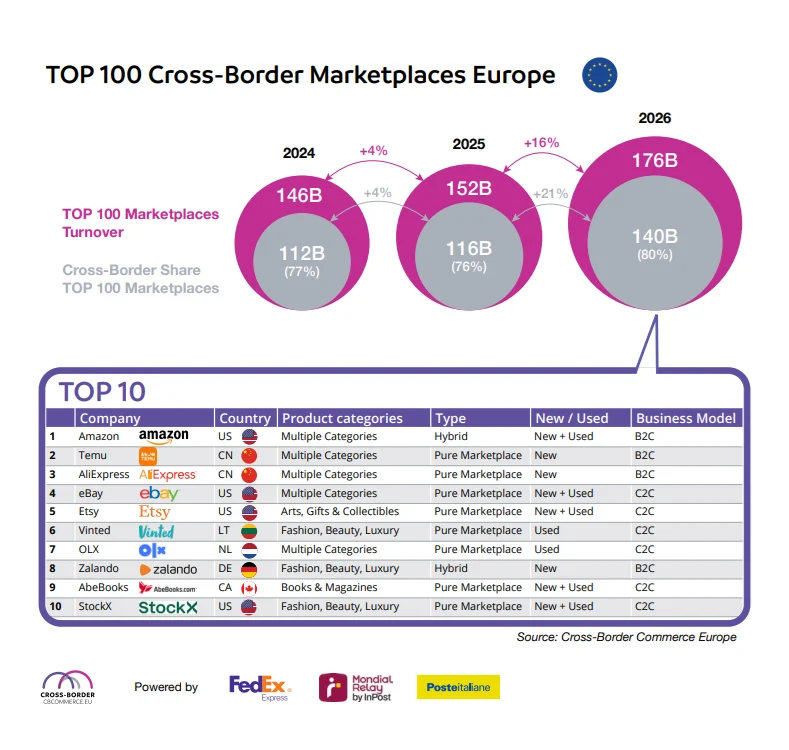
The latest data from CBCommerce paints a picture of a sector characterized by rapid expansion and international integration. The 100 largest marketplaces currently operating within Europe are projected to reach a staggering Gross Merchandise Volume (GMV) of 175.8 billion euros. Of this total, a significant 79.5 percent—roughly 139.8 billion euros—is attributed to cross-border transactions.
This reliance on international trade is not a stagnant phenomenon; it is an upward trajectory. The study indicates that by 2026, the cross-border GMV of these top 100 platforms will surge to 139.8 billion euros, capturing an even larger share of the total market volume.
The growth projections for the immediate future are equally aggressive. For 2027, researchers anticipate an 8 percent increase in the total GMV of the top 100 marketplaces, pushing the combined value to approximately 190 billion euros. More impressively, the cross-border segment is expected to outpace total growth, expanding by 10 percent to reach 154 billion euros. This will elevate the cross-border market share to 81 percent, signaling a future where the concept of a "domestic-only" marketplace becomes an increasingly rare anomaly in the European retail space.
A Chronology of Marketplace Evolution
To understand the current state of European e-commerce, one must look back at the developmental arc of the industry.
Phase I: The Emergence of Local Giants (2010–2015)
In the early 2010s, European marketplace commerce was largely fragmented. Consumers shopped primarily on domestic platforms that catered to specific linguistic and regional preferences. During this period, logistical hurdles, varying VAT regulations, and localized payment preferences acted as natural "border guards," keeping e-commerce domestic.
Phase II: The Global Aggregator Expansion (2016–2020)
The mid-2010s marked the arrival of the "global aggregator" era. Platforms like Amazon solidified their pan-European presence by investing heavily in cross-border fulfillment centers. During this window, the European Union’s Digital Single Market initiative began to harmonize consumer protections and data privacy laws, creating a more fertile ground for international expansion.
Phase III: The Rise of the New Guard (2021–Present)
We are currently in the third phase of this evolution, characterized by the meteoric rise of non-European giants. Platforms such as Temu and AliExpress have utilized aggressive pricing strategies and sophisticated AI-driven algorithms to bypass traditional retail distribution channels. This period has seen a pivot from simple "online shopping" to "social commerce," where the discovery process is increasingly driven by influencers, short-form video, and algorithmic recommendations rather than traditional search engines.
Supporting Data: The Pillars of Dominance
The CBCommerce study employs a rigorous methodology to determine the top 100, focusing on four primary metrics:
- Cross-border Sales: The total volume of goods sold to customers outside the marketplace’s country of origin.
- SEO Results: Visibility in organic search across diverse European markets.
- Geographic Coverage: The number of European countries served and the depth of local operations.
- Website Traffic: The volume and engagement of visitors across different regions.
Currently, the leaderboard is anchored by heavyweights: Amazon, Temu, and AliExpress. These companies have achieved a level of dominance that creates a "winner-take-most" environment. Their success is rooted in massive infrastructure investments—local fulfillment centers, localized logistics partnerships, and multi-language customer support teams—which effectively lower the "friction" that once prevented cross-border trade.

Official Perspectives and Industry Implications
The report, which serves as a definitive roadmap for stakeholders, highlights several critical implications for the European economy.
The AI-Driven Product Discovery Revolution
The way in which consumers interact with these marketplaces has shifted from "search-based" to "discovery-based." As the report highlights, AI-driven algorithms are now the primary gatekeepers of commerce. These tools analyze billions of data points to predict consumer needs before the consumer even searches for a product. For retailers, this means that "being found" is no longer about SEO keywords, but about feeding into the black-box logic of the marketplace’s recommendation engine.
Regulatory Complexity
While cross-border trade is booming, it is not without its challenges. The European Union has implemented a suite of new regulations—including the Digital Services Act (DSA) and the Digital Markets Act (DMA)—designed to curb the power of "gatekeeper" platforms. These regulations add a layer of complexity for marketplaces that must now navigate varying compliance requirements across 27 member states.
Industry experts note that while these regulations aim to protect consumers and ensure fair competition, they also impose high operational costs that could disadvantage smaller, emerging marketplaces, inadvertently cementing the status of the current top 100.
The Infrastructure War
Perhaps the most significant development is the shift from "digital-only" to "bricks-and-mortar-integrated" cross-border trade. International platforms are no longer content to ship from abroad. They are increasingly leasing local warehouses and partnering with regional last-mile delivery services in Europe. This move is intended to reduce delivery times—which remains the single biggest deterrent to cross-border shopping—and mitigate the risks of future supply chain disruptions.
Implications for the Future: A New Era of Competition
The growth of cross-border marketplaces presents a dual-sided reality for Europe. On one hand, it provides consumers with unprecedented variety and lower prices. On the other, it threatens the viability of local retail ecosystems that cannot compete with the economies of scale enjoyed by global giants.
The Pressure on Local Retailers
Small and medium-sized enterprises (SMEs) in Europe face a difficult choice: integrate into these global marketplaces—thereby paying commission fees and ceding control over customer data—or attempt to compete independently, which requires significant capital investment in digital infrastructure. The report suggests that the future of independent European retail may lie in "niche specialization" and "authenticity-led" branding, as broad-spectrum commodities are effectively being monopolized by the top 100 platforms.
The Sustainability Mandate
As these marketplaces grow, so too does their environmental footprint. The sheer volume of individual, cross-border shipments is under intense scrutiny. Future iterations of the CBCommerce report are expected to track not just GMV, but "Green Metrics," as the European Union pushes for stricter carbon reporting and circular economy mandates. Marketplaces that fail to adapt their logistics to be more carbon-efficient may find themselves facing both consumer backlash and legislative penalties.
Conclusion
The seventh edition of the "Top 100 Cross-Border Marketplaces Europe" report confirms that the digital marketplace is no longer a peripheral channel but the primary artery of European commerce. With a projected 154 billion euros in cross-border GMV by 2027, the trend toward international integration is irreversible.
For businesses, investors, and policymakers, the message is clear: the European marketplace is becoming a single, vast, and highly competitive arena. Success in this new era will depend on the ability to leverage AI-driven discovery, navigate complex regulatory landscapes, and build the physical infrastructure necessary to meet the demanding delivery expectations of the modern consumer. As we look toward 2027, the "borderless" nature of European e-commerce will continue to define the economic landscape, challenging existing power structures and setting the stage for a new phase of intense, algorithmically-driven competition.