In the hyper-competitive landscape of modern ecommerce, the distance between a promising product and a household brand is often measured in fractured workflows, exhausted capital, and a maze of disconnected marketing agencies. For most founders, the dream of reaching nine-figure annual sales is stifled by the operational complexity of scaling. Enter ZyG, an end-to-end growth platform that is fundamentally reimagining the mechanics of business expansion by replacing fragmented human-led teams with a sophisticated, AI-driven ecosystem.
By positioning itself not merely as a service provider but as a strategic growth partner, ZyG aims to eliminate the "growth ceiling" that prevents high-potential brands from achieving their true market capacity.
The Core Philosophy: From Manual Management to Autonomous Execution
The traditional model of scaling an ecommerce brand is inherently inefficient. Founders are typically forced to navigate a "web of complexity"—juggling disparate point tools, managing various third-party agencies, and struggling to reconcile data across platforms. This manual orchestration often leads to information silos, where the creative team, the ad buyers, and the inventory managers operate in isolation.
ZyG disrupts this paradigm by moving from "managing tools" to "delivering outcomes." Under the ZyG partnership model, the brand retains full ownership of its physical product and intellectual property. Meanwhile, ZyG assumes the heavy lifting of scaling.
At the heart of this transition is an AI-powered architecture built on a unified data infrastructure. Instead of human-managed spreadsheets, ZyG utilizes a connected system of specialized AI agents. Each agent is programmed to handle a specific node of the customer journey—from acquisition and conversion to retention—all synchronized through advanced predictive modeling. The result is a seamless, automated loop that responds to market signals in real-time, far faster than any traditional marketing team could hope to achieve.
Chronology of the ZyG Approach: A Data-First Methodology
ZyG’s entry into the market is defined by a rigorous, stage-gated process designed to mitigate risk while identifying "unicorn" potential. The methodology is broken down into three distinct phases:
1. The Discovery Phase: The ZyGnal
The process begins with the "ZyGnal," a proprietary, agentic "X-ray" of a brand’s market opportunity. By analyzing external market signals, competitor movements, and consumer search behavior, the ZyGnal strips away vanity metrics to reveal the true, untapped potential of a brand’s niche.
2. The Validation Phase: The Marketability Test
Once the AI identifies high-potential prospects, the process moves to the Marketability Test. ZyG selects 500 brands that show exceptional promise in the ZyGnal phase. To prove their commitment, ZyG invests $10,000 of its own capital into ad buying across various platforms. This is not a theoretical exercise; it is a live-fire test involving real customers, actual creative assets, and performance-based data.
3. The Partnership Phase: The ZyG Scale Partnership
For brands that pass the Marketability Test with flying colors, the relationship enters the final stage: the ZyG Scale Partnership. Here, ZyG provides the capital necessary for customer acquisition, effectively removing the primary barrier to growth for most small-to-medium enterprises. By aligning their capital with their AI-driven execution, ZyG creates a "growth engine" that functions as an extension of the brand itself.
The Mechanics of the ZyG Score
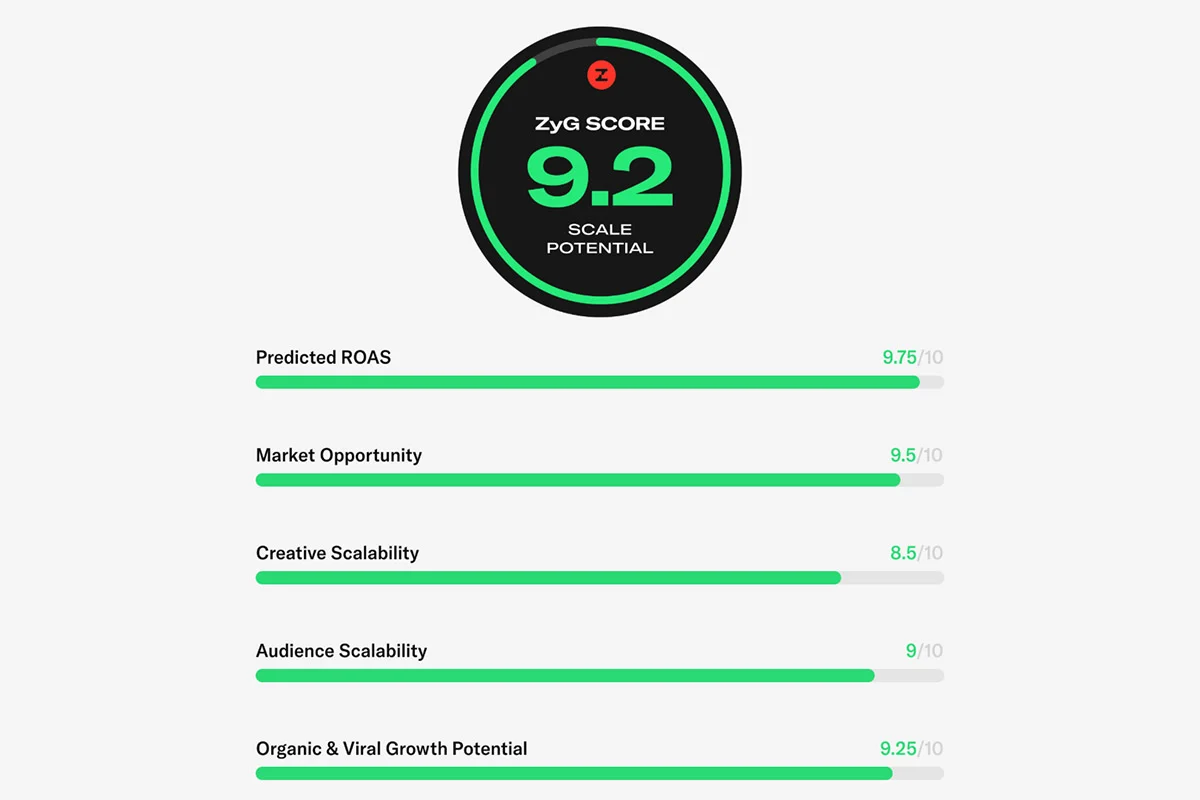
The "ZyG Score" is the cornerstone of the company’s analytical rigor. It is not merely a ranking system; it is a diagnostic tool designed to predict whether a consumer brand has the intrinsic potential to hit the $100 million annual sales mark.
The score is derived from the synthesis of the ZyGnal and the Marketability Test. By merging external market data with internal performance data from the $10,000 test spend, ZyG creates a high-fidelity model of a brand’s future trajectory.
"We’re on a quest to find the brands that can truly break the internet," says Omer Kaplan, CEO and Co-Founder of ZyG. "But there’s enormous value for brands along the way. The ZyGnal gives them a level of intelligence about their market, competition, and opportunity that they simply can’t get anywhere else. And for the 500 brands that show the strongest ZyG Score, we will invest $10,000 of our own capital into a Marketability Test to see how that opportunity holds up with real customers."
This creates a unique value proposition: even for brands that do not ultimately move to the full partnership phase, the diagnostic data provided by the ZyGnal offers actionable insights that can be used to refine their independent business strategies.
Implications: A New Era for Direct-to-Consumer Brands
The implications of ZyG’s business model are profound, signaling a shift toward "autonomous commerce."
Eliminating the Capital Constraint
One of the most significant hurdles for ecommerce brands is the "cash-to-conversion" gap. Even if a brand has a high-converting ad campaign, the delay between paying for ads and receiving customer revenue can kill growth. By providing the financing for customer acquisition, ZyG effectively solves the liquidity crisis that frequently plagues scaling brands.
The Death of the "Generalist" Agency
ZyG’s end-to-end platform threatens the traditional agency model. For years, brands have hired separate agencies for creative, SEO, and paid social. These agencies rarely talk to one another, leading to inconsistent brand messaging and diluted data. By unifying these functions under a single AI-orchestrated platform, ZyG provides a level of cohesion that human-run agencies struggle to replicate.
Predictive vs. Reactive Marketing
Most ecommerce brands operate reactively, looking at last month’s ROAS (Return on Ad Spend) to make decisions for next month. ZyG’s predictive modeling shifts this to a forward-looking approach. By anticipating market shifts and adjusting agent behavior in real-time, ZyG aims to make brands "future-proof."
Supporting Data and Market Context
The current ecommerce environment is fraught with volatility. With the rising costs of customer acquisition (CAC) and the constant changes in platform algorithms (Meta, Google, TikTok), brands are finding it harder than ever to achieve sustainable profitability.
Data suggests that the "breakout" brands of the next decade will not be the ones with the largest ad budgets, but the ones with the most efficient data infrastructures. ZyG’s focus on the "unified data infrastructure" is a direct response to the fragmentation caused by privacy changes (such as the deprecation of third-party cookies). By relying on their own proprietary agentic data collection, ZyG bypasses many of the tracking hurdles that have hindered traditional advertisers over the last three years.
Furthermore, the $10,000 investment per brand for 500 brands represents a massive $5 million commitment to R&D and market testing. This level of investment signals that ZyG is not just building a software company, but an asset-allocation firm that treats brands as high-growth equity.
The Human-AI Symbiosis: An Official Perspective
Despite the heavy reliance on AI agents, ZyG maintains that the human element of brand identity remains paramount. Their model is not intended to replace the creative spirit of a founder, but rather to provide the operational chassis upon which that creativity can scale.
"The objective is not to give brands another set of tools or dashboards to manage themselves," explains Kaplan. "It is to deliver ecommerce scale as an outcome."
This distinction is vital. Founders are often exhausted by the "dashboard fatigue" associated with managing Shopify, Meta Ads Manager, Google Analytics, and inventory software. By taking these dashboards off the founder’s plate and replacing them with a single, autonomous outcome, ZyG allows entrepreneurs to return to what they do best: product development, brand storytelling, and visionary leadership.
Conclusion: The Road Ahead
As ZyG continues to roll out its partnership model, the ecommerce sector will be watching closely. If the company can consistently turn "promising products" into "scaled consumer brands" through its proprietary ZyG Score and autonomous execution, it will likely force a industry-wide reckoning.
The traditional path to scale—hiring, firing, agency-hopping, and constant fundraising—is becoming obsolete. In its place, ZyG is building a future where growth is a mathematical certainty, backed by capital, driven by data, and executed by agents that never sleep.
For the modern entrepreneur, the question is no longer whether they can scale, but whether their brand has the "ZyG Score" to merit the partnership. By commoditizing the complex infrastructure of ecommerce, ZyG is effectively clearing the path for the next generation of internet-breaking brands to reach their full potential.