In the intricate machinery of the United States government, Congress serves as the primary engine of national policy. Beyond its foundational duty to pass legislation, the legislative branch is tasked with the vital responsibilities of constituent advocacy, the confirmation of presidential appointments, and the rigorous oversight of the executive branch. However, as the clock ticks toward the end of the 119th Congress, a sobering reality has emerged: the legislative output of the American government has hit historic lows, marking a trend of diminished productivity that has persisted for nearly four decades.
According to a comprehensive analysis by the Pew Research Center, the 119th Congress, which convened in January 2025, has enacted only 121 laws as of mid-October 2026. This figure places it as the second-least productive legislative session in the past forty years, trailing only the 118th Congress, which had managed to pass a mere 106 laws by the same point in its two-year tenure. This ongoing decline in output raises fundamental questions about the functionality of modern American governance and the changing nature of legislative work in a hyper-polarized political environment.
The Metrics of Output: Defining Substantive vs. Ceremonial
To understand the depth of this decline, it is essential to distinguish between the types of laws being passed. Pew Research Center’s methodology separates public laws—those of general applicability—into two distinct categories: "ceremonial" and "substantive."
Ceremonial laws, while technically part of the public record, generally lack broad policy implications. These include measures to rename federal buildings, authorize the minting of commemorative coins, grant Congressional Gold Medals, or allow for the construction of memorials on federal land. In past decades, such legislation was a routine, non-controversial component of the congressional calendar. However, the current Congress has seen a sharp drop in even these minor legislative acts, with only 12 ceremonial laws enacted thus far.
The more significant metric, however, is the output of substantive laws. These are the measures that carry real-world weight: they allocate federal funding, alter or establish permanent statutes, direct the actions of government agencies, or manage federal land. Currently, the 119th Congress has produced 109 substantive laws. While this is slightly higher than the 84 substantive laws produced by the 118th Congress at the same point in its cycle, it remains the second-lowest tally in forty years.
A Chronological Shift: From High-Volume Legislating to Gridlock
The current state of legislative output stands in stark contrast to the late 20th century. During the era of the 100th Congress (1987-1989) through the 110th Congress (2007-2009), the legislative branch maintained a robust, consistent pace. On average, these sessions enacted 440 laws per term before the November elections, with an average of 306 of those being substantive in nature.
By comparison, the average output of modern Congresses since 2011 has plummeted to roughly half of that historic volume. This decline was not sudden; it has been a gradual, grinding process marked by increased partisanship, narrower majorities, and a fundamental shift in how the chambers approach their constitutional duties.
The Impact of "Lame-Duck" Sessions
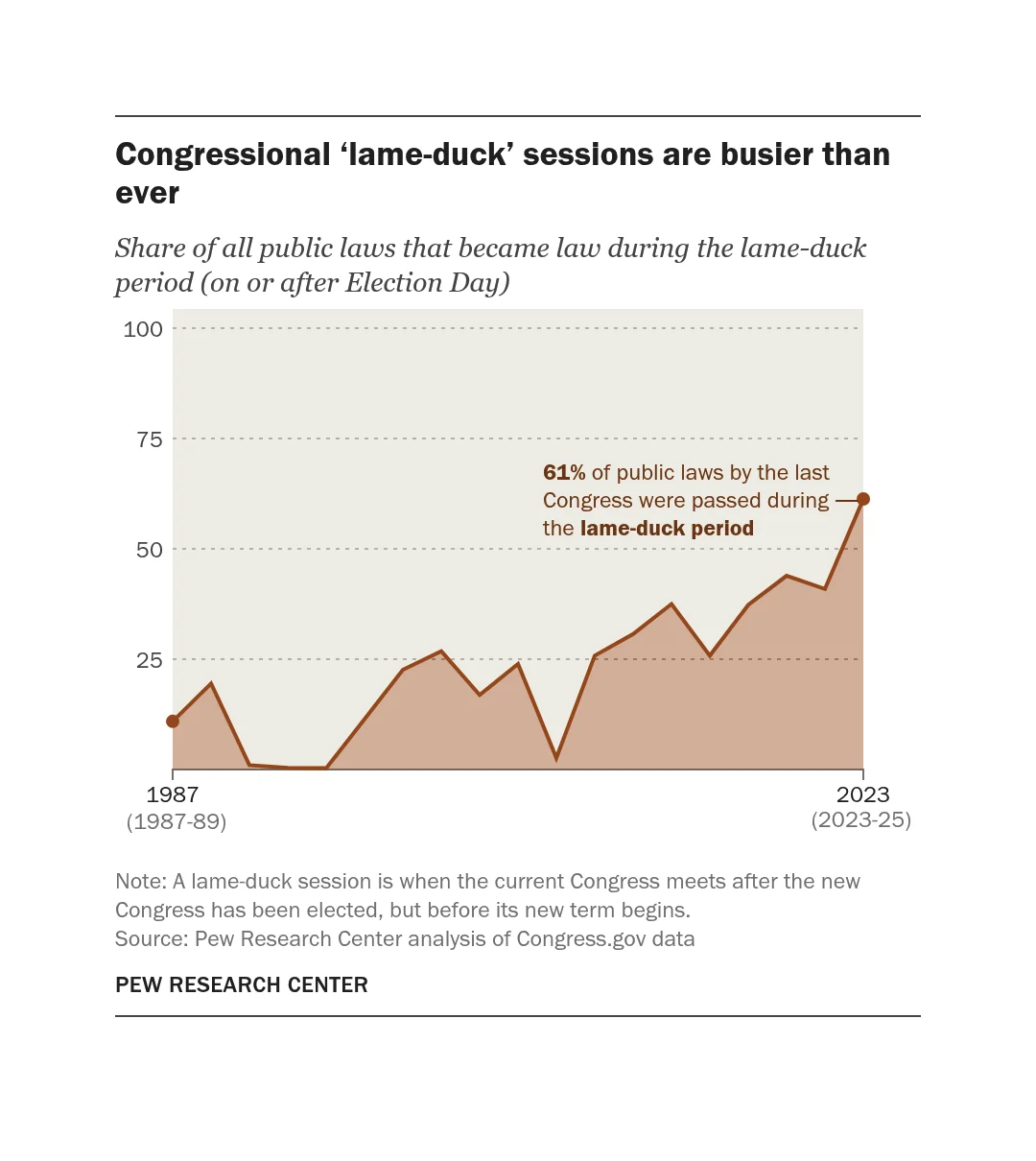
One of the most profound changes in congressional operations is the increasing reliance on "lame-duck" sessions—the period after the general election but before the new Congress is sworn in. Historically, these sessions were rare or limited in scope. In the 100th Congress, for instance, only 11% of its total legislative output occurred after Election Day.
As political tensions intensified, particularly starting in the 2010s, this dynamic shifted dramatically. The 113th Congress saw 38% of its laws passed after the election, and by the time the 118th Congress concluded its work, a staggering 61% of its total laws were enacted during the lame-duck period. This trend suggests that the "regular order" of legislating—committee markups, open debate, and floor votes—has been increasingly bypassed in favor of massive, end-of-session packages negotiated behind closed doors.
Notable Legislative Action in the 119th Congress
Despite the overall low volume of legislation, the 119th Congress has not been entirely devoid of significant action. The most notable achievement of this term remains the legislative package colloquially dubbed "The One Big Beautiful Bill," which was signed into law in July 2025. This massive piece of legislation addressed a complex web of tax adjustments and federal spending priorities, serving as the primary anchor for the current Congress’s domestic agenda.
Furthermore, a significant portion of the legislative energy has been directed toward the reversal of previous policies. The 119th Congress has utilized the Congressional Review Act to overturn 23 separate Biden-era regulations, alongside a specific measure to void a local law in Washington, D.C. Combined, these reversal actions account for 20% of all laws passed by the current session. This suggests a legislative body that is increasingly focused on undoing existing regulatory frameworks rather than constructing new ones.
The Implications for Governance and Democracy
The persistent decline in congressional productivity has profound implications for the American democratic process. When the legislative branch fails to pass laws at a rate commensurate with the needs of a growing, complex society, the void is often filled by the executive branch. Through the use of executive orders and agency-driven rulemaking, the President exerts influence over policy areas that were traditionally the domain of Congress.
This shift contributes to the "imperial presidency" narrative, where voters look to the White House to solve problems that the legislative branch is structurally or politically unable to address. The reliance on lame-duck sessions further exacerbates this; it prioritizes the decisions of lawmakers who have already been rejected or retired by their constituents, potentially undermining the democratic accountability of the legislative process.
Furthermore, the data suggests that the "ceremonial" work of Congress has largely evaporated. While minor in terms of policy impact, these types of laws—honoring community heroes or recognizing significant national events—historically served as a way for members of opposing parties to collaborate on non-contentious issues. The cessation of these activities points to a deepening tribalism where even symbolic bipartisanship is viewed with suspicion.
What Lies Ahead: The Final Sprint
As the 119th Congress enters its final months, eyes are turning toward the upcoming post-midterm session. There is speculation among political analysts that the total number of enacted laws could rise considerably if party leadership opts to push through a series of "must-pass" items, such as funding bills or expiring authorizations, during the lame-duck period.
However, relying on these end-of-year sprints is a suboptimal way to govern. It creates "legislative cliffhangers," where complex, multi-billion-dollar bills are rushed through with minimal public debate, often resulting in unintended consequences and a lack of transparency that erodes public trust in the institution.
Conclusion: A Structural Warning
The decline in congressional productivity is not merely a statistical curiosity; it is a diagnostic indicator of a political system under strain. When a branch of government designed to be the primary engine of the state consistently produces fewer outputs than it did four decades ago, it is a sign that the incentives for compromise and the mechanisms for consensus-building are broken.
The 119th Congress stands as a testament to this era of legislative paralysis. Whether the trend will reverse in future sessions remains to be seen, but as it stands, the data provided by the Pew Research Center paints a stark picture: the legislative branch is currently in a state of historical, and perhaps structural, dormancy. For those who believe in the necessity of a functioning, deliberative Congress, the path forward requires not just a change in leadership or party control, but a fundamental reassessment of how the legislative process itself is utilized to serve the American people.