At first glance, the landscape of public opinion research appears to be crumbling. For decades, the polling industry acted as the pulse of the nation—a reliable mechanism for understanding what citizens think, feel, and fear. Today, however, that pulse is being distorted by a perfect storm of technological disruption, bad-faith actors, and the rise of synthetic data.
As artificial intelligence (AI) evolves, some market researchers have begun bypassing the human element entirely, turning to "silicon sampling"—a practice where AI models are prompted to simulate human opinions. Simultaneously, the proliferation of "opt-in" online polls has created a playground for digital fraud, where bot farms and bad actors manipulate data for profit or political influence.
In this era of uncertainty, discerning which data points reflect reality and which are digital mirages has become a critical challenge for journalists, policymakers, and the public alike. To navigate this shifting terrain, we sat down with Courtney Kennedy, Vice President of Methods and Innovation at Pew Research Center, to deconstruct the current state of polling and the existential questions facing the industry.
The Rise of Silicon Sampling: Replacing Humans with Algorithms
The most provocative trend in current research is "silicon sampling." Rather than commissioning expensive, time-consuming surveys of thousands of real Americans, some firms are feeding AI models vast datasets and asking them to predict how specific demographics would respond to complex policy questions.
The Scientific Verdict on AI Simulations
While the speed of AI is undeniably attractive, the scientific community remains deeply skeptical. Researchers at various institutions have conducted experiments to test whether AI can act as a reliable surrogate for human opinion. The results have been consistently concerning.
Studies suggest that AI models, trained on broad swaths of internet data, frequently fall into the trap of stereotyping. When asked to simulate a specific demographic, the models often amplify caricatures rather than reflecting the nuanced, heterogeneous nature of real human thought. Furthermore, research indicates that these models struggle with partisan balance, often showing a "liberal bias" in their simulations, which makes them unreliable for measuring the true spectrum of Republican or conservative viewpoints. Perhaps most alarmingly, AI tends to "smooth over" the complexities of public debate, understating the level of disagreement and polarization that actually exists in society.
The Philosophical Core of Polling
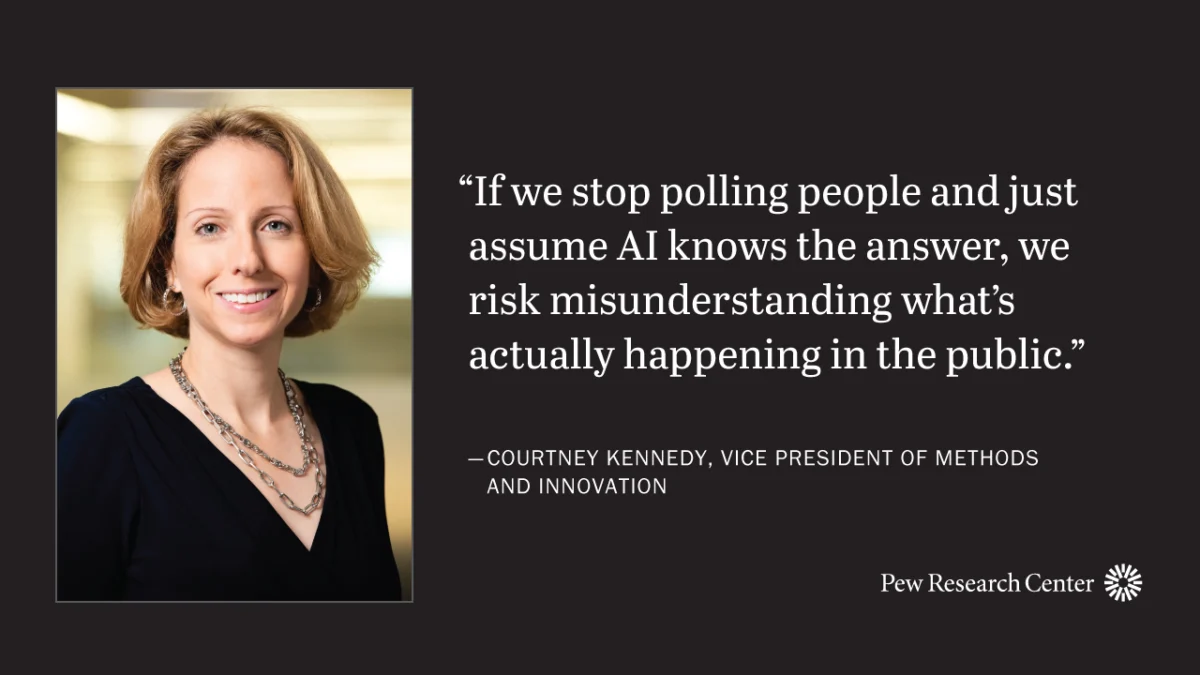
For institutions like the Pew Research Center, the rejection of silicon sampling is not just a scientific choice; it is a moral one. "Polling is fundamentally about humans—what they are thinking and experiencing," Kennedy explains. "Polls give the public a voice in politics and business. They let leaders know what hardships people are experiencing. If we stop polling people and just assume AI knows the answer, we risk losing the reality of the public experience."
Chronology of a Digital Threat: From Opt-In Panels to Bot Farms
To understand why the industry is currently under siege, one must look at the evolution of survey methodologies over the last two decades.
- Pre-2010s: The "Gold Standard" of polling was almost exclusively telephone-based, relying on Random Digit Dialing (RDD). This method ensured that every household had a statistical chance of being included.
- 2010–2020: As phone response rates plummeted due to caller ID and the rise of mobile-only households, the industry pivoted toward "opt-in" online panels. While cost-effective, this created an environment where anyone with an internet connection could theoretically participate.
- 2020–2025: The "Bad Actor" era began. As rewards for survey completion became more common, organized fraud rings realized they could use AI and script-based bots to complete thousands of surveys daily.
- 2026–Present: We have entered the era of AI-generated public opinion, where the threat is no longer just "faking" a survey, but replacing the human voice with a synthetic, algorithmic approximation.
The Fraudulent Economy: Why Opt-In Polls are Vulnerable
The distinction between "probability-based" sampling and "opt-in" polling is the primary fault line in the industry today.

The Economics of Fraud
Opt-in surveys operate on a model of open enrollment. A user clicks an ad, creates an account, and is paid a small fee for their time. This architecture is a magnet for fraud. If a bad actor can deploy a fleet of AI bots to complete 200 surveys a day at $1 per survey, they can generate a monthly income of $30,000.
In contrast, probability-based sampling—used by legacy institutions—is immune to this type of scale-based fraud. In these panels, participants are not "volunteers"; they are selected via random address-based sampling. They cannot self-enroll. Because they are limited to a specific number of surveys per month, the financial incentive for a bot to "infiltrate" the panel is effectively zero. A cheater might make $22 a month—hardly a motivation for a sophisticated criminal operation.
The "Bogus Respondent" Phenomenon
Beyond AI bots, the industry is plagued by "bogus respondents"—human survey-takers who ignore the questions to collect rewards as quickly as possible. These respondents often provide positive, agreeable answers, leading to distorted data. This has already caused significant real-world damage, forcing news organizations to retract stories based on faulty opt-in polling, such as claims about fringe beliefs or behaviors that, upon rigorous investigation, proved to be statistical noise caused by bad-faith actors.
Implications for Democracy and Data Trust
If the industry continues to move toward cheap, AI-driven, or opt-in methods, the implications for democracy are profound.
The Erosion of Truth
Public opinion data serves as a feedback loop for democracy. When that feedback loop is poisoned by bots, or when it is simulated by AI models that merely reflect the biases of their training data, the loop breaks. Policymakers risk designing laws based on "synthetic" public opinion rather than the actual struggles of their constituents.
The Cost of Quality
The primary reason for the shift toward inferior polling methods is cost. Rigorous, probability-based polling is expensive. It requires traditional mailers, random selection, and multi-mode contact strategies (web and phone) to ensure a representative sample.
"We recruit people offline, in real life, via letters mailed to home addresses," says Kennedy. "We use random sampling so that nearly all U.S. adults have a chance of being selected. All those efforts to be rigorous cost money."
Conclusion: How to Spot a Trustworthy Poll
In an environment where headlines are increasingly based on questionable data, consumers of news should apply a "skeptic’s lens" to the polls they encounter.
- Check the Recruitment Method: Was the sample randomly selected, or was it an opt-in panel where anyone could sign up?
- Evaluate the Transparency: Does the pollster disclose their methodology? Reputable organizations provide full details on how they contacted respondents and how they weighted the final data.
- Beware of "Too-Fast" Data: If a major public opinion shift is reported overnight based on a massive, low-cost online sample, treat it with extreme caution.
- Look for Consistency: Does the finding align with established longitudinal research, or is it an outlier that relies on the "wisdom" of an algorithm?
Ultimately, the polling industry stands at a crossroads. While AI and rapid-fire online surveys offer the allure of efficiency, they threaten to replace the messy, complicated, and essential truth of the human experience with a sanitized, algorithmic fiction. For those who value a functioning democracy, the lesson is clear: there is no shortcut to understanding the public mind. It requires the slow, deliberate, and costly work of talking to real people.