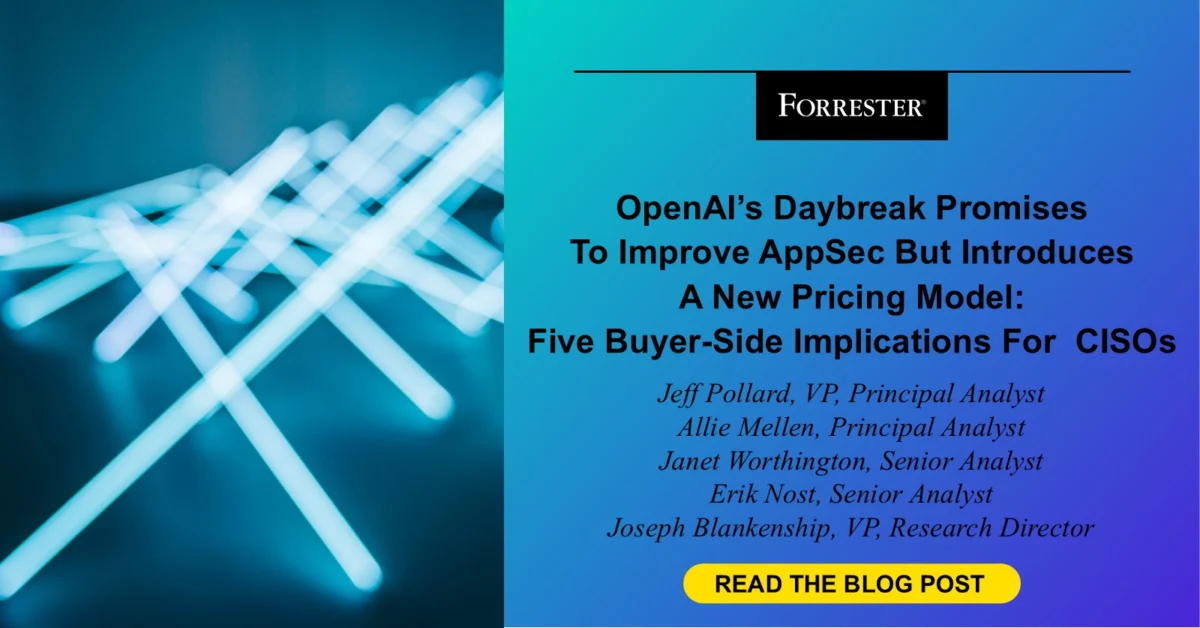
The cybersecurity landscape is undergoing a fundamental structural shift. OpenAI’s recent unveiling of Daybreak, a framework designed to supercharge agentic application security, has sent ripples through the industry. While the technical promise of "agentic" security—where AI models autonomously identify, validate, and remediate vulnerabilities—is profound, the financial implications are even more significant. For CISOs and CIOs, Daybreak represents not a reduction in costs, but a new, volatile era of "token-based inflation" that demands an immediate re-evaluation of cybersecurity budgets.
The Paradigm Shift: From Fixed Costs to Token Consumption
For decades, application security (AppSec) has operated on predictable, asset-based, or per-developer licensing models. Whether a firm uses Snyk, Veracode, Checkmarx, or GitHub Advanced Security, the costs have been relatively static and forecastable. Daybreak shatters this stability by tethering security efficacy to token consumption.
In the Daybreak model, security is treated as a computational task. Multiagent workflows—where specialized AI agents handle threat modeling, sandbox validation, and patch generation—are notoriously "token-hungry." A single comprehensive scan across a large-scale enterprise repository could consume millions of tokens in a matter of hours. When multiplied across a Fortune 500’s entire application portfolio, the economics of AI-driven security quickly eclipse the costs of traditional vendor contracts.
The Myth of Disruption
Despite the marketing noise surrounding Daybreak, it is not a "rip-and-replace" solution for existing AppSec tools. Industry analysis suggests that for the next 12 to 24 months, Daybreak will serve as an additive layer rather than a replacement. Incumbent vendors provide deterministic, efficient scanning that conserves tokens, allowing AI models to focus on the high-level, complex reasoning tasks for which they are best suited. Organizations that abandon their existing security stacks in favor of pure AI workflows will likely find their budgets depleted before the quarter ends.
Chronology of the Agentic Security Arms Race
The emergence of Daybreak follows a rapid acceleration in frontier AI capabilities, marked by several critical milestones:
- Early 2025: The industry begins to experiment with "agentic" workflows, moving beyond simple chatbots to autonomous code-analysis agents.
- May 2026: Anthropic announces "Glasswing," a strategic pivot toward secure AI, signaling a shift in the market toward responsible, enterprise-grade AI security.
- Q3 2026: OpenAI launches Daybreak, creating a multi-vendor ecosystem that integrates with major security platforms like CrowdStrike, Tenable, and Palo Alto Networks.
- Late 2026: Leading financial institutions, including JPMorganChase and Goldman Sachs, begin pilot deployments of AI-augmented threat modeling, setting the precedent for data residency and audit standards.
- 2027 Outlook: The industry transitions from FDE-led (Forward-Deployed Engineer) pilots to system-integrator-led production deployments, with consultancies like McKinsey and Deloitte taking the lead on scaling.
Supporting Data: The Economics of "Tokenomics"
The cost structure of Daybreak is intentionally opaque, relying on private sales motions rather than transparent pricing pages. However, we can extrapolate costs from the GPT-5.5 model architecture. With GPT-5.5 Standard priced at $5 per million input tokens and $30 per million output tokens, and specialized "Cyber" models likely commanding a significant premium, the fiscal impact is non-trivial.
Drawing comparisons to Anthropic’s Mythos Preview—priced at $25/input and $125/output—it becomes clear that enterprise-grade security agents are expensive. According to a 2026 Deloitte report on AI tokenomics, even when tasks are 90% more efficient, total consumption often triples due to the sheer volume of "looping" and "sub-agent" calls. For a CISO, this means that security budgets must now account for:
- Fixed Costs: Existing vendor licensing (Snyk, Veracode, etc.).
- Variable Costs: OpenAI/Anthropic token consumption.
- Deployment Costs: Fees for FDEs (Forward-Deployed Engineers) to manage the integration.
Official Responses and Ecosystem Integration
OpenAI’s strategy for Daybreak is explicitly collaborative. The partner list reads like a "who’s who" of the cybersecurity industry: Akamai, Cisco, Cloudflare, CrowdStrike, Fortinet, Intel, Netskope, Okta, Oracle, Palo Alto Networks, Qualys, Rapid7, Semgrep, SentinelOne, Snyk, Socket, SpecterOps, Tenable, Trail of Bits, and Zscaler.
By positioning itself as the "intelligence layer" atop these systems of record, OpenAI avoids the need to build a comprehensive security dashboard from scratch. Instead, Daybreak outputs evidence directly into the platforms CISOs already trust. This is a critical distinction: Daybreak is an attach-rate product, not a standalone destination.
Strategic Implications: What CISOs and CIOs Must Do
The arrival of Daybreak necessitates a shift in how cybersecurity is managed, governed, and budgeted.
1. Rebuild the Budgeting Model
CISOs must move away from static annual budgeting. You now require token budgets, which include:
- Model Routing Rules: Ensuring low-complexity tasks stay on cheaper, smaller models while only the most complex threats use the expensive GPT-5.5-Cyber.
- Loop Limits: Hard stops on agentic processes to prevent "runaway" token consumption during infinite loops or complex recursion.
- Per-Team Attribution: Charging security token costs back to the specific development teams triggering the scans, enforcing accountability.
2. Treat Daybreak as an "Attach" to Existing Stacks
Do not attempt to replace your current AppSec suite. Instead, view Daybreak as an intelligence layer that enhances the efficacy of your existing tools. Use your incumbent scanners to perform the "heavy lifting"—the deterministic code analysis—and route the findings to Daybreak for sophisticated triage, context-aware threat modeling, and remediation drafting.
3. Prepare for the "FDE Gap"
There is a massive scarcity of engineers capable of deploying these systems. OpenAI’s acquisition of Tomoro to form the "OpenAI Deployment Company" and Anthropic’s joint venture with financial heavyweights highlight the bottleneck. Expect a 12-to-18-month lead time for production-scale deployment. In the interim, engage with System Integrators (SIs) like Accenture or Capgemini early. Do not wait for a "productized" version of Daybreak; secure the talent and the consulting partnerships required to manage the rollout now.
Conclusion: The New Standard of Cybersecurity
Daybreak does not lower the cost of cybersecurity; it raises the standard of what constitutes a "secure" application and then charges a premium to meet that bar. The organizations currently piloting these tools—the global banks and financial giants—have deep pockets and unique compliance requirements that make "tokenomics" a secondary concern to risk mitigation.
However, for the broader enterprise, the next two years will be defined by the friction between the promise of autonomous security and the reality of mounting costs. Those who approach Daybreak with a disciplined, governance-first strategy will be able to harness the power of AI without falling victim to the inevitable inflation of the token-based economy. The goal for 2027 is clear: manage the AI as a utility, not a magic bullet, and ensure that your legacy security investments remain the bedrock upon which this new, expensive intelligence is built.