
As the race to achieve technological supremacy accelerates, the global landscape of artificial intelligence is increasingly being defined by a high-stakes rivalry between the United States and China. A comprehensive new survey from the Pew Research Center, conducted in June 2026, reveals that the American public is deeply skeptical of the U.S. position in this contest. By a three-to-one margin, U.S. adults are more likely to believe that China—not the United States—is currently leading the charge in AI development.
This sentiment, which reflects a growing anxiety regarding the nation’s competitive edge, arrives at a time when AI is no longer a peripheral concern of Silicon Valley but a central pillar of national security and economic policy. With 36% of Americans viewing China as the frontrunner compared to only 12% who credit the U.S. with the lead, the data suggests a significant disconnect between official government narratives and the perception of the average citizen.
The State of Play: Public Perception vs. Technological Reality
The survey of 3,488 U.S. adults highlights a profound sense of uncertainty, with 33% of respondents admitting they are unsure which nation holds the mantle of AI leadership. This ambiguity is not merely a reflection of a lack of interest; rather, it underscores the opacity of a field that evolves at a breakneck pace.
The data reveals sharp demographic fissures. While 18% of men believe the U.S. is the current leader, only 7% of women share this view. Furthermore, political affiliation plays a role in how Americans perceive the balance of power. While Republicans and those who lean toward the GOP are more likely to express confidence in American dominance, Democrats and those who lean toward the Democratic Party are significantly more likely to believe that China has already surpassed the U.S.

Interestingly, the use of AI tools—such as chatbots and generative AI platforms—correlates with a more optimistic view of American standing. Those who actively engage with AI chatbots are more likely (16%) to believe the U.S. is in the lead compared to those who do not use such technologies (9%). This suggests that familiarity with the current state of AI may bolster a sense of confidence, whereas those who remain detached from the technology are more prone to doubt the nation’s competitive capabilities.
A Chronology of Escalation: The Road to the 2026 AI Rivalry
The current atmosphere of competition did not materialize overnight. To understand why public opinion has shifted so dramatically, one must look at the recent history of the AI arms race:
- 2023–2024: The "Generative Boom" triggered a global scramble for compute power and talent. As AI models became more sophisticated, both the Biden administration and Chinese leadership began framing AI as the "new space race."
- Early 2025: Tensions mounted as the U.S. implemented more stringent export controls on high-end semiconductors, specifically targeting the hardware necessary to train large-scale neural networks.
- Mid-2025: The United Nations and other international bodies began raising alarms about the "AI divide," noting that the concentration of capital and hardware in just two nations was leaving the Global South behind.
- January 2026: Political rhetoric intensified. President Donald Trump and other high-level officials began emphasizing "global dominance" as a mandatory policy goal, framing AI as an existential necessity for national security.
- June 2026: The Pew Research Center conducted its latest survey, capturing a snapshot of a public that is increasingly wary of the geopolitical implications of this technological acceleration.
Supporting Data: The Weight of National Importance
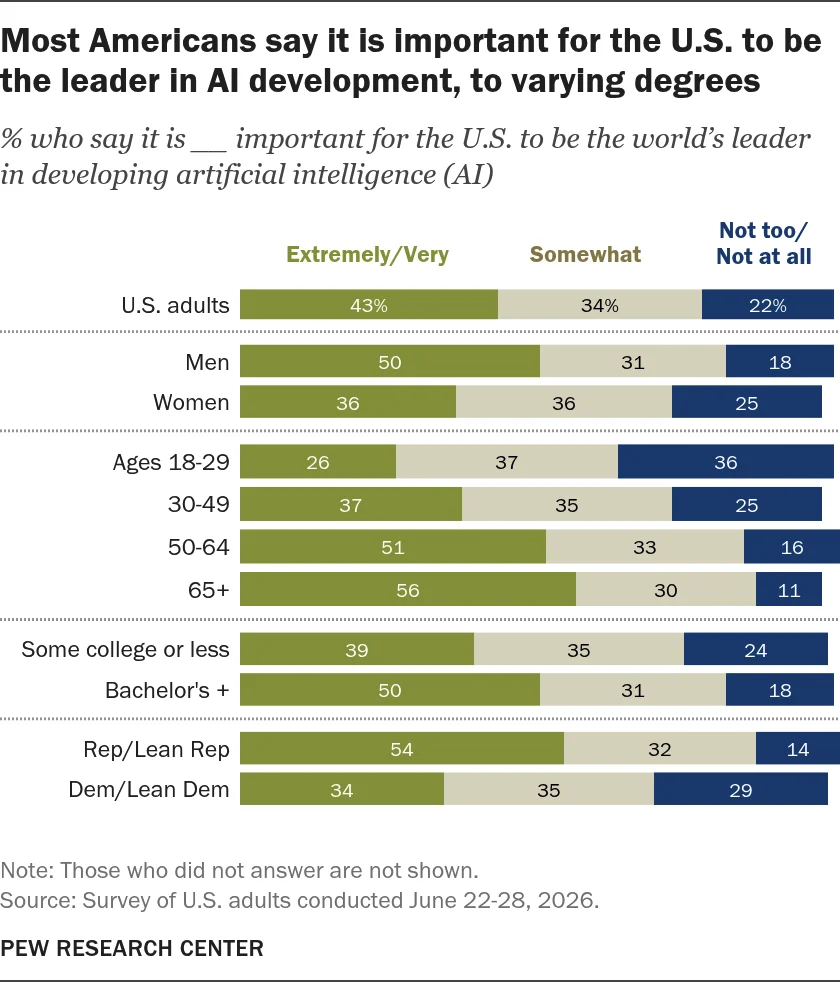
While the public may be pessimistic about the current lead, they are nearly unified in their belief that the U.S. should be leading. Approximately 43% of Americans view it as "extremely or very important" for the U.S. to be the world leader in AI.
The demographics of this urgency are telling. Older Americans are the most vocal proponents of American dominance, with 56% of those aged 65 and older asserting that U.S. leadership is vital. This contrasts sharply with the 18- to 29-year-old cohort, where only 26% feel the same level of urgency. This generational gap may suggest that older generations view AI leadership through the traditional lens of Cold War-style geopolitical stability, while younger, more "digital native" generations may be more focused on the socio-economic impacts of AI rather than the nationalist competition between states.

Educational attainment also serves as a divider. Half of all college-educated Americans believe that U.S. leadership in AI is critical, compared to just 39% of those with less education. This indicates that those with higher levels of professional involvement in the knowledge economy are more acutely aware of how the loss of such leadership could impact the future of American economic competitiveness.
Official Responses and the Rhetoric of Dominance
The political establishment in Washington has responded to these anxieties with a dual-pronged approach of "must-win" rhetoric and defensive regulation.
President Donald Trump has been unequivocal in his stance, asserting that the U.S. "must have the most powerful AI systems in the world." This sentiment is shared across the aisle in terms of the urgency of the threat, if not the strategy. Former President Joe Biden’s administration previously emphasized a "containment" approach, focusing on keeping advanced chips and intellectual property away from adversaries to prevent them from utilizing AI for cyber warfare or military expansion.
These policy maneuvers are designed to address the very fears captured in the survey—that a loss of technological superiority equates to a loss of sovereignty. However, the survey suggests that the public is not entirely convinced that the U.S. is winning this defensive game.

Global Implications: The Growing Inequality Gap
Perhaps the most sobering finding in the 2026 report is the public’s perception of the broader global impact of AI. A majority of Americans (51%) believe that the development of AI will exacerbate the gap between rich and poor countries.
This view is shared across different demographics, though it is particularly pronounced among those with higher levels of education (62% of college graduates believe the gap will widen). This suggests a growing awareness that the benefits of AI—increased productivity, automation, and data control—are likely to accrue to the nations that already possess the infrastructure, while less developed economies may struggle to keep pace.
The "digital divide" is evolving into an "intelligence divide." As AI becomes the engine of global GDP growth, nations without access to the latest models or the power to train them risk being relegated to a secondary status. The 25% of the public who remain "not sure" about these effects highlight a significant opportunity for policymakers to engage in a more nuanced discussion about the international governance of these technologies.
Conclusion: The Path Forward
The Pew Research Center’s findings serve as a barometer for a nation at a crossroads. While the American public remains uncertain about who is currently winning the AI race, they are clear about the stakes. The belief that the U.S. should be the leader, coupled with the fear that AI will deepen global inequality, creates a complex mandate for policymakers.

Moving forward, the challenge for the U.S. is twofold: first, to translate the national goal of AI leadership into tangible, sustainable, and ethical technological development that resonates with a public that currently lacks confidence in the status quo. Second, it requires a more robust international dialogue. If a majority of Americans already anticipate that AI will worsen global inequality, it is incumbent upon leaders to ensure that the development of these systems does not lead to a world defined by the same divisions they so clearly foresee.
The global AI race is not merely a technical challenge or a matter of military capacity; it is a profound social experiment that the American people are watching with deep concern. Whether that concern leads to a renewed period of American innovation or a defensive retreat into protectionism remains the central question of the coming decade.