In the heart of India’s rural landscapes, a quiet revolution is transforming the way the country approaches both waste management and affordable housing. For decades, the post-harvest season has been synonymous with a thick, suffocating haze, as farmers—faced with the logistical challenge of disposing of millions of tons of agricultural residue—resort to the traditional, albeit environmentally disastrous, practice of stubble burning. Simultaneously, the nation grapples with a growing mountain of non-recyclable plastic waste.
However, researchers at the Indian Institute of Technology (IIT) Jodhpur have unveiled a breakthrough that turns these twin ecological burdens into a robust solution: the production of "Bio Bricks" and "Agro-Plastic Blocks." By repurposing rice straw, wheat straw, sugarcane bagasse, and non-recyclable plastics, this innovation promises to reshape the construction industry, offering a pathway toward cheaper, climate-resilient, and eco-friendly rural infrastructure.
The Genesis of the Innovation: A Dual-Purpose Solution
The technology, recently highlighted by the Times of India, marks a significant departure from conventional masonry. Traditional brick manufacturing is a carbon-intensive process, largely dependent on energy-hungry kilns that contribute heavily to atmospheric pollutants. In contrast, the IIT Jodhpur model relies on localized, low-energy fabrication.
The Bio Brick
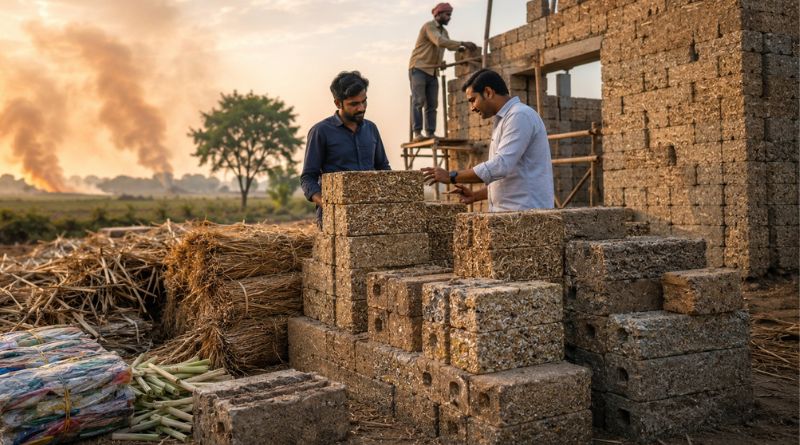
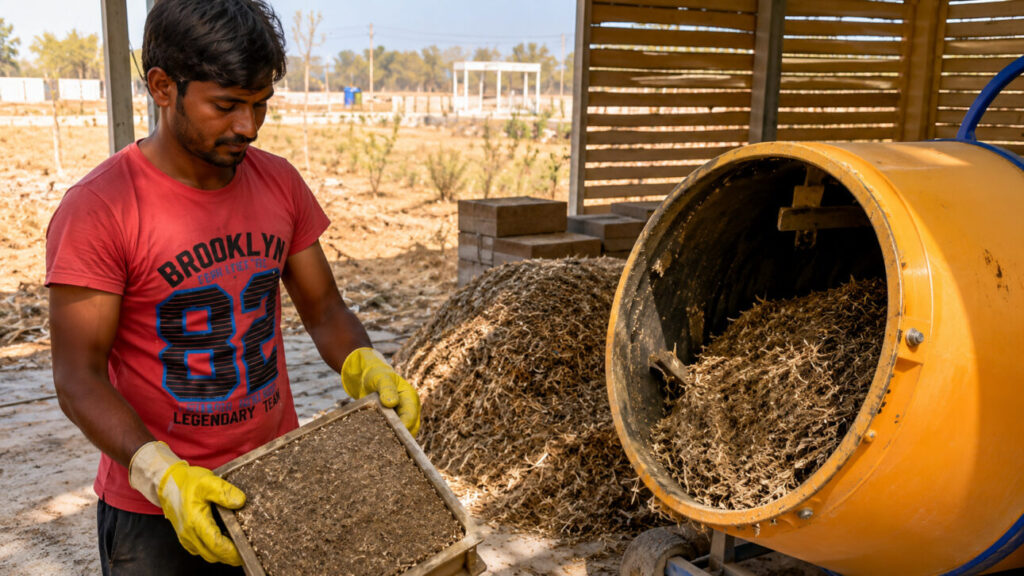
The Bio Brick is crafted entirely from agricultural waste—specifically rice and wheat straw, along with sugarcane bagasse. The core innovation here is the elimination of the kiln-firing process. By utilizing proprietary binding techniques that allow these organic materials to solidify without intense heat, the researchers have created a building unit that is not only carbon-neutral but effectively carbon-negative, as it sequesters the carbon captured by the crops during their growth.
The Agro-Plastic Block
While the Bio Brick addresses organic waste, the Agro-Plastic Block tackles the scourge of non-recyclable plastic. This material, often considered "low-value" or "impossible to recycle" by conventional municipal standards, is combined with agricultural fibers through a process of controlled heating and compression. The resulting block is dense, durable, and weather-resistant, turning a source of environmental pollution into a functional, structural asset.
Chronology of Development: From Laboratory to Prototype
The journey from concept to reality has been a methodical process led by Professor Priyabrata Rautray and his dedicated team at IIT Jodhpur.
- Phase I: Material Characterization (Early Research): The team began by analyzing the physical and chemical properties of various agricultural residues. The objective was to find a binder that could provide structural integrity to loose straw without the need for high-heat firing.
- Phase II: Formulation and Compression Testing: Researchers experimented with different ratios of straw to organic binders. Simultaneously, they tested the viability of integrating non-recyclable plastic polymers into the mixture to enhance moisture resistance.
- Phase III: Scaled-Up Fabrication: Transitioning from small samples to industrial-sized blocks, the team developed machinery capable of applying consistent pressure and heat to ensure uniformity in the building units.
- Phase IV: Campus Prototyping: As of the current date, IIT Jodhpur has successfully erected pilot structures on its campus. These structures serve as living laboratories, allowing the team to monitor thermal performance, load-bearing capacity, and resistance to monsoon conditions over time.
Supporting Data: Why This Matters
The environmental and economic imperative for this technology is grounded in staggering statistics.
The Air Quality Crisis
Agricultural burning is a major contributor to India’s winter smog, particularly in the northern states. Estimates suggest that millions of tons of crop residue are burned annually, releasing particulate matter (PM2.5), nitrogen oxides, and carbon monoxide into the atmosphere. By incentivizing the collection of this straw for use in construction, the IIT Jodhpur project provides an economic alternative to burning, effectively creating a market for what was previously viewed as agricultural waste.
Waste Management Realities
India generates millions of tons of plastic waste annually, a significant portion of which is categorized as "multi-layered plastic" (MLP) or thin-film plastic that cannot be mechanically recycled. These materials often end up in landfills or clog drainage systems. The Agro-Plastic Block provides a permanent "sink" for these materials, effectively locking them into the walls of buildings where they can remain for decades.
Thermal Comfort and Efficiency
One of the most promising aspects of these bricks is their natural insulation properties. Unlike concrete or kiln-fired clay, which conduct heat and often make interiors stifling during India’s extreme summer months, organic-based bricks offer superior thermal regulation. This means rural homes built with these materials require less energy for cooling, further reducing the carbon footprint of the household.
Official Responses and Expert Perspectives
The academic and environmental community has lauded the project as a prime example of "frugal innovation"—the practice of doing more with less.
Professor Priyabrata Rautray has emphasized that the goal is to bridge the gap between rural economic development and environmental stewardship. According to statements provided during the unveiling of the campus prototypes, the project is designed to be "decentralized." The researchers envision small, village-level production units where farmers can bring their harvest waste and plastic refuse to be converted into building materials, thereby stimulating local economies and reducing transportation costs.
Environmental advocacy groups have noted that while this is not a panacea for all of India’s pollution woes, it represents a critical paradigm shift: moving from a linear "extract-use-discard" economy to a circular model where every waste stream is recognized as a resource.
The Broader Implications: A Future Built on Waste
The implications of the IIT Jodhpur technology extend far beyond the construction of a few prototype structures.
Economic Accessibility for Rural Housing
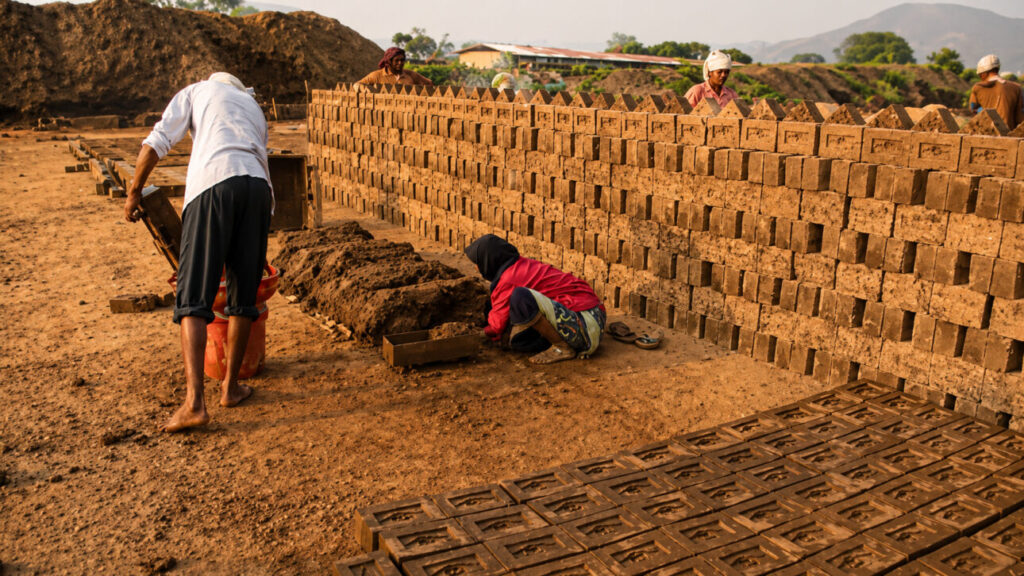
The cost of conventional building materials—cement, steel, and kiln-fired bricks—has risen sharply, placing significant financial strain on low-income rural families. Because the raw materials for Bio Bricks (straw and agricultural waste) are often available at little to no cost in the immediate vicinity, the manufacturing cost is significantly lower. This could democratize housing, allowing for the construction of safer, more permanent, and better-insulated homes for the marginalized.
A Model for Global Application
The challenges addressed by this technology—crop burning, plastic pollution, and the need for affordable housing—are not unique to India. Developing nations across Southeast Asia, Africa, and Latin America face similar hurdles. By open-sourcing or licensing this technology, India has the potential to export a template for sustainable development that can be adapted to local crops and local waste streams.
Future Challenges and Scaling
Despite the clear benefits, the path to mass adoption is not without obstacles. Standardization is the primary hurdle; for these materials to be used in government-backed housing schemes, they must undergo rigorous certification to meet national building codes for load-bearing and fire safety. Additionally, the supply chain for collecting, cleaning, and processing agricultural waste must be formalized to ensure consistent quality in the production of the bricks.
However, the progress made by the team at IIT Jodhpur suggests that these challenges are engineering hurdles rather than fundamental flaws. As the prototypes continue to withstand the test of time, the case for integrating these materials into the mainstream construction industry becomes increasingly compelling.
Conclusion
The story of the Bio Brick and the Agro-Plastic Block is, at its core, a story of perspective. Where society once saw a field of smoke and a pile of discarded plastic, innovators now see the building blocks of a sustainable future. By turning the "valueless" into the "essential," India is demonstrating that the solutions to the most pressing environmental challenges of the 21st century may not lie in complex, high-tech interventions, but in the intelligent, creative reuse of the materials that surround us.
As the project moves toward potential commercialization, it offers a glimpse into a future where the countryside is cleaner, the air is breathable, and the dream of an affordable, comfortable home is within reach for all. The transformation of harvest waste into walls is more than just a technical achievement; it is a testament to the power of human ingenuity to heal the landscapes we occupy.