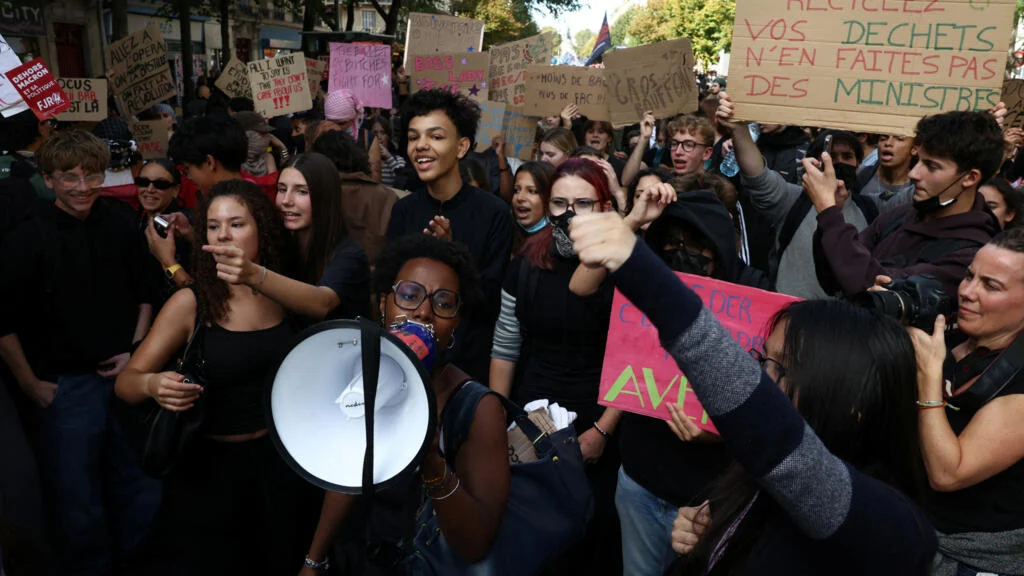
Across France, the promise of universal public education is facing an existential stress test. What began as a localized strike at a single high school in the southern suburbs of Paris has snowballed into a national movement, with hundreds of thousands of students and teachers taking to the streets. From Marseille to Lille, high school gates are being blocked by makeshift barricades of refuse bins, and classrooms are standing empty as the French youth declare they have reached a breaking point.
The movement, which shows no signs of slowing down, represents a systemic rejection of what protesters describe as the "slow-motion collapse" of the French secondary school system. As the government struggles to balance a precarious 2027 national budget against a growing list of emergency demands, the standoff highlights deep-seated inequalities, crumbling infrastructure, and a profound crisis of confidence in the state’s ability to provide a dignified learning environment.
The Genesis of the Uprising: A Chronology of Discontent
The seeds of the current wave of protests were sown on September 17, 2026, at Saint-Exupéry High School in Créteil. Frustrated by systemic understaffing that left the school without a mathematics teacher, a French instructor, a literature professor, a history teacher, and a critical assistant professor—all while the school nurse remained on long-term medical leave—a group of educators walked off the job.
Laurent Bessiere, a mathematics teacher at the school, encapsulated the despair of his colleagues during an interview with France Inter. "We were short a maths teacher, a French teacher, a literature professor, a history teacher, and an assistant professor," he noted, emphasizing that the school was essentially operating in a state of pedagogical paralysis.
By that evening, the students of Saint-Exupéry had organized. Realizing that their education was being compromised by government inaction, they took to the streets the following morning. Their tactics—stacking bins to block entrances and wielding placards demanding the "bare minimum"—quickly proved contagious. Within days, the localized grievance transformed into a nationwide phenomenon, with students from dozens of cities aligning their protests to demand a total overhaul of the educational apparatus.
The Anatomy of the Crisis: Supporting Data
The frustration driving these protests is not merely emotional; it is rooted in quantifiable data that paints a bleak picture of the French classroom. A recent survey conducted by a major trade union representing public school staff revealed that more than 50% of France’s middle and high schools are currently missing at least one teacher. When support staff—such as nurses, psychologists, and career advisors—are included, the percentage of schools suffering from staffing shortages jumps to 69%.
Overcrowding and Neglect
The human cost of these vacancies is severe. Without sufficient teaching staff, classrooms are being consolidated, leading to massive overcrowding. It is not uncommon for a single room to be packed with 35 students, a density that makes personalized learning impossible and creates an environment ripe for conflict and distraction.

The Infrastructure Gap
Beyond the personnel crisis, the physical state of the school buildings has become a flashpoint. Viral social media campaigns have exposed the "deplorable" state of many facilities. Students have shared footage of classrooms with no roofs, hallways infested with vermin, and toilets that remain flooded or non-functional for weeks at a time.
Climate change has further exacerbated these issues. During the record-breaking heatwaves that scorched France this past summer, temperatures in classrooms reached as high as 38°C (100°F). With two-thirds of French schools built before 1970, these structures are fundamentally ill-equipped to handle modern climate realities, lacking both the insulation to keep out the cold and the cooling systems required to survive the heat.
Official Responses and Political Maneuvering
The government’s response has been a mix of administrative caution and defensive posturing. Education Minister Édouard Geffray had initially attempted to downplay the crisis, claiming in late August that teacher shortages would be "minimal" and that the system was on track for a successful academic year. Following the reality of the protests, these comments have been widely criticized as detached from the reality on the ground.
Prime Minister Sébastien Lecornu has since intervened, ordering his ministers to draft formal proposals to address the student demands by the end of October. However, these efforts are complicated by the broader political climate. The French government is currently embroiled in heated negotiations over the 2027 national budget, which is defined by "belt-tightening" measures, including wage freezes and new tax proposals. Finding the necessary funding to recruit thousands of new teachers and renovate thousands of aging buildings is a logistical and political nightmare.
Lecornu has attempted to deflect some of the blame onto regional councils, noting that they are responsible for the maintenance of school buildings. While he pledged that the state would "support" these regions, student leaders have rejected this as a passing of the buck. "Studying in run-down premises is an obstacle to education," Lecornu acknowledged in a recent statement, yet for many students, this admission arrived years too late.
Implications: The Structural Reform Debate
The demands put forward by the student unions go beyond immediate funding. They are calling for a fundamental restructuring of how French students navigate their lives, from their daily schedules to their path into higher education.
The "Long-Day" Dilemma
Students are protesting the grueling nature of the French school day, which can run from 8:00 AM to 6:00 PM. While French students may technically spend fewer total days in school compared to the OECD average, they endure longer daily hours. The 2019 educational reform, which allowed students to choose specialization courses, has, ironically, made timetables more chaotic and gaps between classes more frequent, leaving students exhausted and with little time for family or extracurricular growth.

The Parcoursup Controversy
Perhaps the most contentious issue is the national higher education application platform, Parcoursup. Critics argue that the system is opaque, arbitrary, and discriminatory. Students claim that their cover letters are ignored and that the algorithm used to rank applicants lacks transparency. A February 2026 government report confirmed these fears, noting that the platform reinforces sociocultural inequalities by favoring students from prestigious schools over those from disadvantaged backgrounds.
Lecornu has promised to overhaul the platform, suggesting that students should be given full insight into how their applications are weighed. Whether this promise of transparency will satisfy a generation that feels the system is rigged against them remains to be seen.
The Road Ahead: A Generation Unsilenced
The current mobilization is more than a protest; it is a declaration of intent. The 10 "emergency measures" published by the student union—which include mandatory staffing levels for nurses and psychologists, a massive recruitment drive, and a concrete timeline for building renovations—serve as a blueprint for a new social contract between the state and its youth.
The government is now in a race against time. With the 2027 admissions cycle for higher education looming in January and the national budget negotiations entering their final stages, the administration must decide whether to continue its strategy of containment or to commit to the massive investment required to revitalize the French school system.
For the students currently occupying school courtyards and marching through the streets of Paris and Marseille, the message is clear: the status quo is a failure. They are no longer content with promises of future reform. They are demanding a seat at the table and an immediate end to the neglect of their future. As the government prepares its formal response, the nation watches to see if the authorities will truly listen, or if the "fed up" generation will escalate their movement until the system is forced to change.
In the final analysis, the protests are a symptom of a larger, systemic crisis of inequality in France. If the government fails to address the lack of personnel, the crumbling infrastructure, and the perceived unfairness of the admissions process, it risks further alienating a generation that is increasingly finding its voice in the public square. The classroom may be the setting of the current dispute, but the implications extend to the very future of French society.