While self-employed entrepreneurs accounted for approximately 10% of the U.S. workforce according to 2020 U.S. Census Bureau data, the landscape of American labor has undergone a seismic shift in the years following the onset of the COVID-19 pandemic. What was once a steady segment of the economy has transformed into a surging wave of innovation and necessity, as millions of Americans pivoted away from traditional employment to strike out on their own.
This phenomenon—often dubbed "The Great Resignation" or "The Great Re-evaluation"—is not merely a transient reaction to a global health crisis. It represents a fundamental recalibration of how individuals perceive the relationship between career, autonomy, and security.
The Main Facts: A Surge in New Ventures
The pandemic initially triggered a jarring drop in business applications during the spring of 2020. However, this contraction proved short-lived. Following the initial shock, monthly business applications skyrocketed, shattering previous records. Even as the economy reopened, the rate of new business formation remained significantly elevated compared to pre-pandemic baselines.
The surge was not uniform across all industries. Data indicates that nearly a third of all new applications were concentrated in two primary sectors: retail trade and professional, scientific, and technical services. In 2020 alone, there were over 824,000 applications for new retail businesses—roughly 19% of the total—while professional services saw more than half a million new filings.
Crucially, recent research from the University of Maryland highlights that this boom is largely driven by "nonemployer" firms. These are businesses—typically sole proprietorships, partnerships, or limited liability companies (LLCs) without traditional payroll employees—that represent the nimble, decentralized future of the American entrepreneur.
A Chronology of the Shift
To understand how we reached this point, we must look at the timeline of the last few years:
- Early 2020 (The Initial Shock): As lockdowns were implemented across the United States, businesses shuttered, and uncertainty permeated every sector. Business applications saw a sharp, immediate decline as the economy hit the pause button.
- Late 2020 (The Pivot): Driven by the rise of remote work and the necessity of finding new income streams during widespread layoffs, individuals began to capitalize on shifting consumer behaviors. E-commerce platforms saw a surge in new storefronts.
- 2021 (The Great Re-evaluation): As the labor market tightened, "quit rates" hit record levels. Employees who had reassessed their priorities during the pandemic chose to exit the traditional workforce, opting to build their own businesses rather than return to stagnant corporate environments.
- 2022 and Beyond (The Sustained Surge): The momentum continued as supply chain disruptions forced gaps in the market, creating opportunities for local and niche businesses to fill the void left by larger, struggling corporations.
Supporting Data: Regional Disparities
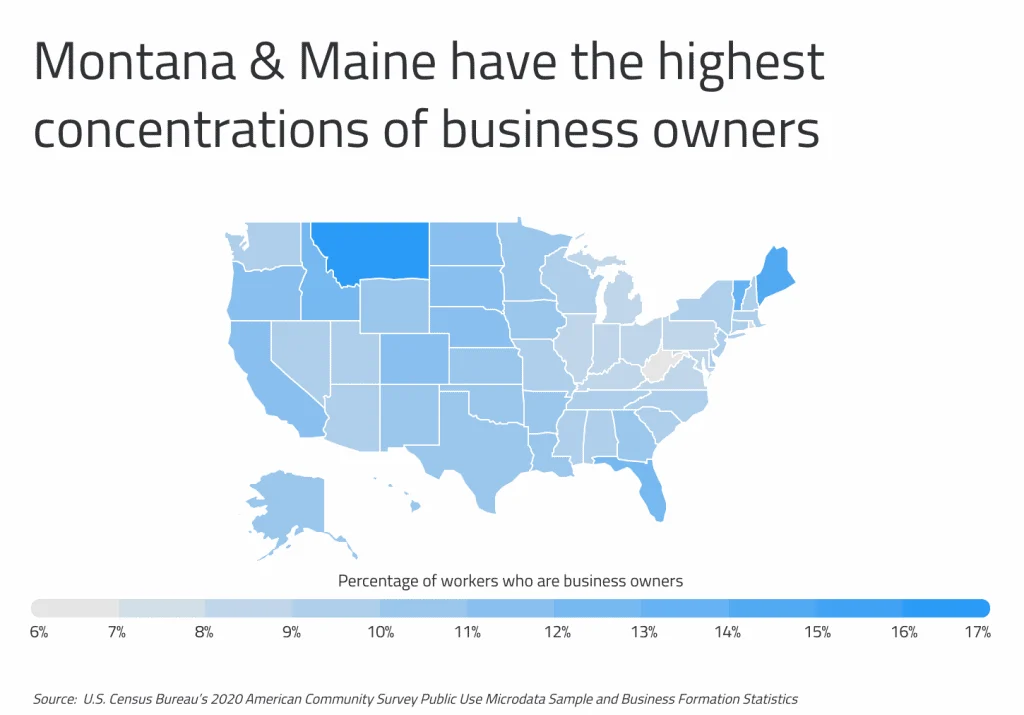
While entrepreneurship is a national trend, its density varies wildly by geography. The U.S. Census Bureau data reveals that some states have become natural hubs for independent enterprise.
Montana leads the nation, with nearly 17% of its workforce identified as self-employed. Maine follows closely at 14%, with Vermont (13%), Florida (12.5%), and Idaho (12.4%) rounding out the top of the list. These states often feature robust tourism, professional consulting, and outdoor-oriented economies that lend themselves well to sole proprietorships.
Conversely, the "Rust Belt"—including states such as West Virginia, Ohio, Pennsylvania, Kentucky, and Indiana—shows lower concentrations of entrepreneurship. West Virginia, for instance, reports only 6.8% of its workforce as self-employed. This regional divide suggests that local economic incentives, the availability of high-speed digital infrastructure, and the health of traditional manufacturing sectors play significant roles in determining where new businesses take root.
Top 15 Metropolitan Areas for Entrepreneurs
Researchers at Commodity.com analyzed the 100 most populous U.S. metro areas to identify where the entrepreneurial spirit is strongest. The following cities represent the current leaders in self-employment:
- North Port-Sarasota-Bradenton, FL: A hotspot for service-based and professional consulting, this region has become a magnet for independent contractors.
- Miami-Fort Lauderdale-West Palm Beach, FL: A hub for international trade and professional services, attracting a diverse range of solopreneurs.
- Asheville, NC: A thriving market for creative and boutique retail enterprises.
- Deltona-Daytona Beach-Ormond Beach, FL: Benefitting from regional growth and tourism-driven business models.
- Cape Coral-Fort Myers, FL: A rapidly growing area that has seen a surge in construction and personal service startups.
- McAllen-Edinburg-Mission, TX: A key location for trade-linked small businesses.
- Los Angeles-Long Beach-Anaheim, CA: Despite high costs of living, the massive consumer market continues to fuel a high density of sole proprietors.
- New Orleans-Metairie, LA: A unique culture that supports a high concentration of hospitality and service-sector entrepreneurship.
- Bridgeport-Stamford-Norwalk, CT: A center for high-end professional and technical consulting services.
- Oxnard-Thousand Oaks-Ventura, CA: Known for its proximity to tech hubs and high-income demographics.
- Austin-Round Rock, TX: A booming tech and creative hub that encourages high rates of self-employment.
- Charleston-North Charleston, SC: A growing market for logistics and tourism-based ventures.
- Lafayette, LA: A strong regional hub with a high density of local business owners.
- Lancaster, PA: A unique mix of agricultural, manufacturing, and local service businesses.
- Little Rock-North Little Rock-Conway, AR: A consistent performer in regional entrepreneurship.
Official Perspectives and Expert Analysis
Economic analysts argue that this shift is a rational response to systemic instability. When the traditional corporate "safety net" failed during the pandemic, the psychological barrier to starting a business vanished.
"The pandemic removed the illusion of safety in traditional employment," says one industry observer. "When the risk of being laid off became equivalent to the risk of starting a business, the fear factor associated with entrepreneurship dropped significantly."
Furthermore, federal, and state-level policy responses—such as the Paycheck Protection Program (PPP) and various stimulus measures—provided a degree of liquidity that, for some, served as seed capital for new ventures. However, critics note that these measures were often tilted toward larger employers, leaving the "nonemployer" sector to rely on personal savings and the proliferation of low-cost digital tools (like Shopify, Etsy, and freelance platforms) to launch their operations.
Implications for the Future
The rise of the "solopreneur" and the small-scale LLC carries profound implications for the future of the U.S. economy.
1. The Decentralization of the Workforce
As more individuals become their own bosses, the traditional 9-to-5 model will likely continue to erode. This creates a more resilient, if more fragmented, labor market. While these businesses may lack the scale of a Fortune 500 company, their collective impact on local tax bases and community vibrancy is substantial.
2. Economic Diversification
The shift toward professional, scientific, and technical services suggests that the American economy is becoming more knowledge-based. These entrepreneurs are often providing specialized services to companies that have downsized their own internal departments, creating a symbiotic relationship between large corporations and a growing army of independent contractors.
3. Digital Infrastructure as a Utility
The success of this entrepreneurial wave depends heavily on reliable, high-speed internet. As these new businesses settle into suburban and rural areas—as evidenced by the high rankings of cities like Asheville and Sarasota—there will be increased political and economic pressure to treat broadband as an essential utility rather than a luxury.
4. A New Approach to Benefits
Perhaps the most significant challenge remains the lack of institutional benefits for the self-employed. Traditional health insurance, retirement planning, and paid leave are tied to employment status in the U.S. As 10% or more of the workforce transitions to independent status, policymakers will face increasing pressure to modernize the social safety net to accommodate a "gig" or "solo-business" economy.
Conclusion
The data is clear: the pandemic did more than just interrupt the status quo; it acted as a catalyst for a profound transformation in how Americans work. From the sunny coasts of Florida to the creative enclaves of North Carolina, the surge in business applications reflects a population that is increasingly willing to take control of its economic destiny.
While challenges remain—specifically regarding economic security for the self-employed—the momentum is undeniable. We are witnessing the birth of a new, more decentralized American economy, defined by the innovation, grit, and independence of the individual entrepreneur. As we look ahead, the ability of these small businesses to adapt to changing market conditions will determine whether this entrepreneurial renaissance is a fleeting trend or the foundation of a new era of American prosperity.