
Introduction: A Fragile Geopolitical Equilibrium
The geopolitical landscape between Washington and Tehran has reached a precarious inflection point. Diplomatic channels, once viewed as the primary mechanism for de-escalation in the Middle East, appear to be suffering from a systemic breakdown. Following a series of acerbic exchanges and the rejection of a U.S.-led peace framework, the prospect of a renewed military confrontation has moved from the periphery of risk assessments to a central concern for global policymakers and financial markets alike.
As President Donald Trump prepares for a high-stakes summit with Chinese President Xi Jinping, the shadow of the Middle East crisis looms large. With the Strait of Hormuz—a critical artery for global energy supplies—at the center of the dispute, investors are increasingly pivoting toward safe-haven assets, while simultaneously grappling with the hawkish reality of a persistent inflationary environment in the United States.
The Chronology of Deterioration
The current standoff is the culmination of weeks of escalating rhetoric and failed back-channel diplomacy. The timeline of this collapse provides critical context for the current market volatility.
The Breakdown of Negotiations
Earlier this week, the diplomatic effort to secure a ceasefire and reopen the Strait of Hormuz suffered a terminal blow. President Trump publicly disparaged an Iranian counter-proposal, labeling the document "unacceptable" and referring to it in blunt, dismissive terms as a "piece of garbage." This rhetoric marked a departure from the previously cautious optimism held by international mediators.
Following this rejection, the White House signaled that the window for a negotiated settlement was rapidly closing. In subsequent briefings, President Trump characterized the state of negotiations as being on "life support." This assessment has triggered a shift in strategic planning within the U.S. defense apparatus, with reports circulating that the administration is actively reconsidering military options to secure the maritime passage.
Tehran’s Stance
Tehran has remained defiant, showing no inclination to bow to the mounting pressure from Washington. By rejecting the U.S.-backed proposal, Iran has effectively signaled that its regional security requirements are non-negotiable, regardless of the threat of renewed kinetic action. This intransigence has left the diplomatic community scrambling to find a secondary path to stability, though few viable alternatives currently exist.
Global Implications: The Xi-Trump Summit
All eyes are now turned toward the upcoming bilateral meeting between President Trump and President Xi Jinping. While the official agenda is set to cover trade imbalances and the status of Taiwan, the "Iran question" has become an unavoidable subtext.
China as a Potential Guarantor?
Analysts have long suggested that Beijing holds a unique position of influence over Tehran, primarily due to its status as a major importer of Iranian crude oil. There is a prevailing theory in diplomatic circles that if China were willing to leverage its economic ties, it could act as a guarantor for a lasting peace deal.
However, observers are tempering their expectations. While China has a vested interest in the stability of energy markets, Beijing has historically been reluctant to insert itself into the center of U.S.-Iranian security disputes. The consensus among geopolitical experts is that while the topic will undoubtedly be broached, a breakthrough originating from this specific summit remains unlikely.
Economic Fallout and Market Turbulence
The uncertainty surrounding the Middle East has had a profound impact on global financial instruments, particularly gold futures and the broader inflation narrative.
The Inflationary Surge
Economic data released this past Tuesday underscored the severity of the situation. U.S. consumer prices rose by 0.6% in April, pushing the annual Consumer Price Index (CPI) to 3.8%—the highest level recorded since mid-2023.

Economists point to the surge in energy prices, driven by the instability in the Middle East, as the primary catalyst for this inflationary spike. The disruption of supply chains and the looming threat to the Strait of Hormuz have created a "war premium" in the oil market, which is now bleeding into the broader economy, complicating the Federal Reserve’s attempts to manage price stability.
The Fed and the Opportunity Cost of Gold
In response to the stubborn inflation data, investors have aggressively priced out expectations for any Federal Reserve rate cuts in the current calendar year. Conversely, market sentiment has shifted to reflect a modest probability of a rate hike.
This environment creates a significant headwind for gold. As a non-yielding asset, gold’s attractiveness is inversely correlated with real interest rates. When borrowing costs rise—or are expected to stay higher for longer—the opportunity cost of holding gold increases, leading investors to reallocate capital toward higher-yielding debt instruments.
Technical Analysis: Gold’s Narrow Range
Market participants are closely monitoring the technical performance of gold futures, which have remained stuck in a tightly defined, range-bound pattern throughout the week.
The $4,737 – $4,654 Corridor
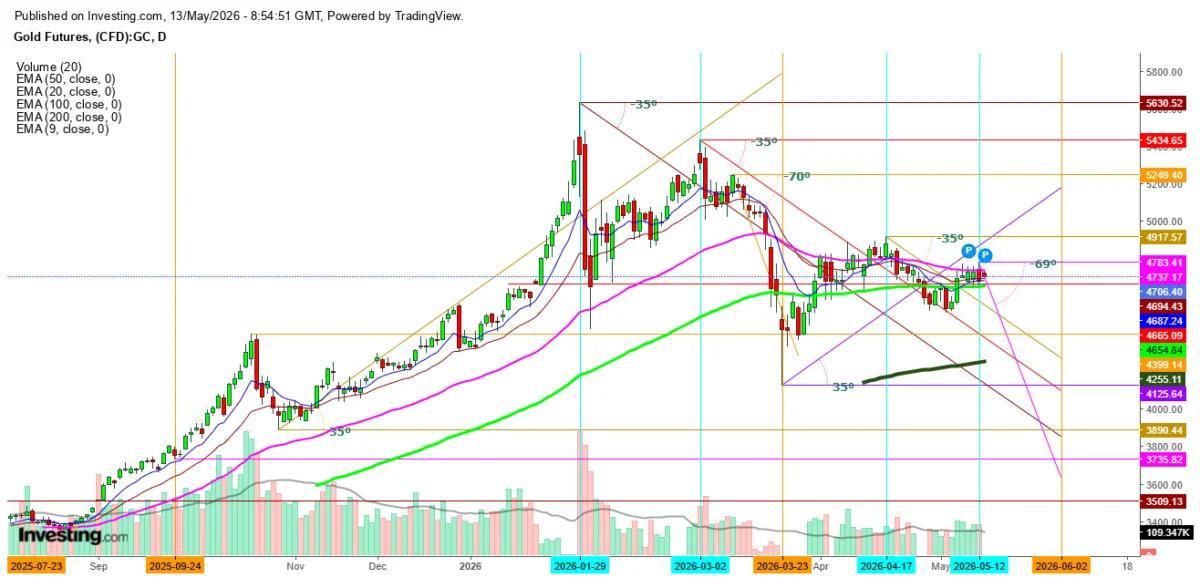
Gold futures are currently oscillating within a narrow band between $4,737 and $4,654. This compression is indicative of a market awaiting a clear catalyst. Analysts agree that a breakout from this range is imminent, but its direction is entirely dependent on the outcomes of the Trump-Xi meeting on May 14-15.
Downside Risks and Support Levels
From a technical standpoint, the outlook for gold leans toward a potential slide. My analysis of the daily chart patterns suggests that the asset is testing the limits of its current support levels.
- The 100-day Exponential Moving Average (EMA): Currently sitting at $4,654, this is the critical support level. A breakdown below this point would signal a significant shift in market sentiment.
- The 200-day EMA: Should the price breach the 100 EMA, the next major floor is located at $4,255.
It is my assessment that gold futures are increasingly vulnerable, particularly as we head into the weekend. Net speculative positions are likely to decline as traders hedge their exposure ahead of the potential volatility emanating from the U.S.-China summit.
Strategic Outlook and Summary
The convergence of a stalled diplomatic process in the Middle East and a high-stakes summit in Washington creates a volatile cocktail for the global economy. The U.S.-Iran conflict is no longer a localized regional issue; it is a fundamental driver of global inflation and a critical variable in the pricing of safe-haven assets.
Key Takeaways for Investors:
- Diplomatic Stagnation: The rejection of peace proposals has increased the probability of military escalation, keeping energy prices elevated.
- Macroeconomic Pressure: The 3.8% CPI reading has effectively neutralized the "Fed pivot" narrative, placing downward pressure on gold prices as real yields remain elevated.
- Technical Vulnerability: Gold is currently trapped in a narrow range. A failure to hold the $4,654 support level could trigger a more sustained bearish trend toward $4,255.
- The Weekend Catalyst: All market movements are contingent on the post-summit commentary from President Trump. Investors should expect heightened volatility during the Monday open.
Conclusion
As we look toward the remainder of the quarter, the correlation between geopolitical stability and market performance will only tighten. While gold has historically served as a hedge against uncertainty, the current interest rate environment presents a unique challenge that may override the traditional "fear premium." Investors are advised to monitor the technical thresholds closely and remain prepared for a swift shift in market sentiment following the conclusion of the Xi-Trump discussions.
Disclaimer: The analysis provided herein is based solely on market observations and technical indicators. Readers are advised to exercise extreme caution and conduct their own due diligence. Any position taken in gold or other financial instruments is done at the reader’s own risk.