By Political Analysis Desk
October 8, 2026
As the United States approaches the 2026 midterm elections, a comprehensive new survey from the Pew Research Center reveals a sobering landscape for the Trump administration and the broader political establishment. Data collected between September 28 and October 4, 2026, underscores a deepening malaise among the American electorate, characterized by a broad decline in public confidence in President Donald Trump’s ability to handle key policy issues and a persistent, historically low level of satisfaction with the direction of the country.
The findings paint a picture of a nation grappling with significant governance challenges, where neither major political party has managed to secure a positive favorability rating from a majority of the public. As voters prepare to head to the polls, the data suggests that the "enthusiasm gap" and ideological polarization continue to define the American political experience.
The Core Data: A Broad Decline in Confidence
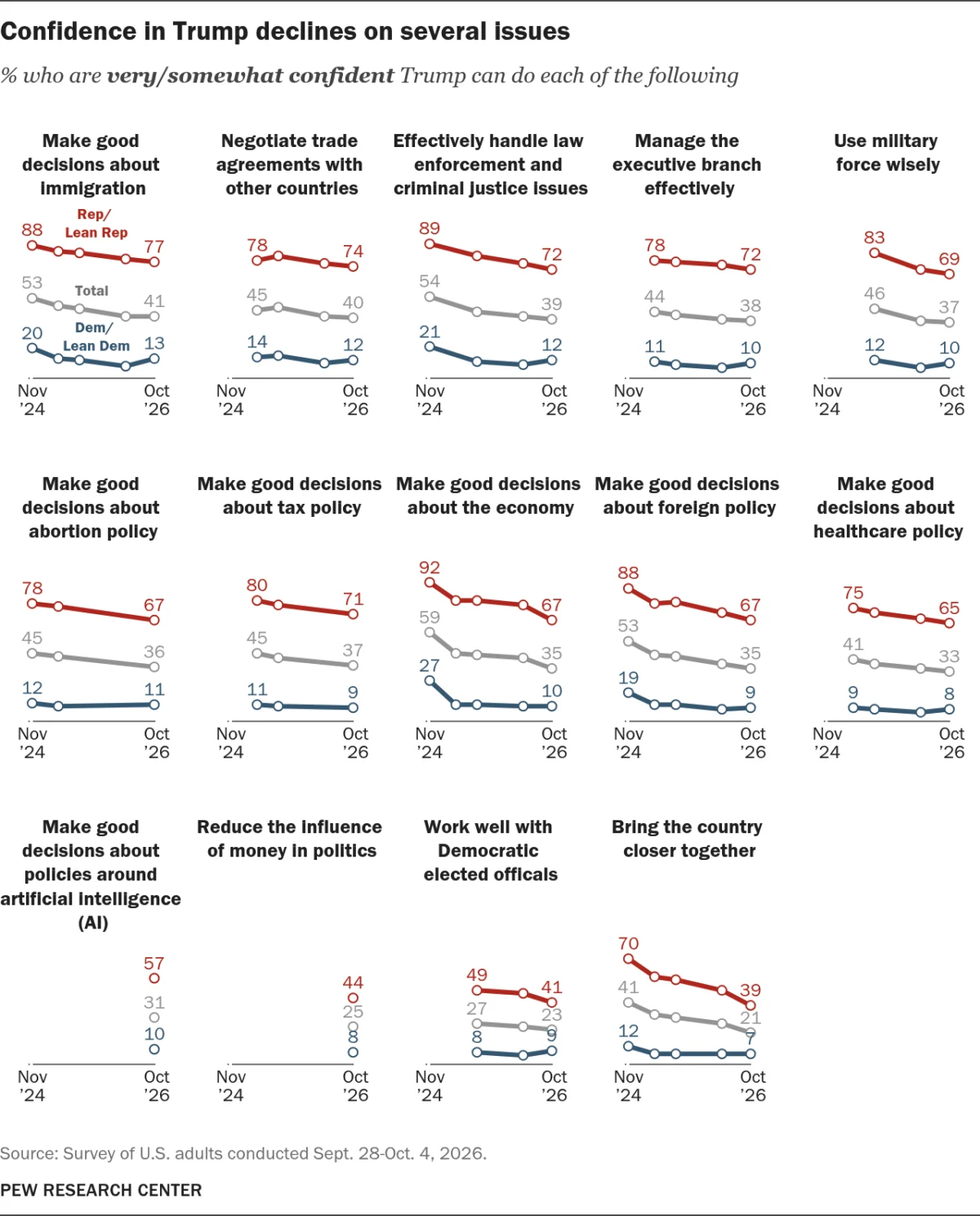
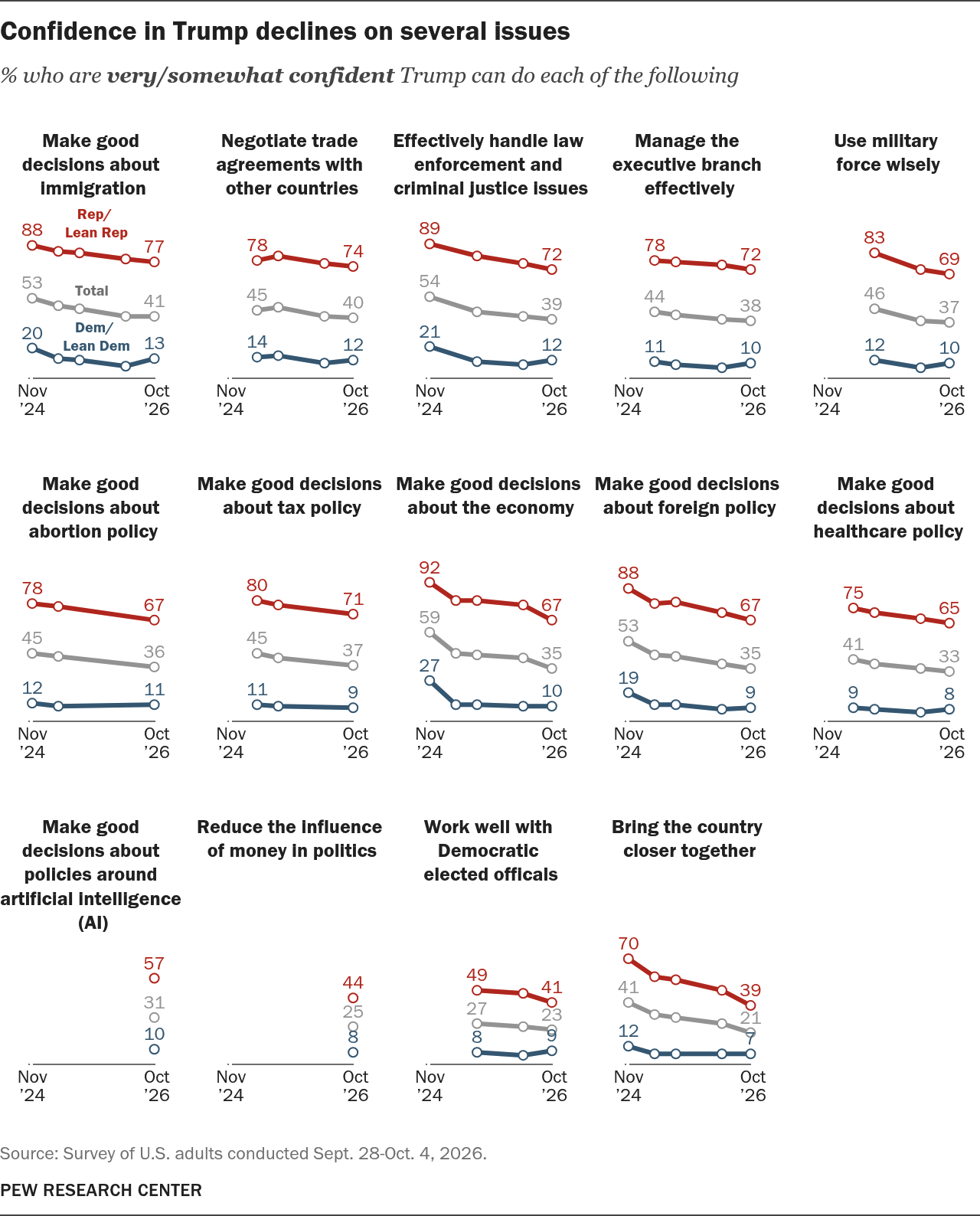
The most striking takeaway from the recent survey is the widespread erosion of public trust in the President’s capacity to manage the levers of government. Across virtually every major metric—from economic stewardship and foreign policy to the management of the executive branch—confidence levels have consistently trended downward since the start of his current term in late 2024.
Economic and Policy Stagnation
The economy, traditionally a pillar of political strength for any incumbent, has seen a significant shift in perception. In November 2024, 59% of Americans expressed confidence that President Trump could make good decisions regarding the economy. By October 2026, that figure has plummeted to 35%. This 24-point drop suggests that the administration’s economic agenda has failed to resonate with the broader public or has been overshadowed by external fiscal pressures.

Similar patterns emerge in other high-stakes policy areas:
- Foreign Policy: Confidence in the President’s foreign policy decision-making has fallen from 53% in late 2024 to 35% in October 2026.
- Immigration: Despite this being a central campaign theme, public confidence in the President’s handling of immigration has slid from 53% to 41% over the same period.
- Healthcare: Perhaps most concerning for the administration is the consistent low ranking on healthcare policy, where only 33% of respondents expressed confidence as of October 2026.
The "Uniting" Deficit
Perhaps the most dramatic shift involves the President’s perceived ability to "bring the country closer together." In November 2024, 41% of adults believed he could foster national unity. As of October 2026, that number has been cut nearly in half, standing at just 21%. This drop highlights the intensifying partisan divide that has become the hallmark of the current political era.
A Chronological Perspective: The Erosion of Goodwill
To understand the current state of public opinion, one must look at the trajectory of the last two years. The data provides a clear timeline of how initial post-election optimism—often referred to as a "honeymoon period"—gradually gave way to the current climate of dissatisfaction.
The 2024 Transition
Following the November 2024 election, the administration enjoyed a baseline of support, with high marks in law enforcement (54%) and economic management (59%). During this period, the nation was arguably more receptive to the new executive agenda, with a palpable sense of anticipation surrounding the administration’s initial legislative and administrative goals.
2025: The Struggle to Implement
By mid-2025, the data began to reflect the complexities of governance. As the administration faced the realities of legislative hurdles and bureaucratic friction, public satisfaction began to dip. For instance, in April 2025, confidence in the administration’s ability to manage the executive branch stood at 44%; by August, it had already begun a slow, steady decline. This period was marked by an increasing difficulty in satisfying the moderate wing of the electorate, while the base remained relatively steady but not expanding.
2026: The Pre-Midterm Reality
The year 2026 has been defined by a consolidation of these negative trends. The survey data from April 2026 served as a warning shot, showing that the declines were not merely transient but structural. By the time the October 2026 survey was conducted, the numbers had settled into a low-confidence equilibrium, with the President’s core supporters (Republicans/Lean Republicans) remaining the only group providing majority-level support, albeit with declining enthusiasm in key areas like immigration and trade negotiation.
The Mood of the Nation: A Persistent Low
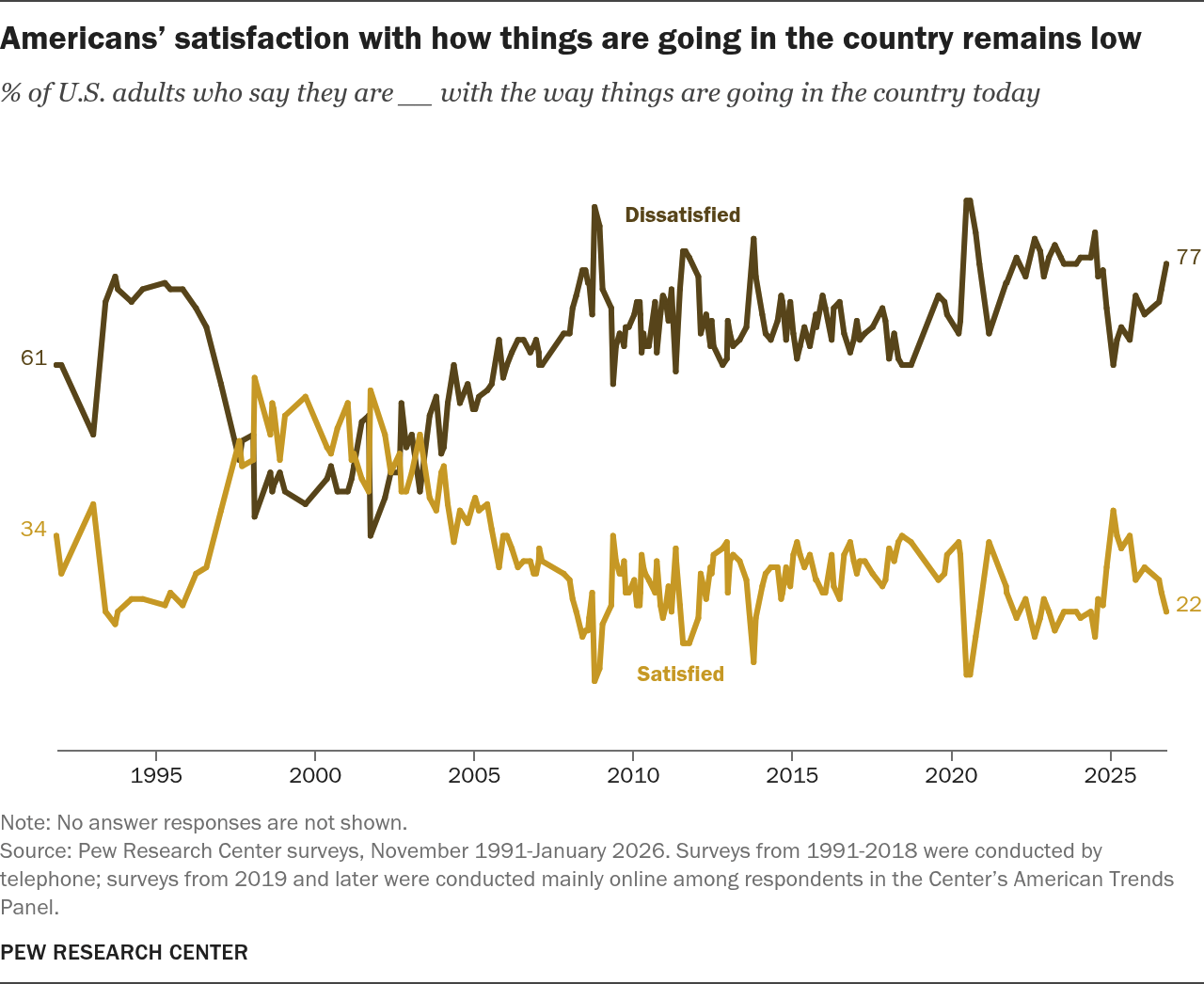
Beyond the specific metrics of presidential performance, the general satisfaction of the American public with the state of the country remains at a historically low ebb. The trend line for national satisfaction is perhaps the most damning indictment of the current political environment.
Data spanning from 1991 to the present shows that, while satisfaction fluctuates, the current era is characterized by an extended period of pessimism. In late 2026, only 22% of U.S. adults reported being satisfied with the way things are going in the country, while 77% expressed dissatisfaction.
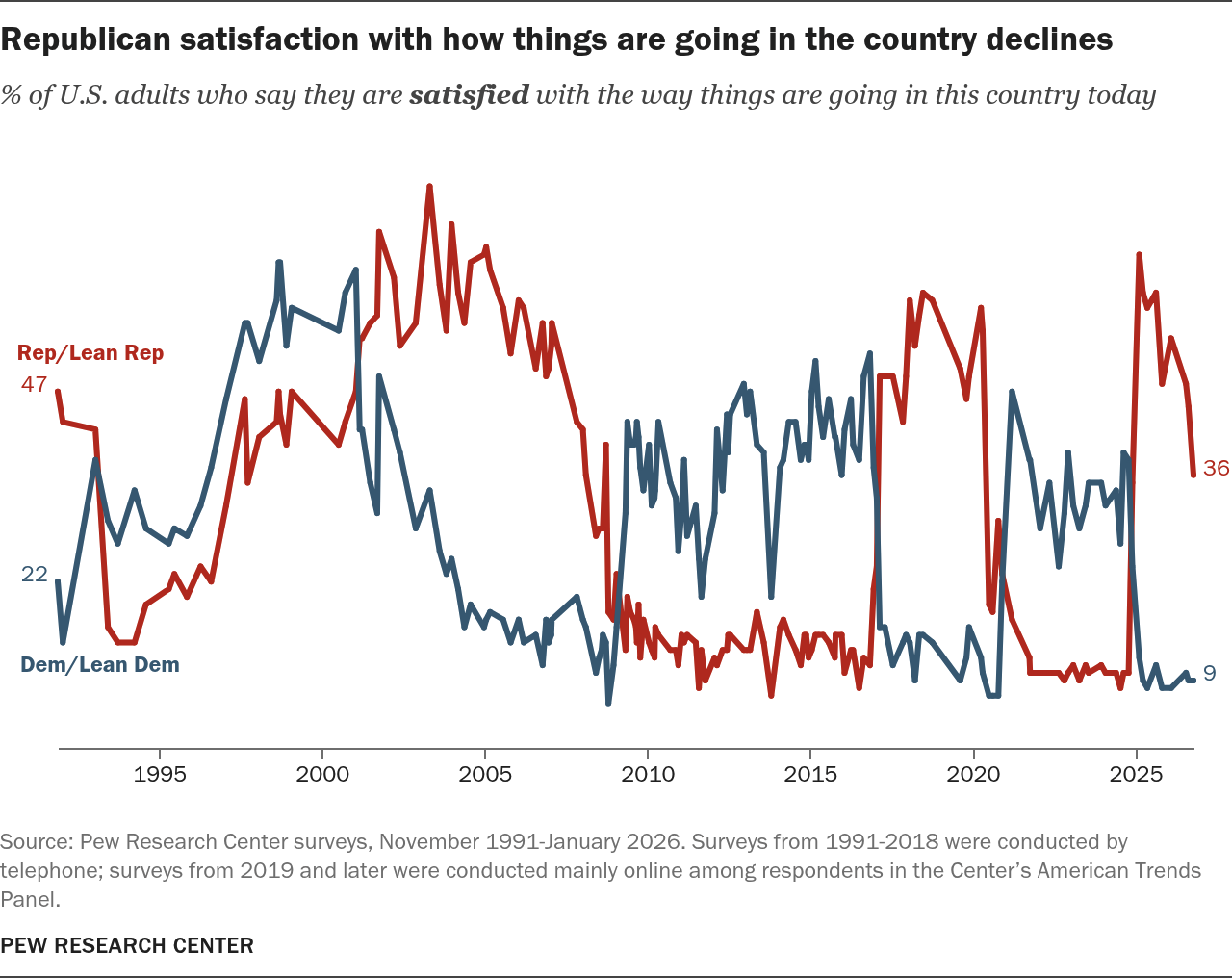
This dissatisfaction is not merely an anti-incumbent sentiment; it is a profound frustration with the status quo. Even among the President’s own party, satisfaction has been volatile. Republican/Lean Republican satisfaction, which peaked during the early months of 2025 (reaching 65% in February), has since declined significantly, falling to 36% by October 2026. This suggests that even the core base is feeling the weight of the nation’s current trajectory.
The Polarization of Party Favorability
The current political landscape is further complicated by the fact that neither the Republican nor the Democratic Party is currently viewed favorably by a majority of Americans.
As of the October 2026 survey, both parties find themselves in a "favorability hole." The Republican Party holds a 37% favorability rating against a 61% unfavorable rating. The Democratic Party is in a nearly identical position, with a 40% favorable and 58% unfavorable rating.
This environment of mutual unpopularity suggests that the 2026 midterms will likely be driven less by enthusiasm for either party’s platform and more by negative partisanship—the impulse to vote against the "other side" rather than for one’s own.
Implications for the 2026 Midterms
The implications of this data for the upcoming midterm elections are profound.
1. The Strategy of Mobilization
With both parties viewed unfavorably by the majority of the public, the path to victory lies entirely in mobilization. The campaigns will likely avoid attempts to win over the "median voter" and instead focus on turning out the base. For the Republican Party, this means re-engaging the voters who have become disenchanted with the administration’s perceived inability to move the needle on immigration and the economy. For the Democratic Party, the focus will be on capitalizing on the general dissatisfaction with the administration to drive turnout in suburban and urban centers.
2. The Role of Independent Voters
Independents are likely to be the deciding factor, yet they are also the group most dissatisfied with the current options. The lack of confidence in both parties suggests that independent voters may stay home in record numbers, or alternatively, vote for third-party candidates, further muddying the electoral landscape.
3. Policy as a Political Weapon
Given the decline in confidence in the President’s handling of specific issues, the administration is likely to pivot to more aggressive rhetoric or specific executive actions in the final weeks before the election to reclaim the narrative. However, the data shows that the "trust bank" is currently depleted, making it significantly harder for the President to pivot and see immediate gains in public opinion.
Conclusion
The Pew Research Center’s latest survey offers a stark assessment of the American political psyche in October 2026. The decline in confidence in the Trump administration is not an isolated phenomenon but is part of a broader, systemic dissatisfaction with the country’s direction and the two-party system.
As the nation moves toward the midterm elections, the central question is whether the current atmosphere of cynicism will lead to a change in legislative power or if it will simply reinforce the status quo of gridlock and polarization. What is certain is that the American public is demanding something—be it results, stability, or a new direction—that the current political order has, thus far, failed to provide.
The upcoming weeks of campaigning will serve as the final test of whether the administration can reverse these trends or if the public’s sentiment is already firmly set. The numbers, however, provide a clear roadmap of the uphill battle the administration faces: when confidence falls, the barrier to re-engaging a disaffected electorate becomes exponentially higher. As the country looks to the future, the 2026 midterms may well be remembered as a referendum on the limits of political power in an age of profound public disillusionment.