In an increasingly volatile global marketplace, the traditional silos between customer acquisition and customer retention are dissolving. Businesses no longer have the luxury of treating marketing and customer experience (CX) as separate disciplines. To thrive, brands must adopt a holistic "Total Experience" framework—a strategic approach that synchronizes how a brand attracts prospects with how it delivers value to existing customers.
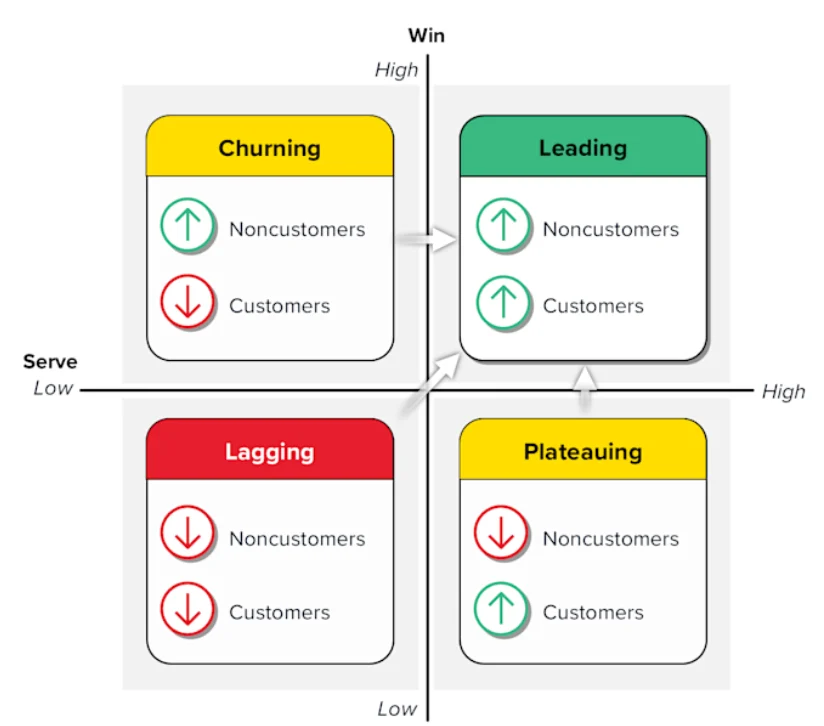
According to new research from Forrester, companies that fail to align these two engines often find themselves trapped in growth plateaus or, worse, cycles of churn. To help organizations navigate this, Forrester has introduced a comprehensive "Growth Grid," a diagnostic tool that maps brands into four distinct quadrants: Leading, Churning, Plateauing, and Lagging. By identifying where a brand sits on this spectrum, executives can make the tough, data-driven choices required to break through to the next stage of market dominance.
Main Facts: The Four Quadrants of Growth
Forrester’s framework is designed to provide clarity in a cluttered environment. The Growth Grid is not merely a descriptive tool; it is a prescriptive roadmap that dictates where a company should focus its capital and human resources.
1. The Leading Quadrant: Maintaining Momentum
Leading brands are those that have successfully mastered both the art of attraction and the science of satisfaction. They possess high brand resonance among prospects and high retention rates among current customers. However, the report cautions that leadership is inherently precarious. The primary risk for leaders is complacency. When a brand rests on its laurels, it becomes susceptible to "disruption from the shadows"—agile competitors who identify gaps in the leader’s innovation pipeline. Leaders must continuously invest in competitive intelligence to ensure they remain relevant.
2. The Churning Quadrant: The Acquisition Trap
Churning brands are often masters of marketing but failures in delivery. They are exceptionally good at filling the top of the funnel, driving significant interest and new acquisitions. However, the customer experience is insufficient to justify the cost of acquisition. These brands effectively "leak" revenue, spending massive amounts to attract customers who depart shortly thereafter. For these firms, the strategy is clear: stop the aggressive spending on new acquisition and pivot toward fixing the post-purchase experience.
3. The Plateauing Quadrant: The "Well-Kept Secret"
Plateauing brands possess a loyal, satisfied customer base, but they suffer from a lack of market awareness. Their product or service is excellent, but it is not reaching enough new prospects. Over time, this results in a shrinking customer base as churn—no matter how low—eventually outpaces new intake. To escape this plateau, these brands must leverage advocacy programs and revisit their brand positioning to ensure it resonates with new, untapped demographics.
4. The Lagging Quadrant: The Turnaround Challenge
Laggards face a double-deficit: they are failing to attract new interest and failing to satisfy those who do engage. This is the most difficult position to occupy, as it requires a fundamental overhaul of both brand identity and operational delivery. The strategy for laggards is to perform a granular analysis of category leaders, identifying the key drivers of success and creating a blueprint to emulate those benchmarks.
Chronology of Market Evolution: From Silos to Totality
The necessity for a "Total Experience" framework has not emerged in a vacuum. Over the past decade, the business landscape has undergone a seismic shift, dictated by three distinct phases of evolution.
The Era of Siloed Marketing (2010–2015)
In the early 2010s, digital marketing was in its ascendancy. The primary goal was reach. Companies poured budgets into SEO, social media, and paid search to capture traffic. During this period, the "Customer Experience" was often an afterthought, handled by separate departments that rarely communicated with the growth marketing teams.
The Rise of the Subscription Economy (2016–2020)
As the subscription model became the gold standard, the cost of acquisition (CAC) began to skyrocket. Brands realized that a high-volume, low-retention model was unsustainable. Companies began to hire "Chief Customer Officers," yet the data often remained siloed. Marketing still focused on the "what," while operations focused on the "how," leading to a fragmented customer journey.
The Total Experience Paradigm (2021–Present)
Today, the barrier to entry in most sectors is lower than ever, leading to unprecedented competition. Forrester’s current framework recognizes that the brand promise (marketing) and the brand reality (CX) must be indistinguishable. If the marketing says "we are fast," but the CX delivery is slow, the brand collapses. This era is defined by the integration of data, where every touchpoint—from a prospect’s first ad view to a long-term user’s support ticket—is mapped against a unified growth strategy.
Supporting Data and Strategic Implications
Forrester’s analysis indicates that the cost of failing to align these domains is existential. Brands that fall into the "Churning" quadrant often find that their return on ad spend (ROAS) is perpetually negative, as they are paying to replace customers who leave due to poor experiences. Conversely, brands in the "Plateauing" quadrant often find their valuation stagnating because investors perceive them as having "limited total addressable market (TAM)," even if their product-market fit is high.
The Cost of Inaction
- For Churning Brands: Every dollar spent on acquisition is a depreciating asset. Without a 20-30% improvement in retention, acquisition marketing serves only to mask the underlying operational failures.
- For Plateauing Brands: The "word-of-mouth" trap is real. Relying on organic growth is noble, but in a digital-first economy, it is often too slow to fend off well-funded, albeit inferior, competitors.
- For Laggards: Emulation is not the same as imitation. Laggards must perform a "gap analysis" on why their CX metrics (such as Net Promoter Score or Customer Effort Score) trail the industry average by more than 15 percentage points.
Official Recommendations and Expert Insights
Dipanjan Chatterjee, the lead analyst behind the Acquire Customers And Serve Them Better With A Total Experience report, emphasizes that "growth strategy requires tough choices." The primary recommendation for any executive is to avoid the temptation of "doing it all."
A brand cannot fix its acquisition funnel and its product delivery simultaneously without risking dilution of effort. The report advocates for a phased approach:
- Diagnosis: Use the Growth Grid to achieve internal consensus on where the brand currently resides. Denial is the greatest enemy of growth.
- Prioritization: If you are a Churning brand, freeze the expansion budget. Redirect those funds to the Customer Success team.
- Innovation: If you are a Leading brand, create a "Red Team" whose sole job is to identify how a competitor could disrupt your category.
- Advocacy: If you are a Plateauing brand, incentivize your existing "super-users" to act as the primary marketing channel.
Implications for Future-Proofing the Business
The "Total Experience" framework serves as more than just a diagnostic tool; it is a cultural directive. By forcing teams to view the customer journey as a single, unbroken chain, organizations can foster better communication between the CMO (Chief Marketing Officer) and the CCO (Chief Customer Officer).
Building a Resilient Brand
In the coming years, brands that will win are those that treat "experience" as their primary product. As AI and automation continue to commoditize services, the human element—the way a customer feels when they interact with a brand—becomes the only sustainable competitive advantage.
How to Engage Further
Forrester’s research is not a static document but a living resource. For organizations looking to move from their current quadrant to a position of leadership, the path forward involves rigorous benchmarking.
- Forrester Clients: Access to the full report, Acquire Customers And Serve Them Better With A Total Experience, provides detailed case studies on companies that successfully navigated these transitions.
- Inquiry Sessions: Forrester offers direct inquiry sessions where analysts can review specific organizational data against the Growth Grid to provide tailored, actionable advice.
- Workshops: Beyond reading, brands can engage in onsite advisory sessions to map their specific customer touchpoints, identifying exactly where the "Total Experience" breaks down.
As markets continue to evolve, the distinction between "marketing" and "experience" will disappear entirely. The companies that succeed will be those that have already begun the work of breaking down these silos, ensuring that every dollar spent on acquisition is supported by a foundation of exceptional, scalable service. The Growth Grid is the starting point for that journey—a map for the long road to sustainable, profitable, and enduring leadership.