In the span of just seven months, public perception of the massive data centers powering the modern digital economy has undergone a profound shift. According to a new comprehensive survey from the Pew Research Center, Americans have become significantly more critical of these facilities, raising alarms about their environmental footprint, impact on local energy costs, and their influence on the quality of life in surrounding communities.
As the backbone of the artificial intelligence revolution and cloud computing, data centers have historically been viewed as symbols of technological progress. However, as these facilities scale in size and frequency, the "Not In My Backyard" (NIMBY) sentiment is hardening into a national trend. With a majority of Americans now expressing discomfort with the prospect of a new data center operating in their vicinity, the industry faces a growing public relations and regulatory crisis.
The Rapid Erosion of Public Support: Main Facts
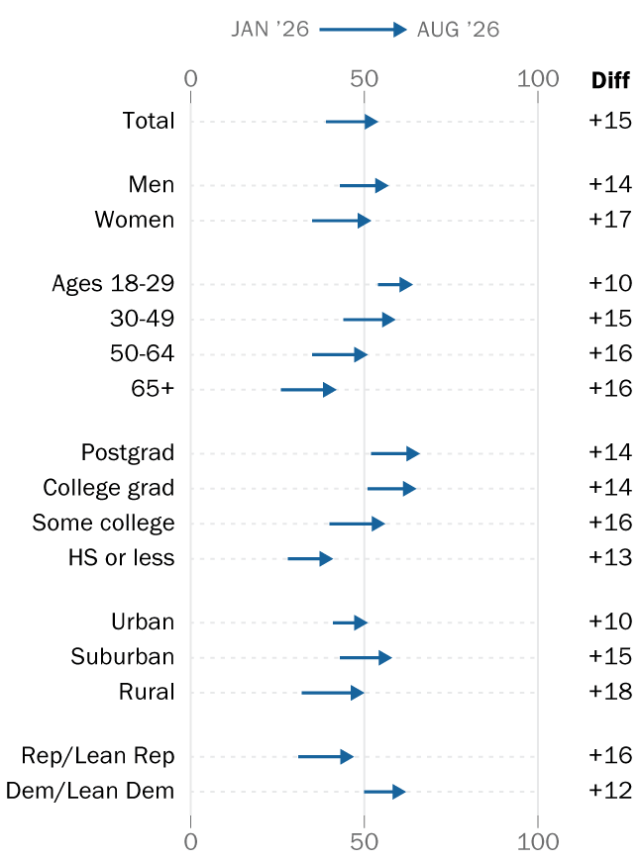
The data, gathered from a survey of 10,548 U.S. adults conducted between July 20 and August 9, 2026, reveals a sharp deterioration in sentiment. Since January 2026, the percentage of Americans who believe data centers have a "mostly bad" impact on the environment has surged from 39% to 54%.
Concerns over household economics are similarly intensifying. Half of the U.S. population now views data centers as detrimental to home energy costs, a 12-percentage-point increase from the start of the year. Perhaps most telling for local planners is the shift regarding community well-being: nearly half of all adults (49%) now say these facilities negatively affect the quality of life for those living nearby, a staggering leap from the 30% recorded in January.
While the debate over jobs and tax revenue remains more polarized and less settled, the trend line is unmistakably moving toward skepticism. The number of people who believe data centers are "mostly bad" for local employment has risen from 15% to 24%, while those viewing them as a burden on local tax revenue has increased from 12% to 21%. Across the board, only about 4% of Americans view data centers as having a "mostly good" impact on these critical community metrics.

A Chronology of Growing Resistance
The narrative of 2026 has been defined by a transition from passive acceptance to active opposition. At the beginning of the year, while infrastructure development was accelerating, the average citizen had little direct engagement with the concept of a data center.
By the spring of 2026, reports began to surface of localized protests, particularly in states where the physical footprint of these facilities is most visible. As the year progressed, this grassroots resistance found its way into legislative halls. Local and state politicians, responding to constituents concerned about noise, land use, and grid capacity, began to push back.
The peak of this shift appears to have arrived in August 2026, when the political divide became stark. While the federal executive branch, led by President Donald Trump, has maintained a stance of vocal support—positioning data centers as vital to U.S. technological and AI dominance—state-level leaders have begun to break rank. Texas Governor Greg Abbott’s August decision to issue a statewide moratorium on new data center development served as a lightning rod for the debate, signaling that even in business-friendly regions, the "infinite growth" model of digital infrastructure is meeting physical limits.
The Data Behind the Discontent
The Pew Research Center’s findings suggest that this shift is not confined to any single demographic or geographic silo. Rather, it is a broad-based movement that transcends partisan, educational, and urban-rural lines.
Environmental and Economic Impact
The most striking data point remains the environmental concern. With 54% of Americans now viewing the environmental impact as negative, the industry’s massive consumption of electricity and water has clearly entered the public consciousness. This sentiment is mirrored in the 50% of respondents who blame these centers for rising home energy costs. As the demand for AI compute power grows, the competition for grid capacity between residential consumers and data center operators has become a tangible kitchen-table issue.

The Demographic Breakdown
The decline in positive sentiment is pervasive across demographic subgroups:
- Age: Younger adults (18-29) are the most critical, with 64% now viewing data centers as bad for the environment. However, the most significant shifts occurred among older demographics (50-64 and 65+), who saw a 16-point jump in negative sentiment.
- Education: Higher education levels appear to correlate with a more critical view. Among postgraduates, 66% now categorize data centers as "mostly bad" for the environment, up from 52% in January.
- Geography: While urban and suburban residents have long expressed concerns, the most dramatic shift has occurred in rural areas. With most new, large-scale data centers being planned for rural plots to utilize cheaper land and lower tax burdens, rural residents have seen their negative outlook on the environment jump from 32% to 50% in just eight months.
Partisan Nuance
While Democrats continue to be more critical than Republicans, the gap is narrowing as skepticism grows among the latter. In January, only 24% of Republicans viewed data centers as a negative influence on local quality of life; by August, that figure had climbed to 42%.
Official Responses and the Policy Tug-of-War
The political landscape is currently characterized by a struggle between federal economic ambition and local governance.
On the federal level, the administration remains committed to data center expansion, viewing it as the primary engine for maintaining a competitive edge in global AI development. This strategy relies on the assumption that infrastructure, once built, will pay dividends in economic growth and technological leadership.
Conversely, the state and local levels are dealing with the immediate externalities of that growth. In Pennsylvania, Governor Josh Shapiro has recently pivoted to advocate for stricter oversight and environmental regulations, reflecting a growing sentiment among Democratic leaders that the current, unchecked expansion is unsustainable. Similarly, in Illinois, Governor JB Pritzker’s move to suspend certain tax breaks for data centers highlights a growing trend: the re-evaluation of public subsidies for an industry that is increasingly being viewed as a drain on local resources rather than a boon.
These political shifts are not merely symbolic. They represent a fundamental change in the "social license to operate" that tech companies have enjoyed for the past two decades.
Implications for the Future of Tech Infrastructure
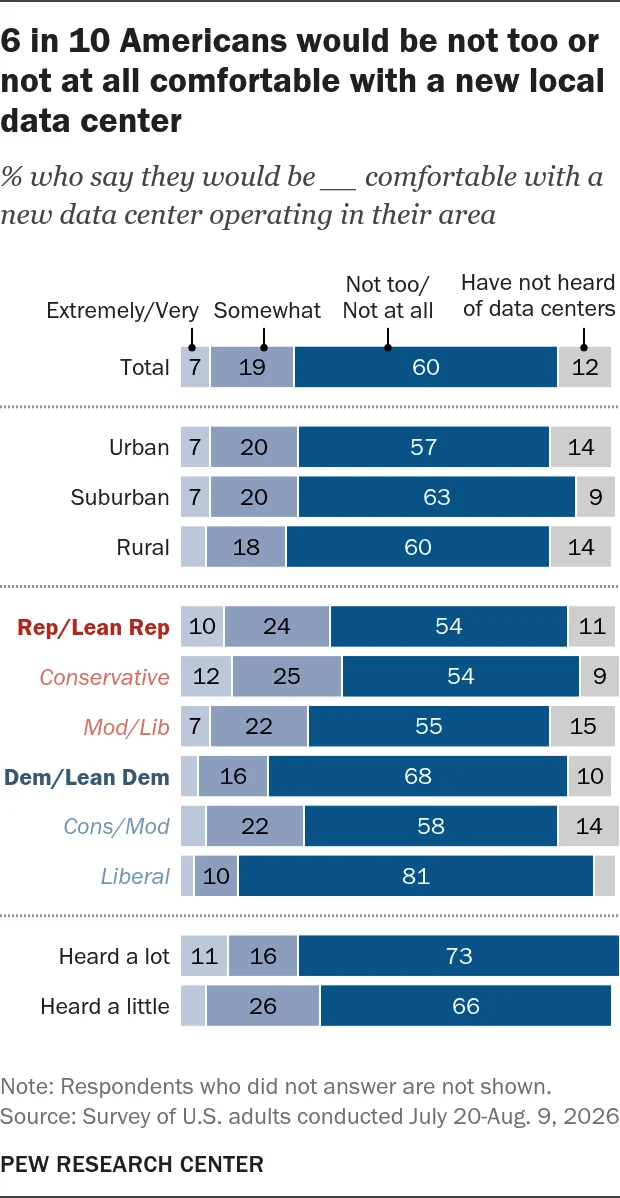
The implications of this survey are far-reaching. If 60% of the American public—a solid majority—would be uncomfortable with a new data center in their neighborhood, the pathway for future expansion becomes significantly more expensive and legally fraught.
1. The Cost of Opposition
For tech giants and real estate developers, the primary implication is an increase in the cost of development. Projects that were once "fast-tracked" will now likely face years of environmental impact studies, public hearings, and litigation. The cost of securing community support, or "social offsets," will likely become a standard line item in project budgets.
2. The Shift to Efficiency
Industry leaders will likely be forced to pivot their messaging and their technology. If the public perceives data centers as "bad for energy costs," companies will be compelled to invest more heavily in off-grid renewable energy sources, water recycling, and heat-recovery systems to neutralize these criticisms. The days of simply plugging a massive server farm into the local municipal grid without public scrutiny are likely coming to an end.
3. The Re-evaluation of "Digital Benefits"
Perhaps the most significant challenge for the tech industry is the erosion of the "jobs and taxes" argument. For years, developers have touted data centers as economic engines for local communities. The fact that the public is increasingly unconvinced—with many remaining neutral or skeptical—suggests that the industry has failed to demonstrate a clear, tangible value proposition to the average citizen.

Conclusion: A Turning Point for Digital Infrastructure
The 2026 Pew Research survey serves as a warning shot to the tech sector. The era of silent, invisible expansion is over. As Americans become more aware of what a data center is, they are also becoming more aware of the costs associated with it.
The challenge for the next decade will be to reconcile the insatiable demand for digital services with the local concerns of the communities that host the physical hardware. If the industry continues to ignore the rising tide of public skepticism, it risks a wave of regulatory hurdles that could stifle innovation. Conversely, if it learns to integrate with the needs of the community—by prioritizing local energy resilience, environmental stewardship, and transparency—it may be able to rebuild the trust that has clearly been lost.
As it stands, the data center is no longer just a technical marvel; it is a political flashpoint. The path forward requires more than just better hardware; it requires a new social contract between the architects of the digital age and the public they serve.