In the crowded landscape of digital navigation, a clear dichotomy has long existed: utility versus community. For years, tech giants like Google and Apple have dominated the map space by focusing on the "how"—the most efficient route, the shortest commute, and the most accurate business hours. However, a new report published by Snap Inc. suggests that the next frontier of mapping isn’t just about getting from point A to point B; it is about deciding where the "vibe" is, where your friends are, and what constitutes a culturally relevant experience.
Snap’s recent research into consumer behavior reveals a nuanced shift in how users interact with mapping technology. While utility-focused platforms remain the gold standard for logistical planning, Snap Map is carving out a unique niche as a "social map," serving as a digital bridge between online interaction and real-world congregation.
The Core Findings: A New Paradigm for Navigation
The report, developed in partnership with research firms eye square and Horizon, draws from a comprehensive survey of 17,000 digital map users aged 13 to 44. The study spanned six major global markets: the United States, Canada, the United Kingdom, France, Germany, and Saudi Arabia.
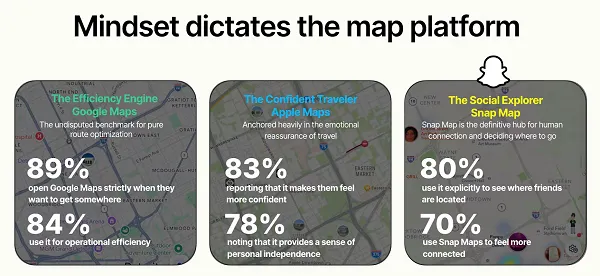
The primary takeaway is that the modern consumer utilizes a multi-platform approach to navigation. The user journey has become bifurcated: users turn to Google Maps or Apple Maps when they have "direct intent"—such as needing to find a specific address or checking store hours—but they turn to Snap Map when they are in a state of "discovery."
Snap argues that this represents a significant mindset shift for marketers. In the past, location-based advertising was purely about visibility in search results. Today, Snap suggests that reaching an audience requires showing up in the digital spaces where users are already "hanging out" and actively curating their social lives.
Chronology of Social Mapping: From Utility to Interaction
To understand why Snap is making this push, one must look at the evolution of the Snapchat platform.
- Early Days: Snapchat began as a ephemeral messaging service. The introduction of Snap Map in 2017 was initially met with skepticism regarding privacy, but it quickly became a staple for younger demographics.
- Expansion of Features: Over the years, Snap introduced "Places," allowing users to bookmark their favorite spots, share recommendations with friends, and view "Our Story" content tagged to specific geographic locations.
- The Pivot to Business: Recently, Snap has doubled down on monetizing these features. By introducing Promoted Places and incentivizing check-ins, the company is attempting to formalize the word-of-mouth recommendations that have organically occurred on the platform for years.
- The Present Moment: The current report acts as a strategic manifesto, positioning Snap Map not as a competitor to Google Maps’ utility, but as a complementary tool that provides the "social proof" that traditional maps lack.
Supporting Data: The Power of Social Proof
The survey data provides compelling evidence for the "ripple effect" of social discovery. Perhaps the most striking statistic provided by Snap is that consumers are 2.9 times more likely to discover their favorite real-world businesses on Snapchat than on other major social media platforms.
The platform boasts 450 million global monthly active users, a massive footprint that provides significant scale for businesses looking to tap into a younger, mobile-first audience. According to the survey:
- 76% of users consult Snap Map to see where their friends are currently located.
- 27% of users actively use the map to coordinate face-to-face meetups.
These numbers highlight that for the Gen Z and Millennial cohorts, the map is not just a navigational tool—it is a social communication channel. When a user sees their friend at a particular cafe or restaurant on the map, it serves as a powerful, high-trust endorsement that traditional banner ads cannot replicate.
Official Responses and Strategic Positioning
In its official commentary, Snap emphasized the importance of brands becoming a part of the "social canvas."
"Snapchat transforms the traditional map into an interactive canvas for social connection," the company stated. "Snap Map extends connection into the real world by helping people discover where life is happening, highlighting what’s happening nearby, and guiding people to explore culturally relevant places."
The company suggests that businesses that fail to maintain a presence on social maps are missing out on a critical stage of the consumer journey. By utilizing features like bookmarking and promoted listings, brands can move from being "search results" to being "destinations." Snap’s message to marketers is clear: to remain relevant, brands must show up where consumers are browsing, gathering social proof, and deciding where to spend their time.
Implications: The Reality of the Market Split
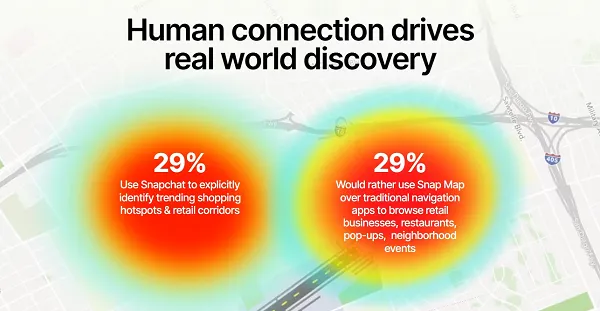
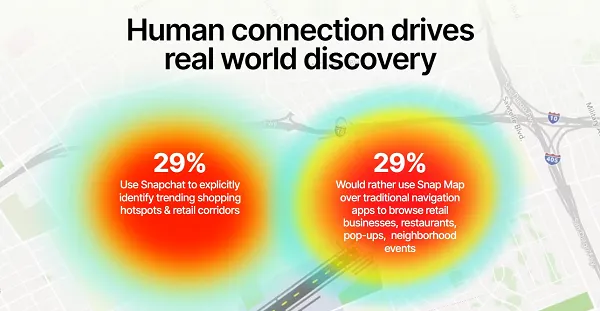
While Snap’s data is compelling, it is important to contextualize it within the broader ecosystem of mapping tools. The report indicates that roughly one-third of respondents use Snap Map to discover businesses. While this is an impressive figure, it also means that, conversely, approximately 70% of the surveyed population does not prioritize Snap Map for business discovery.
This creates a clear implication for marketing strategy: The "Both/And" Approach.
The Utility Advantage
For high-intent tasks, such as finding a pharmacy or a gas station, Google Maps remains the undisputed king. Businesses that neglect their Google Business Profile do so at their own peril. The search volume and integration with search engines make Google Maps the primary tool for "utility-first" discovery.
The Social Advantage
Snap Map occupies the "leisure-first" territory. It is where users go when they are deciding where to spend a Friday night, where to meet for a first date, or which trendy spot their friends have been frequenting. This is "discovery" in the truest sense of the word—it is driven by curiosity, social status, and FOMO (fear of missing out), rather than logistical necessity.
Strategic Recommendations for Marketers
Based on the current trends, brands should consider the following:
- Prioritize Utility for Infrastructure: Ensure that hours, locations, and contact information are perfectly optimized on Google and Apple Maps. This is the foundation of customer acquisition.
- Optimize for Social Presence: On platforms like Snap Map, focus on visual appeal and social context. Use Promoted Places to appear in the "nearby" feeds of users who are already in the vicinity and looking for a social outing.
- Incentivize User Content: Since social discovery is driven by word-of-mouth, brands should create "Instagrammable" or "Snap-worthy" moments that encourage users to check in or share their location. Every check-in acts as a digital billboard for the business to the user’s entire social circle.
The Future of Social Discovery
The evolution of Snap Map represents a broader trend in technology: the "socialization" of every digital interface. Just as shopping has become social through platforms like TikTok and Instagram, navigation is becoming social through platforms like Snapchat.
As we look toward the future, the boundary between the map and the social feed will likely continue to blur. Augmented Reality (AR) integration—a core competency for Snap—could further revolutionize this space. Imagine walking down the street and seeing virtual pins or "Snap-tagged" reviews floating above storefronts, placed there by your friends. This is the logical conclusion of the path Snap is currently carving.
Ultimately, the takeaway for business owners and marketers is that the "map" is no longer just a static image of streets and buildings. It is a dynamic, living layer of the real world, influenced by the habits, preferences, and social movements of the people using it. Whether the platform is a utility-first tool or a social-first app, the goal remains the same: to be visible at the exact moment a consumer decides to step out into the real world. By balancing traditional search optimization with the emerging power of social mapping, brands can ensure they are not just found, but chosen.