In the rapidly evolving landscape of artificial intelligence, understanding the structural "DNA" of a model is no longer a luxury—it is a necessity. As researchers and developers pivot toward increasingly complex, multi-modal, and modular architectures, the traditional method of navigating Hugging Face repositories has hit a bottleneck. For years, practitioners have been forced to manually parse dense JSON configuration files, decipher recursive layer definitions, and rely on scattered documentation to mentally reconstruct the internal flow of a neural network. This process is not only tedious but highly susceptible to human error.
Enter HFViewer, a transformative tool designed to bridge the gap between abstract code and architectural intuition. By converting complex model configurations into interactive visual graphs, HFViewer is changing the way engineers, researchers, and students audit the backbone of modern AI.
The Challenge: The "Black Box" Problem in Model Repositories
When you open a model repository on Hugging Face—such as the high-performing DeepSeek-V4-Pro—you are typically greeted by a wall of data: config.json files spanning thousands of lines, parameter counts, and model cards that provide high-level summaries. While these resources explain what a model does, they are notoriously opaque regarding how the model is constructed internally.
For a developer looking to prune a model, implement a custom layer, or simply debug a performance bottleneck, this information is fragmented. One must cross-reference various files to understand the sequence of attention blocks, normalization layers, and routing logic. This cognitive load often discourages deep exploration, leading many developers to treat these sophisticated systems as "black boxes" rather than modular engineering feats.
A New Paradigm: The URL-First Approach
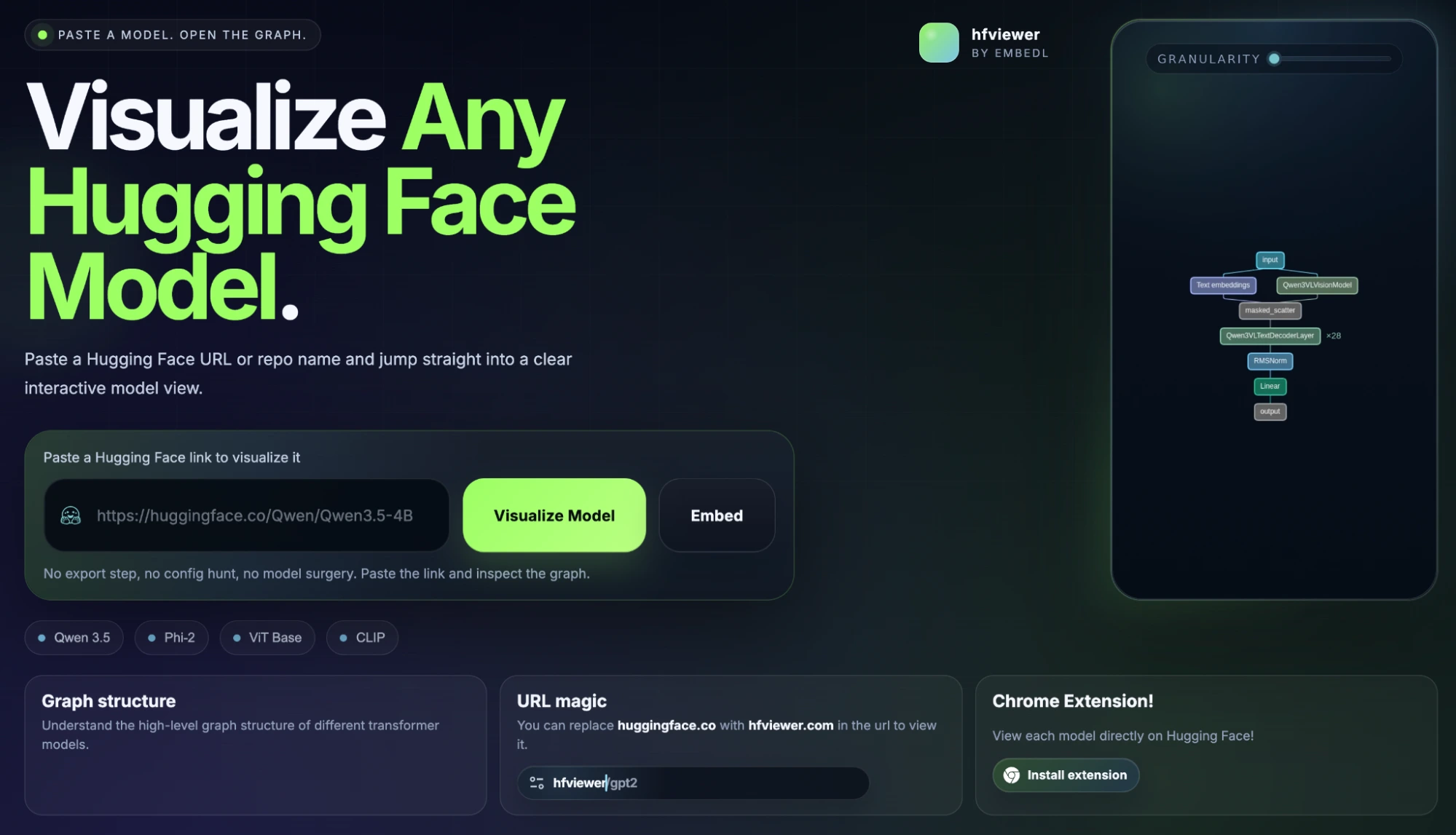
The core value proposition of HFViewer is its radical simplicity. It removes the friction of installation, environment setup, and dependency management. The tool operates on a simple, elegant mechanism: The URL Trick.
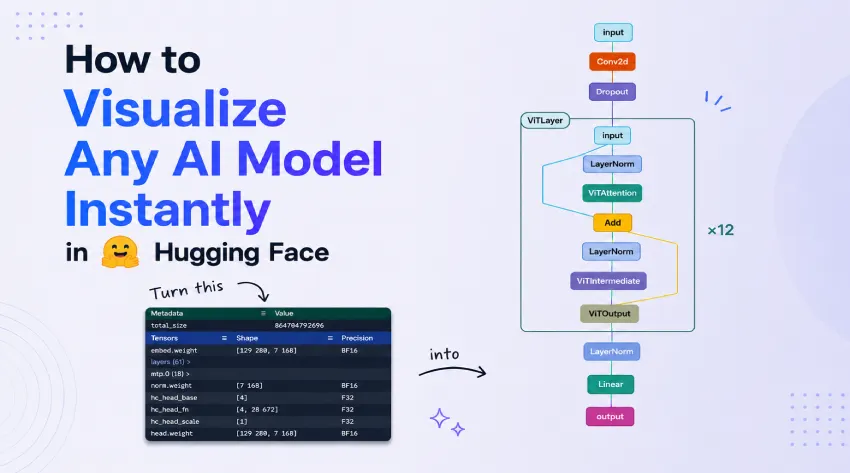
By substituting the domain huggingface.co with hfviewer.com in any standard model URL, users are instantly redirected to a rendered, interactive visualization of that specific model’s architecture.
- Standard URL:
https://huggingface.co/deepseek-ai/DeepSeek-V4-Pro - HFViewer URL:
https://hfviewer.com/deepseek-ai/DeepSeek-V4-Pro
Upon hitting enter, the browser renders a dynamic graph where the user can zoom, pan, and click through individual layers. This transformation of static text into a navigable map allows for a "top-down" view of the model’s design, turning hours of tedious reading into seconds of visual analysis.
The Chronology of Model Inspection
The history of model inspection has moved through three distinct phases:
- The Era of Manual Documentation (2017–2020): Practitioners relied almost exclusively on academic papers or GitHub README files to understand architectures. Code was the only truth, and it was often poorly documented.
- The Era of Config Files (2020–2024): With the rise of the Hugging Face ecosystem, the
config.jsonstandard became the industry benchmark. This was an improvement but left the structural relationship between layers implicit rather than explicit. - The Era of Interactive Visualization (2025–Present): Tools like HFViewer represent the current frontier. By treating model architecture as a visual asset rather than a static text file, the barrier to entry for understanding state-of-the-art AI systems has been significantly lowered.
Supporting Data: Why Complexity Demands Visualization
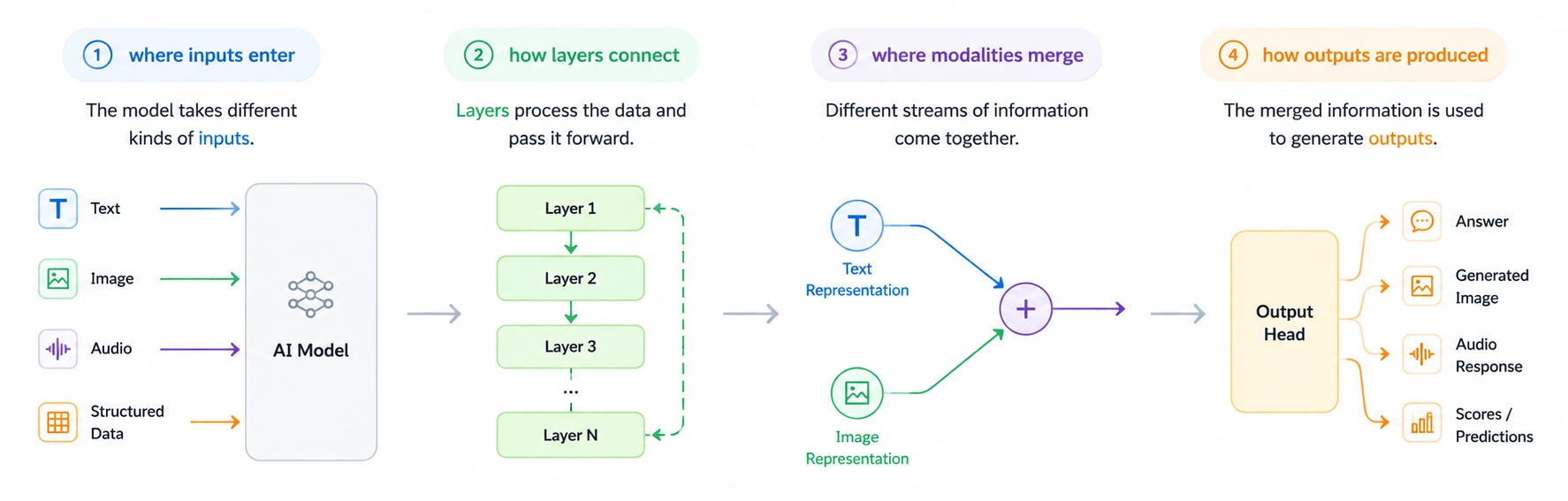
The demand for such a tool is backed by the sheer scale of current architectures. A contemporary Large Language Model (LLM) or Multimodal model is no longer a simple sequence of layers. They now feature:
- Attention Blocks: Multi-head, grouped-query, and sliding-window attention mechanisms.
- Vision Encoders: Complex patches for image processing integrated into the language backbone.
- Routing Logic: Mixture-of-Experts (MoE) layers that dynamically decide which parts of the network to activate.
- Projection Layers: Bridges between different modalities (text, audio, vision).
When these components are stacked, the "mental map" of a developer is easily overwhelmed. Visualization tools provide an objective, data-backed representation of these hierarchies. Studies in cognitive ergonomics suggest that visual representation of complex systems reduces the time required for knowledge acquisition by up to 60%, a metric that is critical in the fast-paced world of AI development.
Integration: From Terminal to Browser
For power users, HFViewer provides multiple access points that fit into existing workflows.
1. The Terminal Interface
Developers can bypass the browser search entirely by using command-line interface (CLI) commands. Whether you are on Linux, macOS, or Windows, you can trigger the visualization directly:
- Windows (PowerShell):
start https://hfviewer.com/google/vit-base-patch16-224 - Linux/Unix:
xdg-open https://hfviewer.com/google/vit-base-patch16-224
This integration is vital for engineers who spend most of their time in the terminal, allowing them to verify model structures without breaking their flow state.
2. The Browser Extension
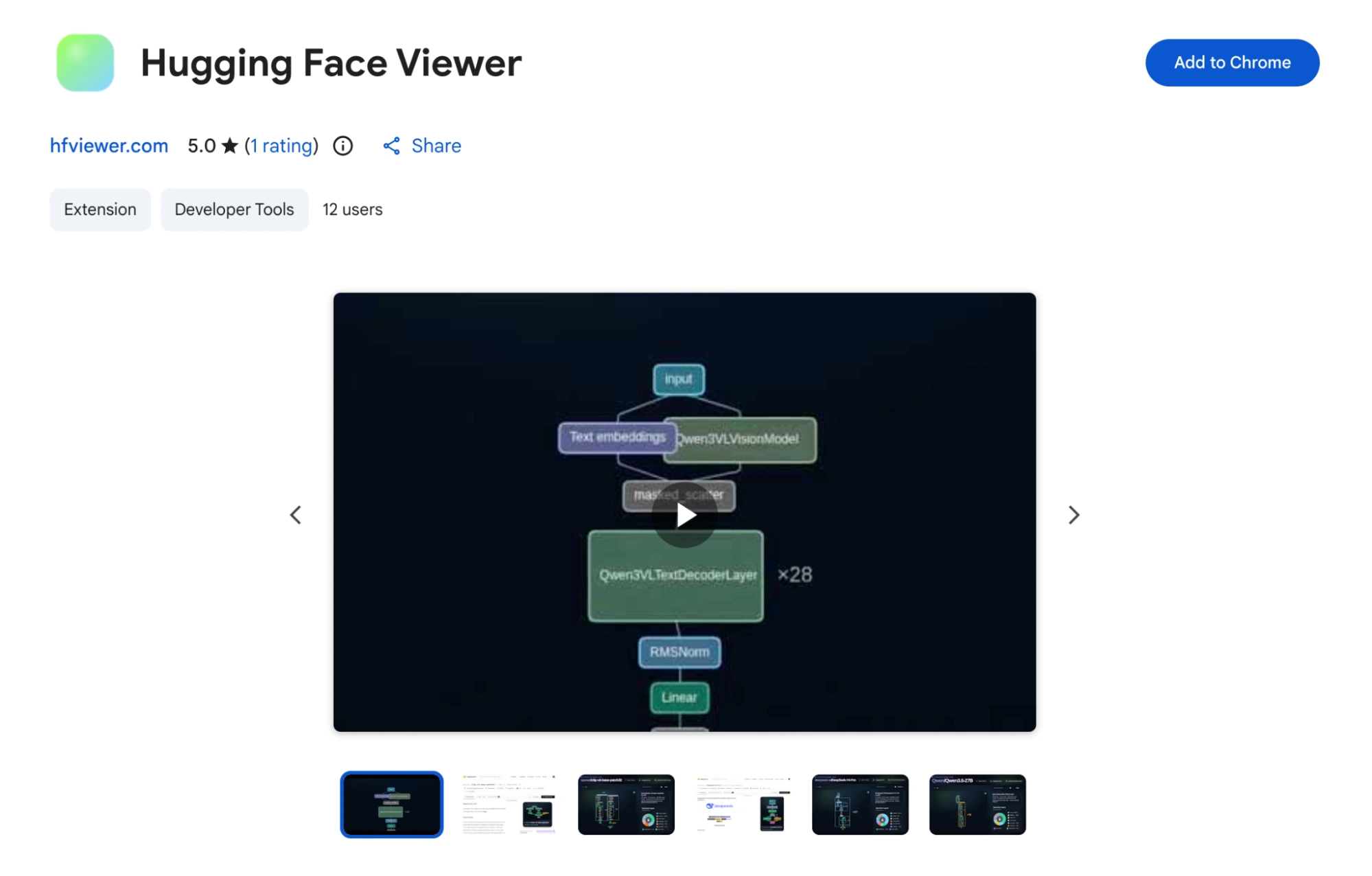
For those who live on Hugging Face, the official Hugging Face Viewer browser extension is the most efficient solution. Once installed, it adds a button directly to the model repository page. This effectively upgrades the standard web interface, making structural visualization a native feature of the browsing experience. This is particularly useful for comparing two different versions of a model or evaluating different architectures within a specific family.
Implications for the AI Community
The existence of HFViewer has broader implications for the transparency and reproducibility of AI research.
Democratizing AI Literacy
By making architectures accessible to visual learners, HFViewer lowers the barrier for students and junior developers to enter the field. When the internal structure of a model is legible, it stops being "magic" and starts being engineering.
Accelerating Debugging
In professional environments, "model drift" or unexpected inference behavior is often rooted in a misunderstanding of how layers are initialized or connected. Visual inspection allows developers to catch structural errors—such as incorrect dimension projections or missing skip connections—before they spend compute cycles on training or fine-tuning.
Standardizing Model Audits
As AI regulation becomes more common, the ability to perform a "structural audit" will be paramount. Regulators and third-party researchers will need tools that allow them to quickly inspect the architecture of models that claim to have specific safety or performance characteristics. HFViewer provides a standardized, objective baseline for these inspections.
Frequently Asked Questions
Q1. Does HFViewer store my model weights or private data?
A. No. HFViewer performs static analysis on public configuration files. It does not download or process your model weights, nor does it require access to your private Hugging Face account.
Q2. Is it compatible with all Hugging Face models?
A. The tool supports the vast majority of standard architectures. However, for extremely custom or experimental models that use non-standard configuration formats, the visualization may be limited to the available JSON metadata.
Q3. How does this differ from the model.summary() method in PyTorch?
A. model.summary() requires you to instantiate the model, which consumes significant RAM and GPU memory. HFViewer is a lightweight, metadata-driven approach that works instantly without requiring the model to be loaded into memory.
Conclusion
As AI models continue to grow in modularity and scale, the gap between "code" and "concept" will only widen. We have reached a point where the human brain can no longer reliably trace the architectural paths of a billion-parameter system via raw text.
Tools like HFViewer represent a necessary evolution in our development toolkit. They remind us that while the math behind AI is complex, our ability to interact with that math should not be. By simply changing a URL, we move from passive consumption to active inspection, ensuring that we remain the masters of the systems we build, rather than just observers of their output. As the industry advances, the ability to "see" the AI will prove to be just as important as the ability to train it.