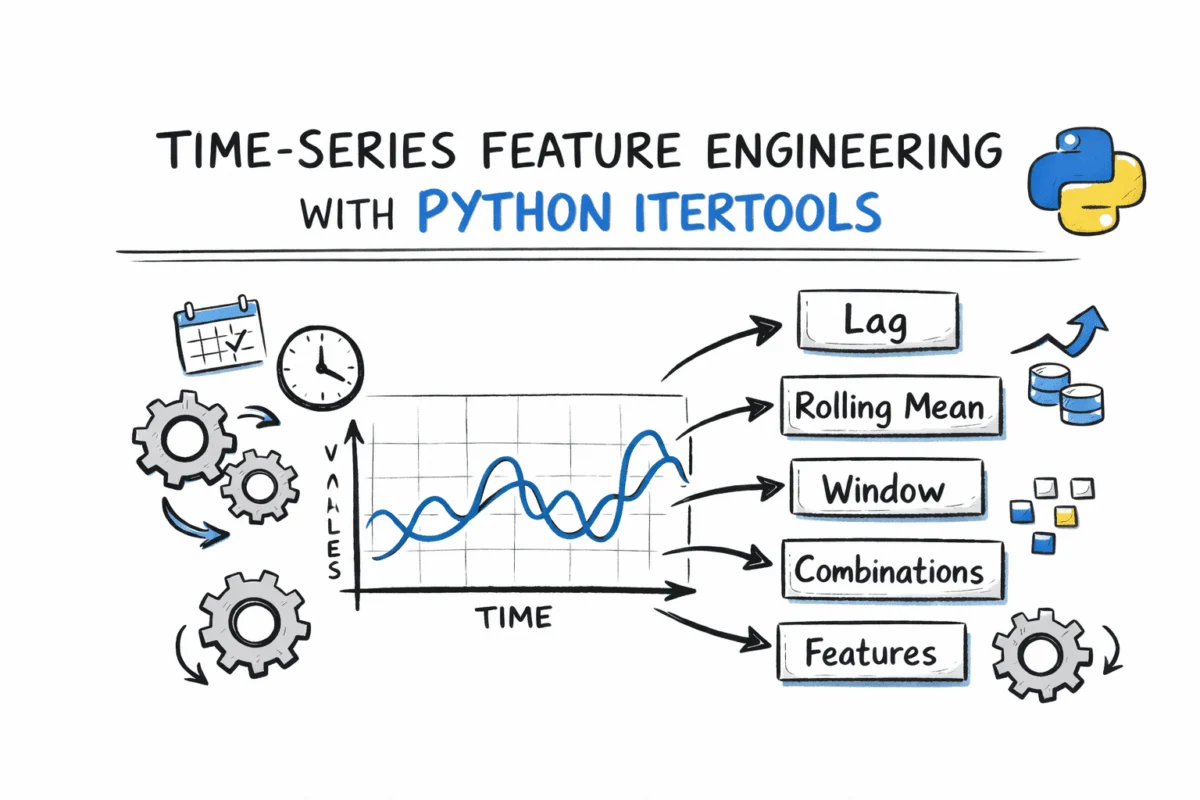
In the realm of data science, tabular data often behaves predictably. Features are typically independent, and the row order is frequently incidental—a mere artifact of data collection. However, time series analysis shatters these conventions. In this domain, observations are inherently linked by the temporal dimension; the sequence matters as much as the values themselves. Consequently, the most predictive signals are rarely found in raw, individual readings, but rather in the patterns that emerge across time: rates of change, seasonal shifts, rolling baselines, and cross-variable dependencies.
While high-level libraries like pandas offer powerful abstractions such as .rolling() and .shift(), there is significant utility in understanding the lower-level mechanics of sequence processing. This is where Python’s itertools module becomes an indispensable tool in the data scientist’s kit. By leveraging the primitives of iteration, developers can construct highly customized, efficient, and memory-conscious features that provide a nuanced view of temporal data.
The Paradigm Shift: Why Itertools Matters
Time series feature engineering is, at its core, an exercise in iteration over ordered sequences. Whether you are building sliding windows or grouping data across different temporal resolutions, you are essentially defining a window and moving it across a stream of data.
itertools does not aim to replace the convenience of pandas. Instead, it provides the "building blocks" of iteration. Using these tools allows for full control over the underlying logic, ensuring that feature construction remains efficient, readable, and highly extensible—especially when moving from batch processing to real-time streaming pipelines.
Establishing the Baseline: A Synthetic Sensor Environment
To explore these concepts, we must first establish a controlled environment. We will simulate a sensor dataset representing one week of hourly readings, encompassing temperature, humidity, and power consumption—variables that exhibit distinct daily cycles, trends, and noise.
import numpy as np
import pandas as pd
import itertools

# Simulation parameters
np.random.seed(42)
periods = 168  # One week of hourly readings
index = pd.date_range(start="2024-03-01", periods=periods, freq="h")
hours = np.arange(periods)

# Synthetic data generation
temp_base = 3.5
temp_daily = 1.2 * np.sin(2 * np.pi * hours / 24)
temp_drift = 0.003 * hours
temp_noise = np.random.normal(0, 0.3, periods)
temperature = temp_base + temp_daily + temp_drift + temp_noise

humidity = 78 - 2.1 * (temperature - temp_base) + np.random.normal(0, 1.2, periods)
power = (42.0 + 18.0 * ((index.hour >= 8) & (index.hour <= 18)).astype(int) *
         np.where(index.dayofweek >= 5, 0.6, 1.0) + np.random.normal(0, 2.1, periods))

df = pd.DataFrame("temperature_c": np.round(temperature, 3),
                   "humidity_pct": np.round(humidity, 2),
                   "power_kw": np.round(power, 2), index=index)
1. Lag Features: Peering into the Past with islice
Lag features are the foundational stones of temporal modeling. They represent the value of a variable at fixed intervals in the past. By comparing current readings to those from 1, 6, or 24 hours ago, we capture short-term fluctuations and long-term seasonality.
itertools.islice is highly efficient for this task. It allows us to slice an iterator without creating intermediate copies of the entire list. By padding the beginning of our sequence with None (or zeros), we ensure that the resulting features remain perfectly aligned with our original index, a critical requirement for training machine learning models.
2. The Mechanics of Rolling Windows
Rolling statistics—such as mean, standard deviation, and range—provide a "smooth" view of data, filtering out high-frequency noise. While pandas handles this natively, using itertools.islice combined with accumulate allows for a granular, step-by-step calculation.
The accumulate function is particularly efficient; it computes the running sum of a window in a single pass. For large-scale datasets, this approach minimizes redundant operations. As the window slides, we avoid the overhead of repeatedly calling sum() on a slice, which would result in $O(N times W)$ complexity; instead, we maintain an incremental state, optimizing the calculation for performance.
3. Seasonal Interaction: The Power of product
Real-world time series rarely exist in a vacuum. They are influenced by layered seasonality: the hour of the day, the day of the week, and operational shifts. itertools.product enables the creation of a Cartesian product of these dimensions.
By generating a "lookup grid," we can create categorical interactions that define expected behaviors. For example, a "weekday/on-peak" shift will have a different baseline expectation than a "weekend/off-peak" shift. Mapping these back to our main dataset provides a powerful feature for anomaly detection: if the current reading deviates significantly from the seasonal baseline, it may signal an operational fault or an outlier.
4. Parallel Processing with tee
In complex feature engineering, we often need to compute multiple statistics (mean, range, rate-of-change) from the same window of data. Typically, this would involve multiple passes over the list. itertools.tee solves this by creating independent iterators from a single source.
By "teeing" our window, we can pipe the same data into multiple analysis functions simultaneously. This is a memory-efficient way to parallelize feature extraction, ensuring that we only traverse the data source once while outputting a multidimensional feature set.
5. Multi-Resolution Synthesis with chain
Data scientists often work with multiple temporal resolutions—hourly, daily, and rolling averages—which must be flattened into a single feature vector for model input. itertools.chain is the elegant solution for concatenating these disparate lists.
As the feature set grows, chain acts as a clean, readable glue. It enables the assembly of features into logical groupings (e.g., raw sensors, rolling statistics, calendar indicators) without the syntax clutter of manual list appending or deep nested loops.
6. Pairwise Dynamics: Using combinations
The relationship between two sensors (e.g., how temperature impacts humidity) is often more predictive than the sensors themselves. itertools.combinations allows for the systematic generation of pairwise relationships across all sensor columns.
By calculating a rolling correlation, we can observe when the expected coupling of two sensors breaks down. This "decoupling" is often a primary indicator of system degradation or structural change in a time series. The programmatic generation of these features ensures that even as the number of sensors increases, our feature engineering code remains concise and scalable.
7. Operational Baselines: The accumulate Advantage
Finally, we address the "running baseline." In many industrial applications, understanding how a value compares to the historical average since the system start-up is crucial. Using accumulate to track both the sum and the count of readings allows us to derive a running mean in linear time.
This provides a real-time "drift" metric. If a sensor’s deviation from its running mean begins to grow, it serves as a non-parametric early warning system for long-term wear and tear, far more intuitive than raw values alone.
Implications for Data Engineering
The methods outlined here demonstrate that feature engineering is not merely about using library defaults; it is about architectural design. By adopting a functional, iterator-based approach, data scientists gain three major advantages:
- Memory Efficiency: By avoiding the creation of large intermediate data structures, these techniques are suitable for processing massive files that exceed available RAM.
- Streaming Readiness: Because
itertoolsoperates on iterators, the logic remains identical whether you are processing a static CSV file or a live stream from an IoT gateway. - Modular Logic: Each tool provides a specific, reusable primitive. When a new feature requirement emerges, it can often be composed from existing
itertoolsfunctions rather than written from scratch.
Conclusion: Bridging the Gap
Time series feature engineering is fundamentally about describing context. The goal is to translate a raw stream of numbers into a language that machine learning models—whether they are simple linear regressions or complex gradient-boosted trees—can understand.
While pandas remains the workhorse for most data scientists, the underlying itertools module provides the flexibility and granular control required for high-performance, custom temporal feature engineering. As you continue to refine your pipelines, remember that the most effective features are often those that best capture the temporal narrative of your data. By mastering the art of the iterator, you move beyond mere data manipulation and into the realm of intelligent signal processing.