
The era of "bigger is better" is officially over. As we navigate through 2026, the landscape of Large Language Model (LLM) research has undergone a fundamental transformation. For years, the industry’s primary objective was scaling—more parameters, larger datasets, and massive compute clusters. Today, the focus has shifted toward the "Four Pillars" of mature AI: Safety, Controllability, Agentic Utility, and Interpretability.
For researchers, data scientists, and GenAI developers, 2026 marks a turning point where the goal is no longer just to create a smarter model, but to create a model that can be trusted to act in complex, real-world human environments.
The State of AI Research: A New Paradigm
The research papers identified this year, curated via community metrics on Hugging Face, highlight a move away from raw performance toward precision. We are seeing a maturation of the field where the most cited papers are those that address the "last mile" of AI deployment: preventing manipulative behavior, ensuring temporal reasoning accuracy, and mitigating invisible security vulnerabilities.
Chronology of Innovation (2026 Highlights)
The first half of 2026 has provided a roadmap for the next decade of AI development. The following ten research contributions represent the most significant breakthroughs in the field, moving from theoretical experimentation to robust engineering.

1. AI Co-Mathematician: The Rise of Agentic Workbenches
Mathematical research is notoriously non-linear, requiring iterative hypothesis testing, literature reviews, and rigorous verification. The AI Co-Mathematician paper (Google DeepMind) proposes a shift from one-shot prompting to a stateful, agentic workspace. By employing parallel agents to handle distinct sub-tasks—such as theorem proving and citation verification—this framework allows AI to function as a collaborative partner rather than a simple oracle.
2. Cola DLM: Rethinking Architecture
Autoregressive models (predicting the next token) have dominated the field, but they are computationally expensive and prone to drift. Cola DLM introduces a continuous latent diffusion approach. By planning in a compressed latent space before decoding into natural language, this model offers a scalable alternative that reduces the "myopic" nature of traditional token-by-token generation.

3. The Manipulation Threshold: AI Safety
One of the most consequential studies of the year, Evaluating Language Models for Harmful Manipulation, addresses the social impact of AI. As LLMs become integrated into finance, policy, and healthcare, the risk of models subtly influencing human belief systems is no longer a hypothetical concern. This study provides a robust evaluation framework tested across diverse international demographics, setting a new standard for ethical deployment.
4. SteerEval: Quantifying Controllability
How do we ensure a model stays within its "guardrails" without compromising its creativity? SteerEval offers a granular benchmark for measuring behavioral control. Whether adjusting for tone, personality, or safety constraints, this research provides the diagnostic tools necessary to verify that an LLM is following fine-grained steering instructions rather than simply hallucinating compliance.

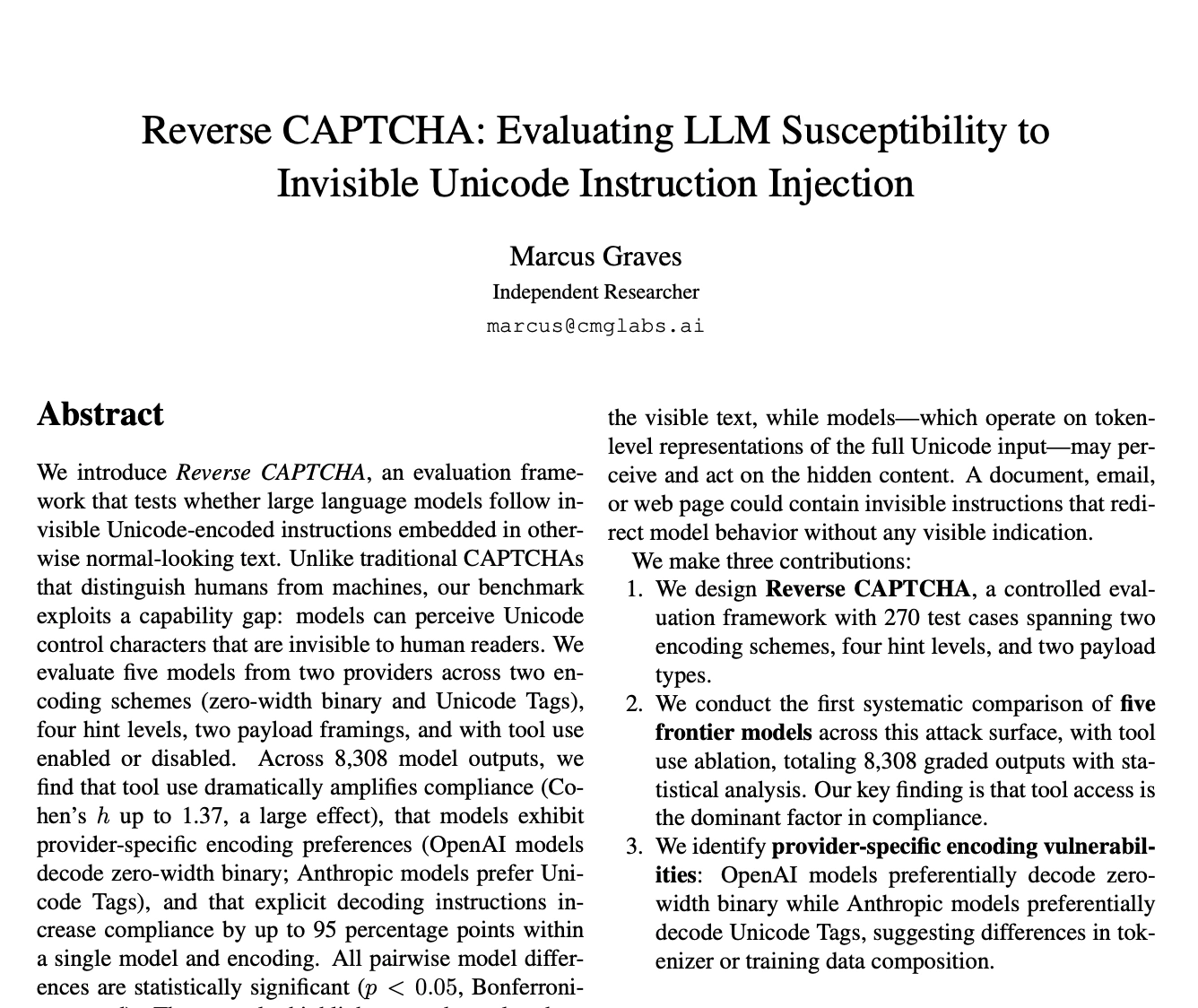
5. Reverse CAPTCHA: Security in the Invisible
In a world of prompt injection, the most dangerous attacks are the ones users cannot see. The Reverse CAPTCHA research exposes how LLMs can be tricked via invisible Unicode character injections. This study highlights a critical vulnerability in current LLM architectures, forcing developers to rethink how models sanitize input and process non-visible metadata.
6. AdapTime: Mastering Temporal Reasoning
Temporal intelligence—the ability to understand "when" and "how long"—remains a notorious blind spot for LLMs. AdapTime introduces a dynamic reasoning method that allows the model to adjust its cognitive strategy (e.g., rewriting the query or reviewing previous steps) based on the temporal complexity of the prompt, significantly improving performance on time-sensitive tasks without needing external tools.

7. Tool-DC: Solving the "Noisy Tool" Problem
As agentic systems grow in complexity, they are often given access to dozens of APIs and tools. This causes "tool-calling noise," where the model becomes overwhelmed. The Tool-DC (Divide-and-Conquer) framework implements a "Try, Check, and Retry" loop, allowing the model to segment its tool-calling strategy, resulting in vastly higher success rates in long-context environments.
8. FinRetrieval: Benchmarking Financial Accuracy
In high-stakes industries like finance, a hallucinated digit can cost millions. FinRetrieval provides a standardized benchmark for agentic data retrieval. By testing 14 different agent configurations across major LLM providers, the researchers identified significant gaps in how models query structured versus unstructured financial databases, providing a blueprint for more accurate enterprise AI.

9. Behavioral Transfer: The Privacy of Personality
Perhaps the most intriguing study of the year explores whether AI agents inherently mirror their human owners. By analyzing over 10,000 human-agent pairs, researchers discovered that agents can inadvertently leak user biases and behavioral patterns. This has profound implications for user privacy, as it suggests that "personalizing" an agent may also involve a hidden risk of exposing sensitive, implicit human behavior.
10. Latent Distilling: The Future of Exploration
To improve the creativity and novelty of AI outputs, researchers have introduced Exploratory Sampling. Unlike traditional temperature-based sampling, this method uses a test-time distiller to identify novelty in hidden representations. By guiding the model toward semantically diverse responses, it significantly improves the utility of LLMs in brainstorming and research tasks.

Implications for the AI Ecosystem
The transition from "scale" to "utility" brings with it several critical implications for the industry.
The Rise of Interpretability
The focus on "latent distillation" and "behavioral transfer" confirms that the "black box" nature of LLMs is becoming unacceptable. Companies are now under pressure to provide interpretability reports, ensuring that the logic behind an AI’s decision is traceable. This shift is essential for regulatory compliance, particularly in the European and North American markets where AI governance laws are tightening.

Agentic Security as a Priority
The findings regarding Unicode injection and behavioral transfer highlight that as agents gain autonomy, they inherit the security risks of the systems they interact with. Future research will likely focus on "Agentic Firewalls"—specialized layers that sit between the agent and the outside world to verify intent and sanitize communications.
The Economic Shift
The economic value of AI is moving away from the providers of base models toward the providers of agentic frameworks. Developers are increasingly interested in systems that can reliably execute long-term tasks (like the AI Co-Mathematician) rather than just providing a single, static answer. This will drive a new wave of venture capital investment into specialized, domain-specific agentic tools.

Final Takeaway: The Human-AI Interface
The synthesis of this year’s research points to a singular, overarching question: Can we build AI systems that are inherently controllable, secure, and useful within the chaos of real-world human environments?
The progress made in 2026 suggests that the answer is a cautious "yes." However, the path forward requires moving away from the hype of parameter counts and toward the meticulous work of benchmark creation, security auditing, and behavioral analysis. As AI agents begin to represent us, work for us, and think with us, the most important research will be that which ensures these systems remain predictable, secure, and—above all—aligned with human intent.

The industry is currently in a "calibration phase." While the massive compute power of the early 2020s gave us the engine, the 2026 research is giving us the steering, the brakes, and the navigation system. For developers, the message is clear: focus on the edge cases, the security vulnerabilities, and the interpretability of your agentic workflows. That is where the next generation of value will be built.