
Introduction: The Changing Landscape of Data Manipulation
For over a decade, Pandas has been the undisputed heavyweight champion of Python-based data manipulation. It transformed the way data scientists, analysts, and researchers handle tabular data, turning complex ETL (Extract, Transform, Load) tasks into concise, readable code. Its intuitive API and massive ecosystem made it the bedrock of the Python data stack.
However, the modern data environment has shifted. As organizations scale their operations, datasets have grown from thousands of rows to millions, and from gigabytes to terabytes. In this high-velocity environment, the "Pandas ceiling"—the point where memory overhead and sequential execution become bottlenecks—has become a significant pain point for developers. This is where Polars enters the fray, promising a more efficient, parallelized, and memory-conscious future.
Built in Rust and powered by the Apache Arrow memory format, Polars is not just a faster alternative to Pandas; it is a fundamental rethinking of how DataFrames should interact with modern CPU architectures.
The Core Problem: Why Pandas Hits a Wall
Pandas was designed for a different era of computing. Its design choices—specifically its reliance on single-threaded execution and eager evaluation—were revolutionary in 2008 but are increasingly suboptimal for modern multicore processors.
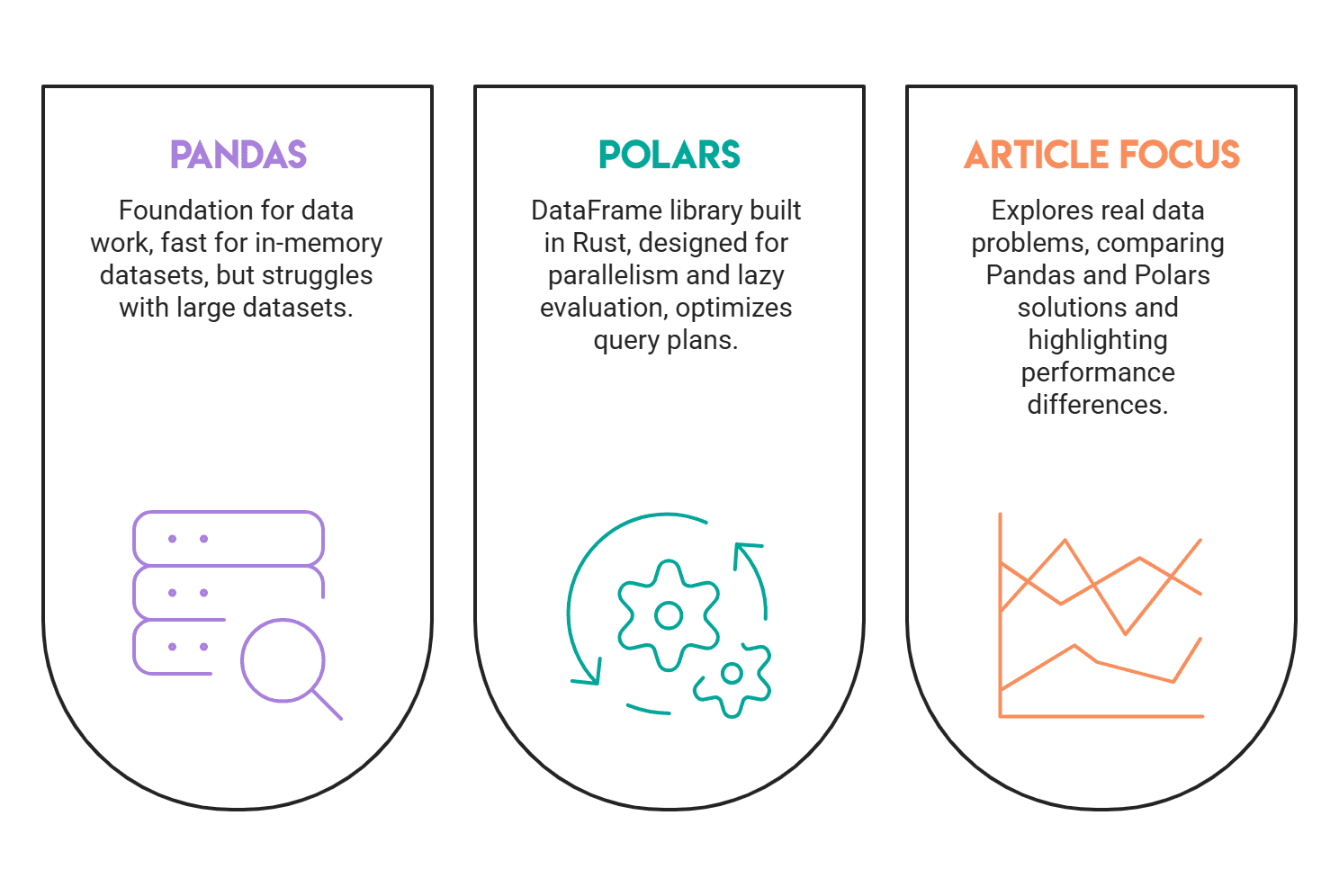
When a dataset exceeds available RAM, Pandas often forces users to implement cumbersome chunking or resort to distributed computing frameworks like Dask or Spark, which introduce their own levels of complexity. Common operations such as groupby, merge, and window functions often require intermediate memory allocations, creating massive temporary copies of data. Furthermore, Pandas executes operations sequentially; if you have a 16-core machine, Pandas typically utilizes only one core, leaving the vast majority of your hardware idle.

The Polars Paradigm Shift
Polars changes the game through two primary features: Parallelism and Lazy Evaluation.
- Parallelism: By leveraging Rust’s memory-safe concurrency, Polars automatically executes operations across all available CPU cores.
- Lazy Evaluation: Instead of executing each line of code immediately, Polars builds a "Query Plan." It analyzes the entire sequence of operations before running them, allowing it to optimize by pushing filters down, pruning unnecessary columns, and merging operations to reduce redundant passes over the data.
Case Study 1: Activity Rank – Efficiency via Row Counting
In a typical interview scenario from the StrataScratch platform, a data scientist is tasked with ranking users by their email activity. The requirement is to assign a unique, deterministic rank based on total emails sent, with ties broken by user ID.
The Pandas Approach
In Pandas, one might use groupby().size() followed by rank(method='first'). While functional, this approach is expensive. The rank function requires internal sorting and complex bookkeeping to handle ties. For millions of rows, this process consumes significant memory and CPU cycles.
The Polars Advantage
Polars avoids the overhead of the rank function entirely. By sorting the data by total_emails (descending) and user_id (ascending) and then applying .with_row_count(), the library achieves the same outcome using a linear-time sequential pass. Because Polars utilizes its multicore engine to handle the sort, the overall performance can be 5 to 10 times faster than the Pandas equivalent on massive datasets.
Case Study 2: Finding User Purchases – Avoiding Memory Bloat
Another critical scenario involves identifying "returning active users" who made a second purchase within a specific 1–7 day window of their first. This requires temporal arithmetic and filtering.
The Complexity of Pandas
A standard Pandas solution involves multiple steps:
- Isolating unique purchase dates.
- Ranking dates using
cumcount(). - Pivoting the data to align first and second purchases.
- Dropping missing values and performing date arithmetic.
Each of these steps creates a new object in memory. If the amazon_transactions table contains ten million rows, the pivot operation alone can trigger an "Out of Memory" error on many consumer-grade machines.
The Polars Efficiency
Polars uses "Window Expressions." By using .over("user_id"), the library computes the earliest purchase date for every user in a single pass without creating a wide, intermediate pivot table. The entire operation remains "lazy," meaning Polars only allocates the memory required for the final result, drastically reducing the memory footprint.
Case Study 3: Rolling Averages – The Power of Predicate Pushdown
Calculating a cumulative rolling average of monthly sales seems straightforward, but it highlights the difference between eager and lazy execution.
The Pandas Bottleneck
Pandas executes a join between book_orders and amazon_books across the entire dataset before applying a filter for the year 2022. This means the computer processes data that will eventually be discarded.
The Polars Optimization
Because Polars uses a lazy engine, it performs "Predicate Pushdown." It recognizes the filter(year == 2022) command and pushes it into the join operation itself. The engine joins only the relevant rows, significantly reducing the size of the initial working set. Furthermore, while Pandas uses a Python loop to handle expanding().mean(), Polars uses a compiled Rust loop for cum_mean(), which is orders of magnitude faster.
Implications for Data Science Careers
The rise of Polars signals a broader shift in the data industry toward performance engineering.
1. The Migration Trend
Companies are increasingly moving away from massive, expensive cloud-based Spark clusters for tasks that can be performed on single, high-memory machines using Polars. This "scale-up" approach is often more cost-effective than "scale-out" distributed computing.
2. The Skill Gap
For data scientists, the ability to write efficient code is no longer just about readability; it is about infrastructure cost. Understanding how to structure queries—using lazy evaluation and avoiding unnecessary data copies—is becoming a highly sought-after skill.
3. Tooling Ecosystem
While Pandas remains the default for small-scale, exploratory data analysis (EDA), Polars is rapidly becoming the standard for production-grade pipelines. Most modern data tools, including DuckDB and various streaming platforms, are increasingly compatible with the Apache Arrow format that Polars uses, creating a cohesive, high-speed ecosystem.

Official Perspective and Community Response
The data community has reacted with significant enthusiasm to the Polars project. Contributors point to the library’s stability and its adherence to the Apache Arrow standard as reasons for its rapid adoption.
In technical forums, engineers often highlight that while the learning curve for Polars syntax can be slightly steeper for those deeply ingrained in Pandas, the performance rewards are immediate. The project’s maintainers emphasize that Polars is not intended to replace Pandas for every use case—simple tasks remain simple in both—but rather to provide a professional-grade tool for when the limits of single-threaded Python are reached.
Conclusion: Preparing for the Future of Data
The transition from Pandas to Polars is reminiscent of the industry’s shift from standard Python loops to NumPy vectorization. It represents a maturation of the data science craft. By embracing libraries that utilize modern hardware—specifically multicore processing and efficient memory management—data scientists can spend less time waiting for code to run and more time building models and extracting insights.
Whether you are preparing for a technical interview or optimizing a production data pipeline, mastering Polars is a strategic move. As datasets grow in size and complexity, the ability to leverage efficient, parallelized query engines will distinguish the modern data scientist from the hobbyist.
For those looking to start their journey, the best approach is to take familiar Pandas workflows and attempt to rewrite them using Polars’ lazy API. You will likely find that not only does your code run faster, but the logic itself becomes cleaner and more robust. As we look toward the next decade of data science, tools like Polars ensure that our ability to analyze information keeps pace with our ability to collect it.