In an era defined by the rapid proliferation of artificial intelligence, deep-seated political polarization, and a persistent "infodemic" of inaccurate reporting, the burden of discerning truth has shifted from the editorial board to the individual. As the digital landscape becomes increasingly fragmented, the Pew Research Center, through its Pew-Knight Initiative, has released a groundbreaking study exploring how U.S. adults define the responsibilities of a "good news consumer."
The findings reveal a public that is deeply concerned with the integrity of the information they consume, yet divided on how best to navigate an environment where trust in traditional institutions is at a historic low.
Main Facts: The New Literacy of Skepticism
The study, based on a survey of 3,560 U.S. adults conducted between December 8 and 14, 2025, highlights that there is no singular consensus on what constitutes responsible news consumption. However, the most recurring theme is one of vigilance.
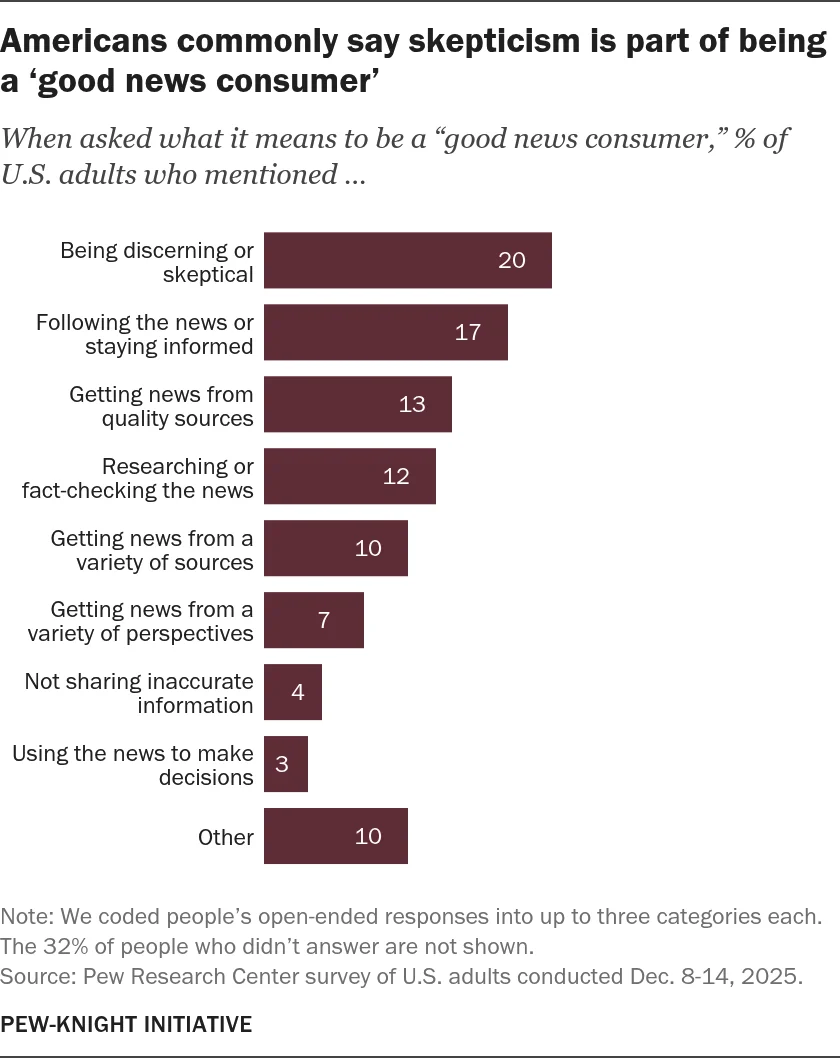
One-in-five Americans (20%) identified skepticism and discernment as the primary characteristics of a good news consumer. Rather than passive absorption, the modern citizen sees their role as an active gatekeeper of truth. This involves taking reports "with a grain of salt," questioning the provenance of viral headlines, and maintaining a healthy suspicion of propaganda.
Following this, 17% of respondents emphasized the importance of staying informed on a regular basis, while 13% prioritized the selection of "reputable" sources. A significant 12% noted that the mark of a good consumer is the willingness to conduct independent research—fact-checking official narratives against multiple sources before accepting them as reality.
Chronology of the Modern News Crisis
To understand why Americans have adopted this guarded approach, it is essential to look at the recent evolution of the media ecosystem:
- Early 2025: Growing anxiety regarding the role of AI in journalism begins to take hold, as citizens express fears about the potential for automated misinformation and "hallucinated" news reports.
- June 2025: A series of nine focus groups conducted by PSB Insights reveals a palpable frustration among the public. Participants describe a sense of exhaustion from attempting to reconcile conflicting narratives, leading to a "do-it-yourself" approach to verification.
- October 2025: Data confirms that a majority of Americans regularly encounter inaccurate news, fueling a cycle of distrust that makes it difficult for any single outlet to gain widespread credibility.
- December 2025: The Pew Research Center administers its comprehensive survey to the American Trends Panel, seeking to codify how the public defines its own media literacy.
- May 2026: The final analysis is released, providing a window into the psychological toll and behavioral shifts required to survive the current information landscape.
Supporting Data: The Anatomy of a News Consumer
The data paints a picture of a population struggling to find its footing. When asked to categorize their priorities, the survey respondents offered a diverse array of strategies:
| Attribute | Percentage of Mentions |
|---|---|
| Being discerning or skeptical | 20% |
| Following the news or staying informed | 17% |
| Getting news from quality sources | 13% |
| Researching or fact-checking the news | 12% |
| Getting news from a variety of sources | 10% |
| Getting news from a variety of perspectives | 7% |
| Not sharing inaccurate information | 4% |
| Using the news to make decisions | 3% |
Crucially, the data reveals a "generational divide." While older generations tend to view daily news engagement as a civic duty, younger adults are increasingly likely to rely on serendipitous discovery—encountering news through social media algorithms rather than seeking it out proactively. This shift raises questions about the future of traditional journalism, as the "active searcher" model of the 20th century competes with the "passive recipient" model of the 21st.
The Search for Truth: Official Responses and Expert Insight
The Pew-Knight Initiative, a joint effort between The Pew Charitable Trusts and the John S. and James L. Knight Foundation, serves to illuminate the intersection of civic engagement and media consumption.
"The modern news environment has placed an unprecedented level of responsibility on the individual," says the report’s introduction. "Information is coming at people faster than ever before, and a seemingly endless array of options is competing for their attention and trust."
Focus group participants echoed this sentiment. One woman in her 50s noted that the process of being a "good" consumer is now an act of labor: "Double-checking, verifying, gathering news from multiple types of media and from multiple sources, and then drawing your own conclusion… that is what it takes."
A male participant in his 30s emphasized the necessity of ideological diversity, stating, "The right way to me is to consume it from multiple sources, on every side, so that you can get the facts." However, this ambition is hampered by the reality that there is no single news outlet that a majority of U.S. adults currently trust. Political polarization has created silos where "reputable" is often synonymous with "agrees with my worldview."
Implications: The Future of Civic Information
The implications of this research are profound for both the news industry and the health of American democracy.
1. The Death of the "Single Source" Era
The fact that only 13% of Americans believe in relying on "quality sources" suggests that the brand equity of legacy media has been severely eroded. Trust is no longer given; it is earned through transparent, multi-source verification. Organizations that fail to demonstrate their work—showing their sources and methodology—will continue to face skepticism.
2. The Responsibility of Sharing
A small but significant percentage of respondents (4%) identified "not sharing inaccurate information" as a hallmark of a good consumer. This highlights a growing awareness of the "viral misinformation" problem. Social media platforms, which often prioritize engagement over accuracy, are at odds with this emerging civic value, setting the stage for future regulatory and design challenges.
3. The Cognitive Load of Citizenship
The most alarming takeaway is the sheer cognitive effort required to be an informed citizen. When individuals feel they must fact-check every piece of information, they are susceptible to "news fatigue." This exhaustion may lead to the very thing the nation cannot afford: disengagement. If the barrier to entry for "being informed" becomes too high, the risk of a misinformed or indifferent electorate increases.
4. The Role of AI and Future Literacy
As AI becomes more integrated into the news cycle, the definition of a "good news consumer" will likely shift toward "technological literacy." Understanding how algorithms prioritize content and how generative AI can be used to create synthetic media will soon be as important as the traditional skills of reading and critical analysis.
Conclusion
The Pew Research Center’s findings serve as both a snapshot and a warning. Americans are trying to adapt to a digital age that is hostile to objective truth, but they are doing so without a unified set of tools. Being a "good news consumer" has evolved from a simple act of watching the evening news into a complex, high-stakes practice of skepticism, cross-referencing, and intellectual discipline. As we move further into the 2020s, the health of the republic may depend not just on the quality of the news being produced, but on the capacity of the public to navigate the labyrinth of the information age.