In the contemporary American landscape, the discourse surrounding mental health has transcended the therapist’s office, moving into the mainstream of daily conversation. As the nation observes Mental Health Awareness Month, a clearer picture of the collective psychological state of the U.S. population is emerging. Recent data from the Pew Research Center reveals a nuanced reality: while mental health is increasingly prioritized, significant disparities persist across age, income, and demographics, highlighting a nation that is talking more about wellness even as many continue to grapple with profound personal challenges.
The Current State of Psychological Well-being: Key Findings
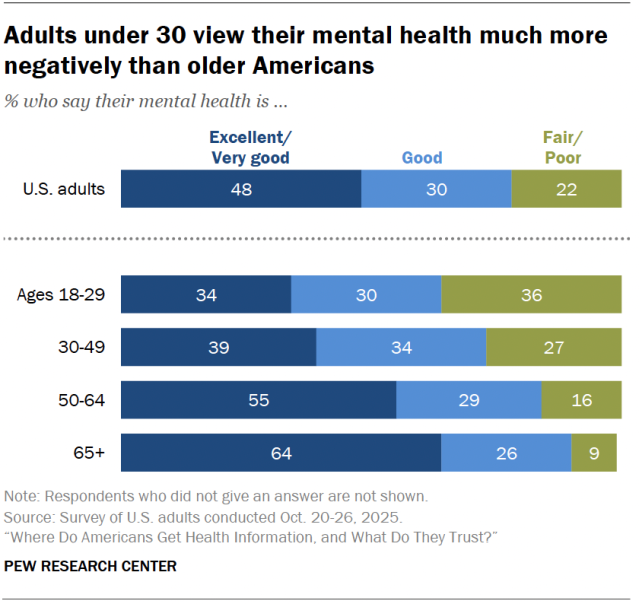
According to a comprehensive survey conducted in October 2025, the majority of American adults maintain a positive outlook on their mental health. Approximately 48% of respondents describe their mental health as "excellent" or "very good," while 30% characterize it as "good." However, this aggregate positivity masks a concerning undercurrent: roughly one-in-five adults—22%—report that their mental health is either "fair" or "poor."
This divide is not uniform across the population. When researchers segmented the data by age, a striking generational gap surfaced. Adults under the age of 30 are four times as likely as their counterparts aged 65 and older to report their mental health as fair or poor (36% versus 9%). This disparity suggests that younger generations are navigating a uniquely difficult set of stressors, whether driven by economic instability, the pressures of the digital age, or shifts in social connectivity.
Financial health also plays a critical role in mental outcomes. Among adults in lower-income brackets, 32% report fair or poor mental health. This figure drops significantly as income levels rise, with 19% of middle-income and only 13% of upper-income adults reporting similar levels of distress. While gender differences are less pronounced—with 23% of women and 20% of men reporting fair or poor mental health—the data indicates that socio-economic status remains a primary determinant of psychological stability.

A Chronology of the Mental Health Shift
To understand the current state of mental health, one must look at the evolution of public perception over the last decade.
- Pre-2020 Era: Mental health remained largely stigmatized, often relegated to private discussions between patients and medical professionals. Public awareness was high but lacked the depth of modern social media-driven discourse.
- 2020–2023: The global pandemic served as a massive catalyst for change. The widespread shift to remote work, social isolation, and the resulting spike in anxiety and depression forced a national reckoning. Mental health became a staple of political, workplace, and educational policy.
- 2024 (The Turning Point): Surveys from early 2024 showed that comfort levels regarding discussing mental health began to stabilize, with close friends and family emerging as the primary "safe spaces" for communication.
- 2025–2026 (The Current Landscape): We have entered a phase where mental health is treated with the same urgency as physical health. Americans are now as likely to report putting significant effort into their mental well-being as they are to report efforts toward their physical fitness.
Supporting Data: The Effort Gap and Communication Comfort
Despite the prevalence of negative self-reporting among younger adults, the commitment to mental health maintenance is broad. Data shows that 36% of adults report putting "a lot of effort" into their mental health, while 49% put in "a little." Only 15% report no effort at all.
Crucially, the "effort gap" does not necessarily follow the age divide. Younger adults, despite their higher rates of self-reported distress, are just as likely—if not more so—to be actively engaged in mental health practices compared to older cohorts. This suggests that the issue for younger Americans is not a lack of effort, but perhaps an environment that produces higher levels of psychological strain.
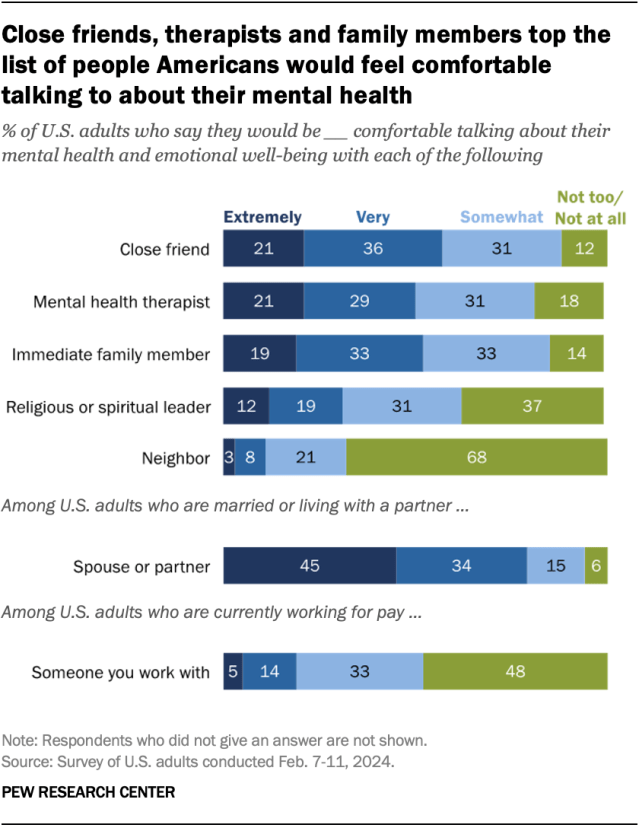
When it comes to seeking support, the data underscores the importance of personal networks over institutional ones. A February 2024 survey found that:
- 57% of adults feel comfortable discussing mental health with a close friend.
- 52% feel comfortable talking to an immediate family member.
- 50% feel comfortable speaking with a mental health therapist.
- 31% feel comfortable talking to a spiritual or religious leader.
- 11% feel comfortable discussing it with a neighbor.
These findings suggest that Americans still favor intimacy and trust when opening up. Interestingly, among the employed, only 19% express comfort in discussing these topics with a co-worker, indicating that while the stigma is fading, the professional sphere remains a largely guarded environment.
The Adolescent Crisis: Perspectives from Teens and Parents
The mental health of the nation’s youth has become a paramount concern for both policymakers and families. A fall 2024 study of teens aged 13 to 17 revealed that 35% of adolescents are "extremely or very concerned" about the mental health of their peers.
Gender and race play significant roles in how teens perceive this crisis. Girls are notably more concerned than boys (42% vs. 28%). Furthermore, Black teens report significantly higher levels of concern (50%) compared to Hispanic (39%) and White (31%) teens.
Parents, meanwhile, are even more anxious. More than half of all parents of teens (55%) report being extremely or very concerned about the state of their children’s mental health. This parental anxiety is particularly high among mothers (61%) and Black parents (70%). These figures reflect a growing societal awareness that the current adolescent experience—marked by social media usage and academic pressure—is a uniquely challenging developmental period.
When teens need to talk, they do not necessarily turn to clinical professionals. Only 31% of teens feel comfortable speaking with a therapist about their mental health. Instead, they overwhelmingly prefer their parents (52%) or their friends (48%). This highlights the necessity of equipping parents with the tools to handle these conversations, as they are the primary frontline for adolescent mental health.
Official Responses and Public Health Implications
The consensus among public health experts is that the "conversation" about mental health is only the first step. The data provided by the Pew Research Center has significant implications for how resources should be allocated:
- The Need for Accessible Care: While there is a high comfort level in talking to friends and family, the persistent "fair/poor" ratings among lower-income adults indicate that professional, affordable care remains out of reach for a significant portion of the population.
- Addressing the Youth Paradox: Policy must address the fact that while teens are highly concerned about their own mental health, they are not utilizing professional therapy at high rates. This suggests a need for school-based, integrated mental health support that feels less "clinical" and more accessible.
- Workplace Culture: With only 19% of workers comfortable discussing mental health with colleagues, corporations have a clear mandate to create psychologically safe environments that reduce the fear of professional repercussions.
- Targeted Support: The disparities in concern levels among Black parents and teens indicate that mental health initiatives must be culturally competent and address the specific systemic stressors faced by these communities.
Conclusion
As we continue to navigate a complex, fast-paced, and increasingly digital world, the data suggests that Americans are becoming more articulate about their psychological struggles. However, the gap between being "aware" and being "well" remains substantial. The fact that one-in-five adults report poor mental health is a call to action.
Moving forward, the focus must shift from simple awareness to the creation of robust, accessible, and community-integrated support systems. Whether it is through the strengthening of parental support networks or the professionalization of mental health support in schools and offices, the path forward requires a transition from talk to tangible, equitable action. As Mental Health Awareness Month reminds us, the goal is not merely to talk about the struggle, but to ensure that everyone has the resources to overcome it.