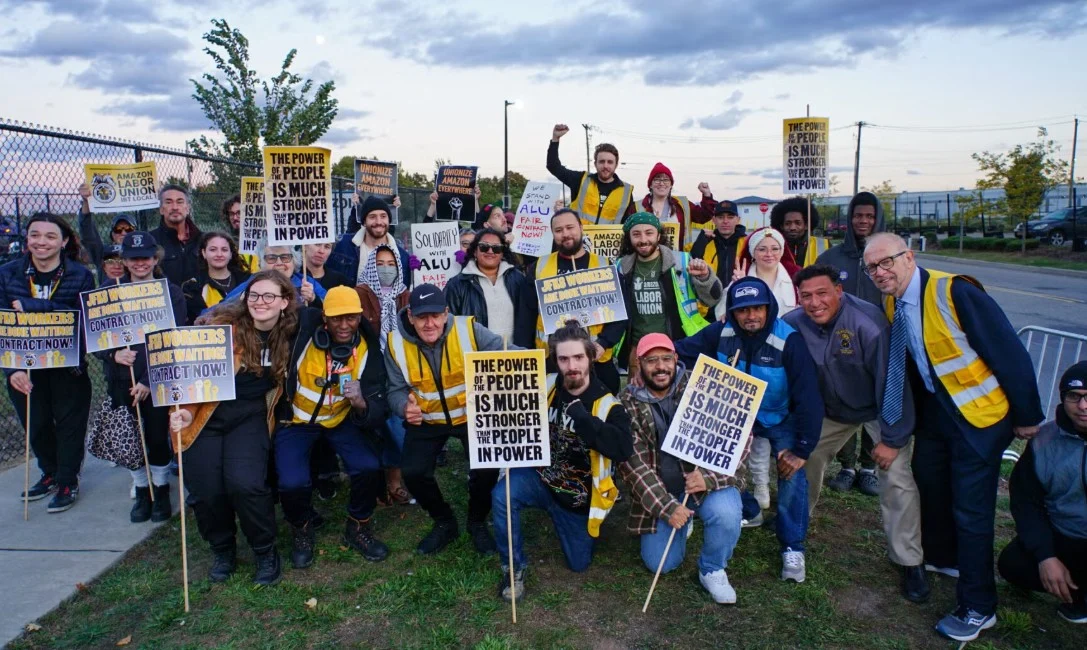
More than four years after a historic, grassroots victory at Amazon’s JFK8 fulfillment center in Staten Island, New York, the tech giant remains locked in a bitter legal stalemate with organized labor. The dispute, which has evolved from a local warehouse uprising into a complex federal court battle, now sits before the Fifth Circuit Court of Appeals. At the heart of the conflict is a fundamental disagreement over the legitimacy of the Amazon Labor Union (ALU) and the National Labor Relations Board’s (NLRB) authority to compel the e-commerce titan to the bargaining table.
As the ALU—now formally aligned with the International Brotherhood of Teamsters (IBT) as ALU-IBT Local 1—seeks to secure a collective bargaining agreement, Amazon continues to utilize every available procedural mechanism to stall, challenge, and ultimately decertify the original election results.
Chronology of a Contentious Relationship
The origins of this legal saga trace back to April 2022, when workers at the massive JFK8 facility shocked the corporate world by voting to unionize. It was the first time in Amazon’s history that a facility in the United States had successfully organized. This win was not backed by a major national union initially, but rather by a scrappy, worker-led movement that relied on social media, community organizing, and deep-seated grievances regarding warehouse conditions.
However, the path to a contract has been anything but smooth:
- The 2022 Breakthrough: Workers at JFK8 vote to unionize, marking a seminal moment in modern labor history.
- The Retaliatory Pushback: Amazon immediately files objections, alleging that the union engaged in coercive tactics and intimidation during the election period.
- The 2023 Setback: A subsequent attempt to organize a secondary Staten Island facility fails, signaling that Amazon’s "union-proof" strategy remains potent elsewhere.
- The 2024 NLRB Order: The National Labor Relations Board officially orders Amazon to begin contract negotiations with the union.
- The "Test of Certification" Gambit: Amazon refuses to bargain, forcing the NLRB to bring an unfair labor practice charge against the company. This move allows Amazon to bring the underlying election certification before a federal appellate court—a process known as a "test of certification" challenge.
The Fifth Circuit Filings: A Tale of Two Approaches
In mid-October 2024, the conflict entered a new phase with dueling briefs filed in the Fifth Circuit Court of Appeals. The filings highlight the vast tactical gulf between the two parties.
Amazon’s brief is a study in legal precision. It focuses exclusively on narrow procedural grounds, arguing that the NLRB overstepped its bounds in certifying the election. The company contends that the election was marred by misconduct and that the Board failed to properly address these concerns during the administrative phase.
In stark contrast, the Teamsters’ brief is a 115-page "behemoth." It serves as a comprehensive historical record of the Staten Island struggle, detailing years of labor disputes, alleged anti-union tactics, and the broader context of the Teamsters’ multi-front war with Amazon. The union’s submission is designed to frame the legal battle not just as a matter of administrative procedure, but as a fight for the fundamental rights of warehouse workers.
Disagreement Over Oral Arguments
Even the procedural logistics have become a point of contention. In a rare twist, the two sides are so far apart on the necessity of debate that they cannot even agree on the value of oral arguments. The union, in a fence-straddling maneuver, noted that while the court could rule without them, oral arguments might prove "useful to address the briefing." Amazon, perhaps eager to resolve the matter through the written record alone, explicitly agreed that the court could decide the issue without hearing oral arguments.
Why Amazon Refuses to Bargain
To the casual observer, Amazon’s refusal to sit at the negotiating table might appear to be a simple act of defiance. However, under U.S. labor law, this is a calculated legal strategy. Because an employer cannot directly appeal an NLRB election certification, they must create a "technical" unfair labor practice. By refusing to bargain, Amazon triggers an enforcement action, which then allows them to challenge the legality of the entire election process before a federal judge.
As the company stated in its brief: "An employer cannot obtain direct judicial review of a decision certifying a union election. Instead, the employer must refuse to bargain with the union, be found to have committed an unfair labor practice, and then challenge the certification when it seeks review of that finding."
The NLRB has repeatedly rejected these arguments, asserting that Amazon had every opportunity to litigate these issues during the original representation proceedings and has failed to present any new, compelling evidence that would justify a reversal of the election results.
The "Enhanced Remedy" Debate
A critical sub-plot in the litigation involves the union’s request for an "enhanced remedy." The ALU-IBT has argued that, given Amazon’s history of anti-union behavior, a simple order to bargain is insufficient. They have pushed for a mandate requiring Amazon to read a notice of employees’ rights aloud at a mandatory company meeting.
Amazon has pushed back aggressively against this proposal, citing three primary arguments:
- Mootness: Amazon contends that the election is likely to be decertified, rendering any remedy irrelevant.
- Lack of Precedent: The company argues that an "enhanced remedy" of this nature has no basis in existing labor law.
- Lack of Justification: Amazon maintains that the union has failed to demonstrate that such an intrusive measure is warranted by the circumstances.
While the NLRB’s General Counsel initially recommended the reading of rights, the full Board rejected the request, leaving the union to hope that the Fifth Circuit might force the issue or, at the very least, remand the case back to the Board for further explanation.
The Existential Threat: The "Joint Employer" Conflict
While the Staten Island case dominates the headlines, a secondary, perhaps more systemic, battle is unfolding regarding the "joint employer" status of Amazon’s Delivery Service Partners (DSPs).
Earlier in 2024, the NLRB’s General Counsel entered into a settlement agreement with Amazon regarding the company’s relationship with its third-party delivery providers. This agreement effectively halted a regional NLRB proceeding in Los Angeles that had initially found Amazon to be a "joint employer" of the drivers working for those independent firms.
If the NLRB were to officially classify Amazon as a joint employer, it would fundamentally restructure the company’s logistics network. It would hold Amazon legally accountable for the labor practices of the hundreds of small businesses that deliver its packages, potentially exposing the company to massive liability and significantly simplifying the process for workers at those firms to unionize.
The Teamsters have decried the settlement as an "ambush," accusing the Board of capitulating to corporate pressure. The docket in this case remains quiet, but the union’s recent correspondence suggests that the fight to overturn this agreement is far from over.
Implications for the Future of Labor
The outcome of these cases will have profound implications for the American labor landscape. Amazon remains the second-largest private employer in the U.S., and its business model—built on speed, efficiency, and a decentralized, third-party logistics network—has become the gold standard for modern retail.
If the Teamsters and the ALU succeed in forcing a contract at JFK8, it could trigger a "domino effect," providing a blueprint for workers at other Amazon facilities to organize. Conversely, if Amazon successfully utilizes the courts to decertify the union or permanently stall the bargaining process, it will send a chilling message to organizers across the country.
For now, the battles are confined to legal briefs and administrative dockets. But behind the technical jargon of "test of certification" and "joint employer" statuses lies the fundamental question of whether the rapid growth of the digital economy can be reconciled with the traditional labor rights of the 20th century. As the Fifth Circuit prepares to weigh in, both the labor movement and the corporate world are watching closely, knowing that the precedent set here will likely dictate the terms of the next decade of American labor relations.