The landscape of professional data science is undergoing a tectonic shift. For years, the industry has operated under a "SaaS-first" paradigm, where enterprise-grade data science platforms—often commanding five-to-six-figure annual contracts—were considered the mandatory cost of doing business. From massive cloud-based AutoML platforms to per-token pricing models for LLM inference, the barrier to entry for high-performance data work has been financial.
However, a new wave of open-source maturity is challenging this status quo. The performance gap between proprietary enterprise tools and their free, open-source counterparts has not only narrowed—it has, in many critical workflows, effectively closed. Data scientists are increasingly finding that the tools they once rented for thousands of dollars a month can now be run locally, offering state-of-the-art performance, superior data sovereignty, and a complete escape from the "billing dashboard anxiety" that haunts modern development teams.
The Financial Burden of the "Standard" Stack
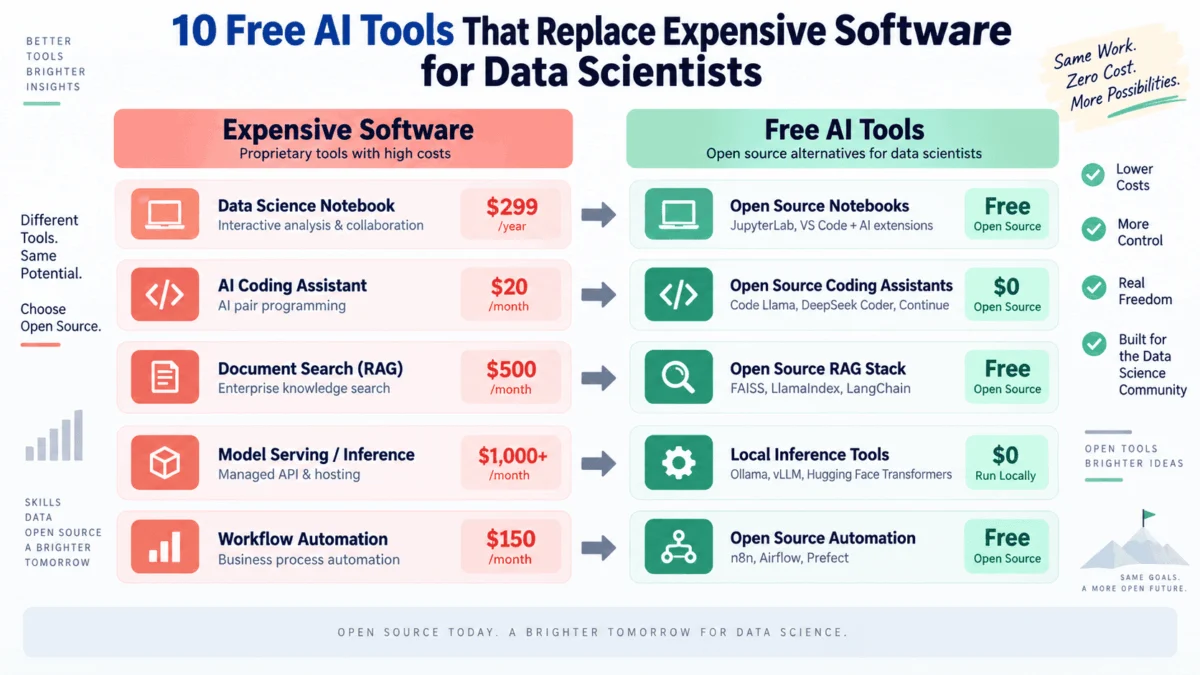
To understand the disruption, one must first quantify the burden. A single seat for platforms like DataRobot can easily exceed $50,000 annually. BI stalwarts like Tableau Creator hover around $900 per user each year. Perhaps most significantly, the rise of Large Language Models (LLMs) has introduced a volatile variable: per-token API costs. For teams running continuous data extraction, summarization, or classification pipelines, these costs can scale infinitely, often leading to thousands of dollars in monthly "inference debt" with no ceiling.
This shift toward open-source isn’t merely a cost-saving measure; it is a strategic pivot toward control. By moving the stack from the cloud back to the local machine or private server, teams regain ownership of their data, their compute, and their architectural destiny.
The Open-Source Arsenal: Replacing the Enterprise Giants
The following ten tools represent the frontline of this transition, each serving as a high-performance replacement for the industry’s most expensive categories.
1. Local LLM Inference: Ollama + Open WebUI
The Replacement For: OpenAI and Anthropic API services.
The Implication: By utilizing Ollama, teams can download and run state-of-the-art models like Llama 3.3, DeepSeek-R1, and Mistral directly on their own hardware. When paired with Open WebUI, the experience becomes indistinguishable from ChatGPT, complete with document uploads and multi-turn conversations. This eliminates per-token costs entirely, allowing for infinite, private, and offline experimentation.
2. AI-Assisted Development: Tabby
The Replacement For: GitHub Copilot Business and Tabnine.
The Implication: For organizations dealing with sensitive intellectual property, sending code to a third-party server is a compliance nightmare. Tabby provides a self-hosted alternative that integrates seamlessly into VS Code and JetBrains IDEs. Beyond security, it offers repository-level context indexing, allowing the model to "understand" a team’s specific internal libraries and coding conventions better than a generic, one-size-fits-all model.
3. Automated Machine Learning: AutoGluon
The Replacement For: DataRobot and H2O Driverless AI.
The Implication: Developed by AWS, AutoGluon is a powerhouse that automates the entire ML lifecycle—from feature engineering to ensemble stacking—without the need for massive cloud infrastructure. It consistently ranks at the top of industry benchmarks. By running this locally, teams avoid the "cloud tax" and dataset size limits imposed by SaaS providers, enabling rapid, cost-free iteration.
4. Natural Language Analytics: PandasAI
The Replacement For: ThoughtSpot and Alteryx.
The Implication: PandasAI allows users to query DataFrames using plain English. For non-technical stakeholders, this provides the self-service analytics capabilities of expensive tools like ThoughtSpot without the licensing fees. It bridges the gap between raw Python code and business insights, empowering analysts to interrogate data in real-time.
5. Knowledge Management & RAG: AnythingLLM
The Replacement For: Enterprise RAG and Knowledge Base platforms.
The Implication: AnythingLLM creates a "chat with your data" interface that remains entirely local. It handles vectorization and retrieval automatically, allowing teams to query internal documentation, PDFs, and codebases with citation-backed accuracy. It is the definitive solution for teams currently spending thousands on third-party RAG infrastructure.
6. Computer Vision Annotation: Autodistill
The Replacement For: Scale AI and Labelbox.
The Implication: Data labeling is a notorious bottleneck. Autodistill uses "foundation models" to label datasets automatically, a process that can replace thousands of hours of manual human annotation. This allows teams to generate high-quality training data for object detection at scale, with human intervention required only for edge-case verification.
7. Visual Analytics: PyGWalker
The Replacement For: Tableau and Power BI.
The Implication: PyGWalker turns Jupyter notebooks into an interactive, drag-and-drop BI environment. By keeping the visualization inside the notebook, it eliminates the need for expensive BI server licenses and data export workflows, keeping the entire analysis loop reproducible and unified.
8. Experiment Tracking: MLflow
The Replacement For: Weights & Biases (Enterprise).
The Implication: MLflow has become the industry standard for experiment tracking and model registry management. It now offers robust LLM-specific observability, tracking prompts and response quality alongside traditional metrics. Being self-hosted, it ensures that your experimental data remains inside your firewall.
9. Analytical Databases: DuckDB
The Replacement For: Snowflake and BigQuery.
The Implication: For the vast majority of data science workloads, DuckDB is faster and cheaper than cloud warehouses. It runs in-process, querying local Parquet and CSV files with extreme efficiency. By bypassing the "cloud round-trip," teams reduce latency and eliminate the monthly compute bills that often plague data-heavy teams.
10. LLM Observability: Langfuse
The Replacement For: LangSmith.
The Implication: Langfuse provides a complete observability suite for LLM applications, offering tracing, evaluation, and prompt management. It provides the same level of granular debugging as enterprise tools but allows for complete control over where that data is stored—a critical requirement for regulated industries.
Supporting Data: The Case for the "Self-Hosted" Shift
The transition to an open-source stack is supported by the rapid maturation of local compute hardware. Modern GPUs, coupled with quantization techniques, allow developers to run models that previously required massive server clusters on a standard workstation.
- Cost Efficiency: Teams that migrate away from API-based inference models report an average reduction of 60–80% in monthly operational expenditure within the first quarter.
- Performance Parity: On standard benchmarks (such as the AutoGluon performance vs. H2O), open-source models now match or exceed commercial counterparts in predictive accuracy.
- Compliance Velocity: Using local tools removes the need for legal and security teams to perform multi-month reviews of third-party data-processing agreements.
Official Perspectives and Industry Implications
Industry analysts observe that this "unbundling" is causing a ripple effect in the tech sector. While software giants are attempting to bundle more services into their platforms, the "best-of-breed" open-source approach is winning over technical teams who prioritize modularity and cost-efficiency.
"The professionalization of open-source tooling is the most significant development in data science in the last five years," says Vinod Chugani, an expert in AI automation and educator. "For a long time, the barrier to entry was the cost of the tools. Now, the barrier is simply the willingness to configure them. The return on investment for that configuration time is staggering."
However, this shift also brings new responsibilities. The primary trade-off for cost savings is the requirement for in-house expertise. Unlike a SaaS product where the vendor handles infrastructure maintenance, an open-source stack requires a team to manage their own Docker containers, updates, and integrations. For companies with existing engineering talent, this is a transition from being "users" to "owners."
Conclusion: The Path Forward
The argument for maintaining an expensive, monolithic enterprise stack is becoming increasingly difficult to justify. As these ten tools demonstrate, the components required to build a world-class data science environment are now available to anyone with the initiative to implement them.
The recommended approach for teams looking to make this transition is incremental. Rather than attempting a "rip and replace" strategy, identify the single highest line item in your current software budget—perhaps your Snowflake bill or your LLM API spend—and prioritize that specific category. By systematically replacing individual components with open-source alternatives, teams can achieve a fully modernized, self-hosted stack within a single quarter.
The era of paying for "convenience" at the expense of control and capital is ending. For the modern data scientist, the future is local, open, and—most importantly—entirely under their own command.