For businesses operating within the United States, the tax environment is not a monolithic structure but a patchwork of federal mandates and state-level variations. As corporations navigate the complexities of profitability and expansion, the interplay between federal corporate income tax (CIT) and varying state-level tax codes remains a primary determinant of economic competitiveness. With an average combined federal and state tax rate of 25.5 percent, understanding the nuances of these levies is essential for any enterprise seeking to thrive in the modern American economy.
Main Facts: The Federal and State Framework
At the federal level, the United States imposes a flat corporate income tax rate of 21 percent. This baseline is the constant in a dynamic equation that shifts drastically once state-level policies are introduced. Forty-four states, along with the District of Columbia, impose their own corporate income taxes, creating a multifaceted landscape of fiscal obligations.
The diversity of these state approaches is striking. Top marginal rates vary significantly, ranging from a modest 2.0 percent in North Carolina to a robust 11.5 percent in New Jersey. Furthermore, states are divided on how they structure these brackets: 13 states employ a graduated rate system, while 31 states and the District of Columbia have opted for a flat tax rate.
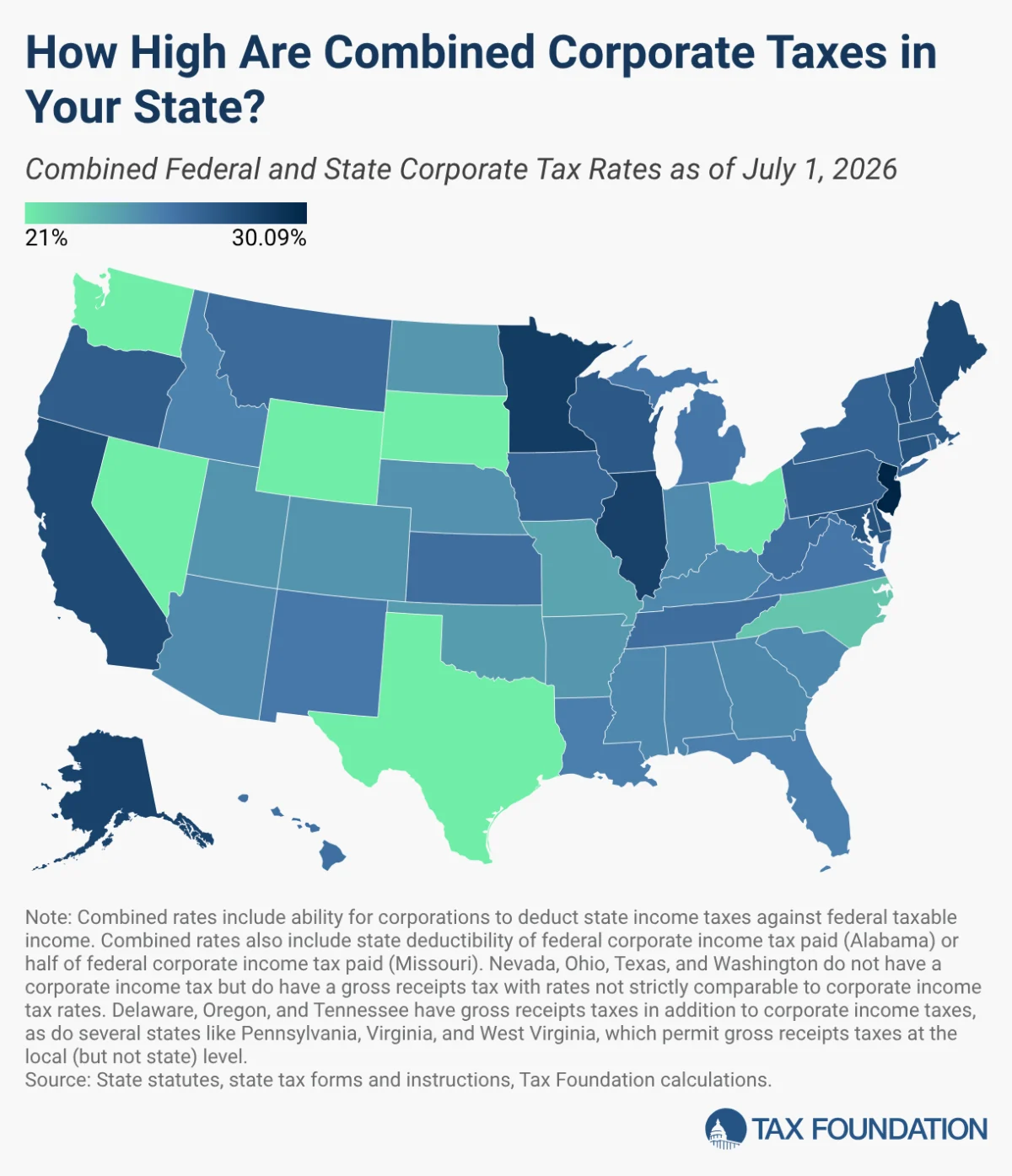
However, the "corporate income tax" is not the only mechanism for state revenue. In jurisdictions such as Nevada, Ohio, Texas, and Washington, corporations are subject to gross receipts taxes rather than traditional corporate income taxes. These levies are applied to a company’s total sales without deductions for business expenses—such as labor, materials, or overhead—a structure that often leads to "tax pyramiding," where the tax is compounded at every stage of the production process.
Meanwhile, states like Delaware, Oregon, and Tennessee utilize a hybrid approach, imposing both a corporate income tax and a separate levy on gross receipts. Pennsylvania, Virginia, and West Virginia take this a step further by layering local-level gross receipts taxes on top of other state obligations. At the other end of the spectrum, South Dakota and Wyoming remain the most "tax-friendly" in this regard, imposing neither a corporate income tax nor a gross receipts tax.
Chronology and Evolution of Tax Policy
The current state of American corporate taxation is the result of decades of legislative shifts, market pressures, and attempts to balance revenue needs with economic growth.
The Post-War Era to the 1980s
For much of the mid-20th century, the U.S. corporate tax rate was significantly higher than today’s, often exceeding 40 percent. During this era, many states followed the federal model, viewing corporate taxes as a primary vehicle for funding public services. However, as global competition increased in the 1970s and 80s, the perception of corporate taxation began to shift toward a focus on "tax competitiveness."
The Tax Reform Act of 1986
A pivotal moment in the chronology of U.S. taxation was the Tax Reform Act of 1986, which sought to simplify the tax code, broaden the tax base, and lower rates. This era marked a transition toward the current debates regarding how states attract corporate headquarters.
The Tax Cuts and Jobs Act (TCJA) of 2017
The most significant recent change occurred with the passage of the TCJA, which slashed the federal corporate income tax rate from 35 percent to the current 21 percent. This reduction was intended to make the United States a more attractive destination for global investment. However, the move placed renewed pressure on state governments to re-evaluate their own tax structures. In the years since 2017, several states have moved to lower their corporate tax rates to remain competitive, while others have explored gross receipts taxes as a way to ensure a stable revenue stream despite fluctuations in corporate profit margins.
Supporting Data: A State-by-State Breakdown
The burden of taxation varies widely depending on the geography of a corporation’s operations. The combined impact of federal and state taxes creates distinct "high-tax" and "low-tax" environments.
The High-Tax Leaders
When calculating the combined corporate income tax rate (accounting for federal and state levies), New Jersey leads the nation with an effective combined rate of 30.1 percent. Alaska, Illinois, Maine, and Minnesota follow closely, with combined rates at or exceeding 28 percent. In these states, corporations must factor in significant tax outlays as part of their operational cost structure.
The Low-Tax and No-Tax Environments
Conversely, states such as Nevada, Ohio, South Dakota, Texas, Washington, and Wyoming offer a different proposition. Because they do not levy a state corporate income tax, businesses in these jurisdictions effectively face only the 21 percent federal rate. While this appears advantageous, it is crucial to note that four of these states—Nevada, Ohio, Texas, and Washington—utilize gross receipts taxes, which can be particularly burdensome for low-margin, high-volume businesses.
The Mechanics of Deduction
The effective tax rate is rarely as simple as the nominal rate due to the deductibility of state taxes. Corporations are permitted to deduct state corporate income tax payments against their federal taxable income. For instance, in a state like Rhode Island, which imposes a 7 percent flat tax, the corporation can deduct this from its federal calculation. This reduces the federal liability, resulting in an effective combined rate (in this example, 26.53 percent) that is lower than the simple sum of the two rates.
Official Perspectives and Policy Responses
Tax policy experts, such as Garrett Watson and Alex Durante of the Tax Foundation, argue that corporate taxes remain one of the most economically damaging ways to raise revenue. Their research highlights that high corporate tax burdens act as a drag on capital investment, which in turn stifles wage growth and labor productivity.
Strategies for Competitiveness
Many states have responded to this by adopting "deductibility" policies. Alabama and Missouri, for example, allow corporations to deduct federal corporate income tax against state liability. Alabama allows full deductibility, while Missouri permits a 50 percent deduction. These policies serve as a deliberate mechanism to lower the effective tax rate, thereby creating a more favorable environment for business retention and attraction.
The Case for Reform
Economists generally advocate for "base-broadening and rate-lowering" reforms. By eliminating complex tax loopholes and lowering overall rates, states can create a more predictable and transparent environment. The current trend suggests that states are increasingly viewing their tax code as a marketing tool. A state with a low, flat, and transparent tax structure is significantly more likely to attract headquarters and regional offices than a state with high, graduated, or hidden taxes.
Implications for the Future of American Business
The implications of the current tax structure are profound for both the public and private sectors. For corporations, the complexity of state tax codes necessitates significant investment in accounting and compliance, which acts as a hidden "tax" on operations.
Economic Growth and Mobility
As the U.S. economy becomes more digital and geographically fluid, corporations are increasingly mobile. Remote work and decentralized operations mean that companies are less tethered to specific states than they were in the past. This mobility forces states into a "race to the top" regarding tax competitiveness. States that fail to modernize their tax codes risk losing their tax base as companies migrate to more favorable jurisdictions.
Equity and Public Services
The primary argument in favor of higher corporate taxes is the funding of essential public infrastructure—roads, schools, and safety—that businesses rely on. The challenge for policymakers is finding the "Goldilocks zone": a tax rate that is high enough to fund necessary government services but low enough to avoid driving away the very enterprises that generate the economic activity needed to sustain those services.
Conclusion: A Call for Transparency
As the dialogue surrounding corporate taxation continues, the emphasis must remain on simplicity and economic neutrality. Tax pyramiding, through the use of gross receipts taxes, and the administrative burden of navigating 44 different state tax systems remain significant hurdles. For policymakers, the path forward involves balancing revenue stability with the imperative of fostering an environment where innovation and investment can flourish. Whether through federal reform or state-level adjustments, the goal remains the same: creating a tax system that promotes long-term economic prosperity for the entire nation.