In the rapidly evolving landscape of artificial intelligence, the term "fine-tuning" has transitioned from an obscure machine learning concept to a cornerstone of modern software development. As Large Language Models (LLMs) like Llama, Mistral, and Qwen become ubiquitous, developers are increasingly tasked with adapting these massive, general-purpose engines to serve specific, high-stakes needs.
But what exactly happens under the hood when we "fine-tune" a model? To understand this, one must look beyond the buzzwords and grasp the fundamental dichotomy of the AI lifecycle: the distinction between the monumental task of pretraining and the surgical precision of fine-tuning.
The Genesis: Understanding Pretraining
To appreciate the nuance of fine-tuning, one must first understand the "foundation" upon which it rests. When a model is first initialized, it is essentially a blank slate—a vast architecture of millions or billions of parameters assigned random numerical values. Attempting to teach this "newborn" model a specific task, such as medical diagnostic coding or legal document analysis, is a futile endeavor. It would be akin to asking a toddler to analyze quantum physics before they have acquired the basic mechanics of language.
The Mechanism of Pretraining
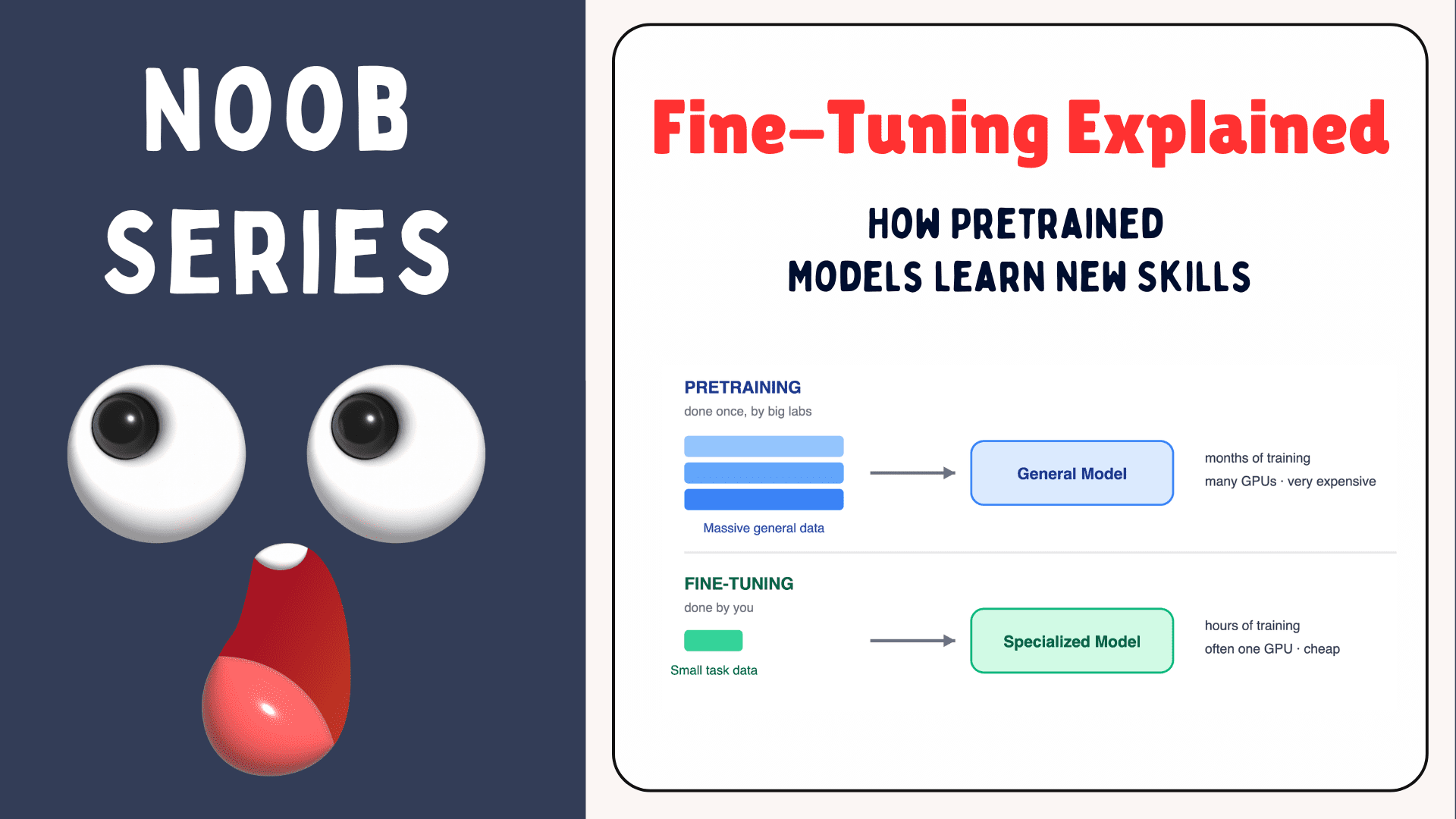
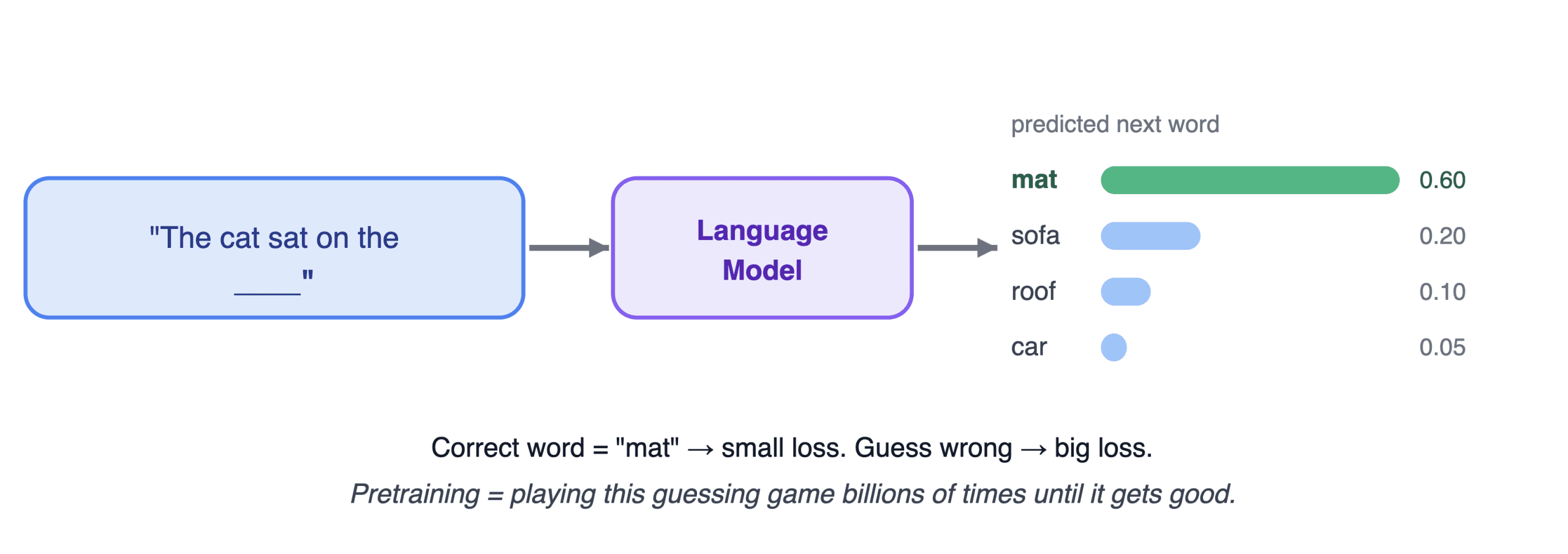
Pretraining is the "heavy lifting" phase of AI development. During this stage, models are fed trillions of tokens—scraped from the vast repositories of the internet, academic libraries, and digitized literature. The objective is remarkably simple yet computationally expensive: Next-Token Prediction.
By obscuring a word in a sentence—such as "The cat sat on the ____"—and forcing the model to guess the missing word, the system is compelled to learn the underlying statistical structure of human language. Over billions of iterations, the model absorbs syntax, semantic relationships, world facts, and even nuanced reasoning patterns. Once training concludes, the model is no longer a collection of random numbers; it is a "Foundation Model" possessing a generalized understanding of the world.
Why You Don’t Pretrain
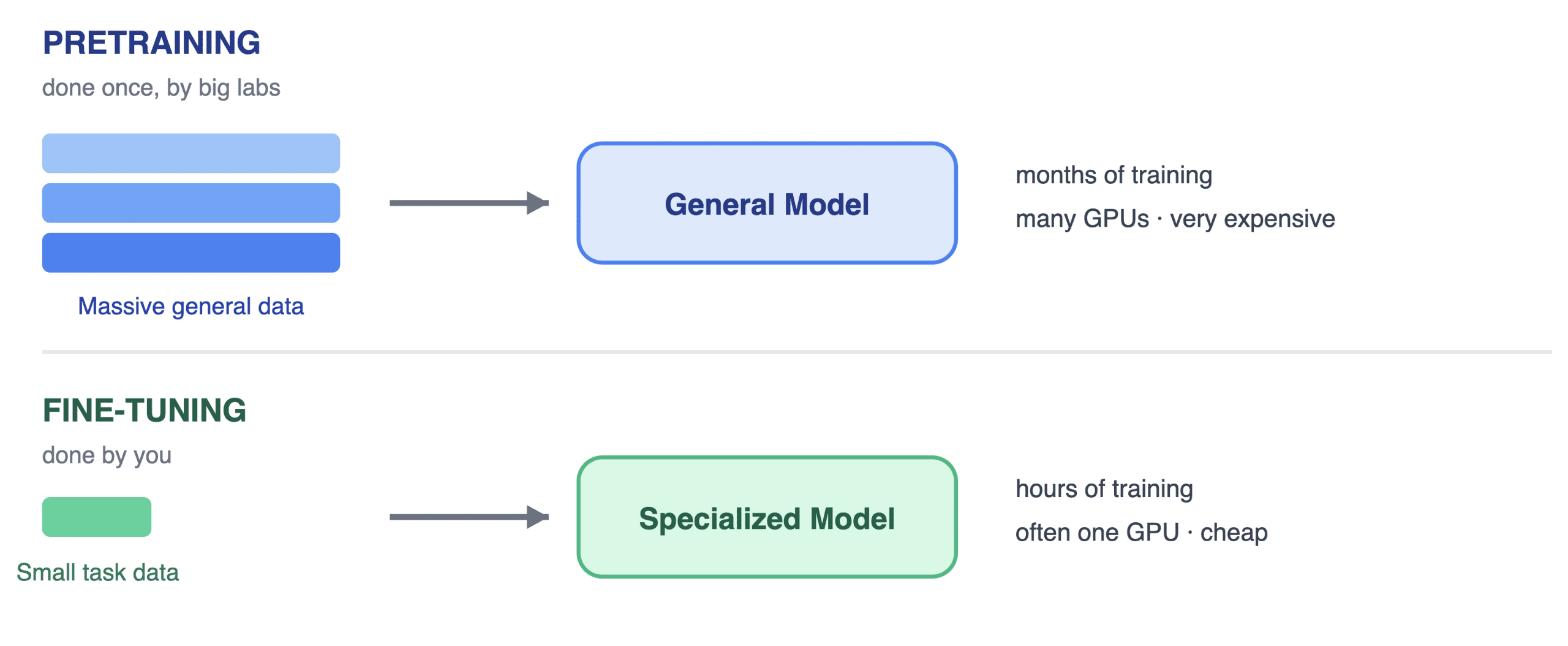
Pretraining is an industrial-scale operation. It requires thousands of high-performance GPUs (typically NVIDIA H100s or A100s) running for weeks or months, costing millions of dollars in electricity and compute time. Consequently, the vast majority of developers do not pretrain; they download these pre-baked "base models" from hubs like Hugging Face and proceed directly to the fine-tuning stage.
Fine-Tuning: The Art of Adaptation
If pretraining is the equivalent of a general university education, fine-tuning is the specialized residency or apprenticeship that follows. Fine-tuning is the process of taking a pretrained model and subjecting it to a secondary, smaller training phase using a curated, domain-specific dataset.
The Culinary Analogy
Consider a group of students graduating from a prestigious culinary school. They all possess the foundational knowledge of knife skills, food safety, and flavor theory. However, if one student is hired by a high-end sushi restaurant and another by a French bakery, they must undergo "fine-tuning." The sushi chef learns the specific, rigid protocols of nigiri preparation, while the baker masters the chemistry of sourdough. Both are still chefs, but their "weights" (their internalized knowledge and reflexes) have been adjusted to excel in their respective environments.
The Fine-Tuning Loop
The process involves a continuous feedback loop:
- Input: A task-specific example is fed into the model.
- Prediction: The model generates a response.
- Loss Calculation: The model’s output is compared against a "ground truth" (the correct answer).
- Weight Update: Using a mathematical technique called backpropagation, the model subtly adjusts its internal parameters to minimize the error (the "loss") between its output and the target.
Chronology of Model Development
The evolution of how we train AI has moved through distinct phases:
- The Era of Scratch-Training (Pre-2017): Developers trained small models on specific tasks. Performance was limited by data volume and compute power.
- The Transfer Learning Revolution (2018–2020): The introduction of architectures like BERT and GPT popularized the "pretrain then fine-tune" paradigm.
- The Scale-up Era (2020–2022): Models like GPT-3 demonstrated that scale alone could produce emergent capabilities, leading to a reliance on massive foundation models.
- The Parameter-Efficient Era (2023–Present): The rise of techniques like LoRA (Low-Rank Adaptation) has democratized fine-tuning, allowing individuals to adapt massive models on consumer-grade hardware.
Two Paths: Full Fine-Tuning vs. PEFT
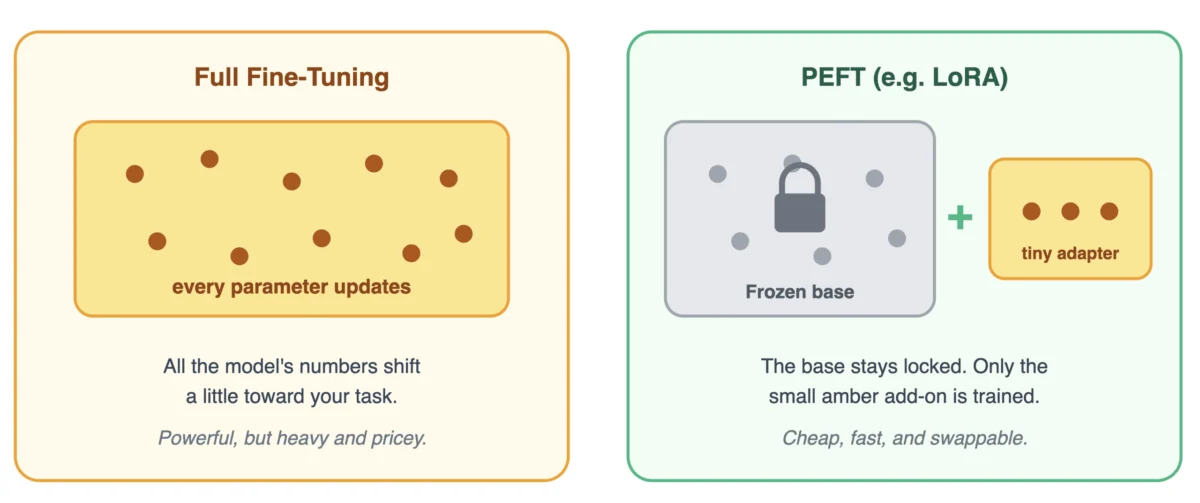
As the size of models has exploded, the computational cost of updating every single parameter (Full Fine-Tuning) has become prohibitive. This has birthed a new category: Parameter-Efficient Fine-Tuning (PEFT).
1. Full Fine-Tuning
In this approach, every single weight in the model is updated. While this offers the highest potential for deep behavioral change, it is incredibly resource-intensive. It requires massive amounts of VRAM and carries the risk of "catastrophic forgetting," where the model becomes so focused on the new task that it loses the general reasoning skills it acquired during pretraining.
2. PEFT (including LoRA)
PEFT techniques, most notably Low-Rank Adaptation (LoRA), freeze the vast majority of the original model’s weights. Instead of updating the entire brain of the model, developers inject small, trainable "adapter" layers. By training only these tiny fragments, the model learns the new task while keeping the original foundation intact. This is faster, requires significantly less memory, and is the industry standard for most modern applications.
Beyond Fine-Tuning: When to Stop
A common pitfall for organizations is the belief that fine-tuning is the "silver bullet" for every AI challenge. It is crucial to evaluate the alternatives before committing to a training run:
- Prompt Engineering: Often, a well-structured system prompt or a "Few-Shot" prompt (providing examples in the chat context) can achieve the desired result without any training.
- Retrieval-Augmented Generation (RAG): If your goal is to provide the model with proprietary or changing information (e.g., company policies, real-time news), do not fine-tune. Instead, use RAG. RAG allows the model to "look up" external documents in a database at query time, ensuring factual accuracy and reducing hallucinations.
In professional environments, the most robust systems are hybrid. They use RAG for information retrieval and Fine-Tuning to instill a specific tone, style, or specialized response format.
Implications and Future Outlook
The ability to fine-tune foundation models has fundamentally shifted the power dynamic in the tech industry. We are moving toward a future of "Model Specialization," where general foundation models serve as the base layer, and thousands of lightweight, fine-tuned "adapters" are swapped in and out based on the user’s specific workflow.

As the barriers to entry continue to lower, the focus will shift from how to fine-tune to what data we use to tune. The quality of the dataset—the diversity, accuracy, and cleanliness of the examples—is now the primary differentiator in model performance.
For those looking to begin their journey, the path is clear: start with a small, high-quality instruct model (such as an 8B parameter Llama or Qwen), experiment with a LoRA-based notebook, and observe how the training loss behaves. By bridging the gap between theory and practice, developers can move from being passive users of AI to architects of highly specialized, intelligent systems.