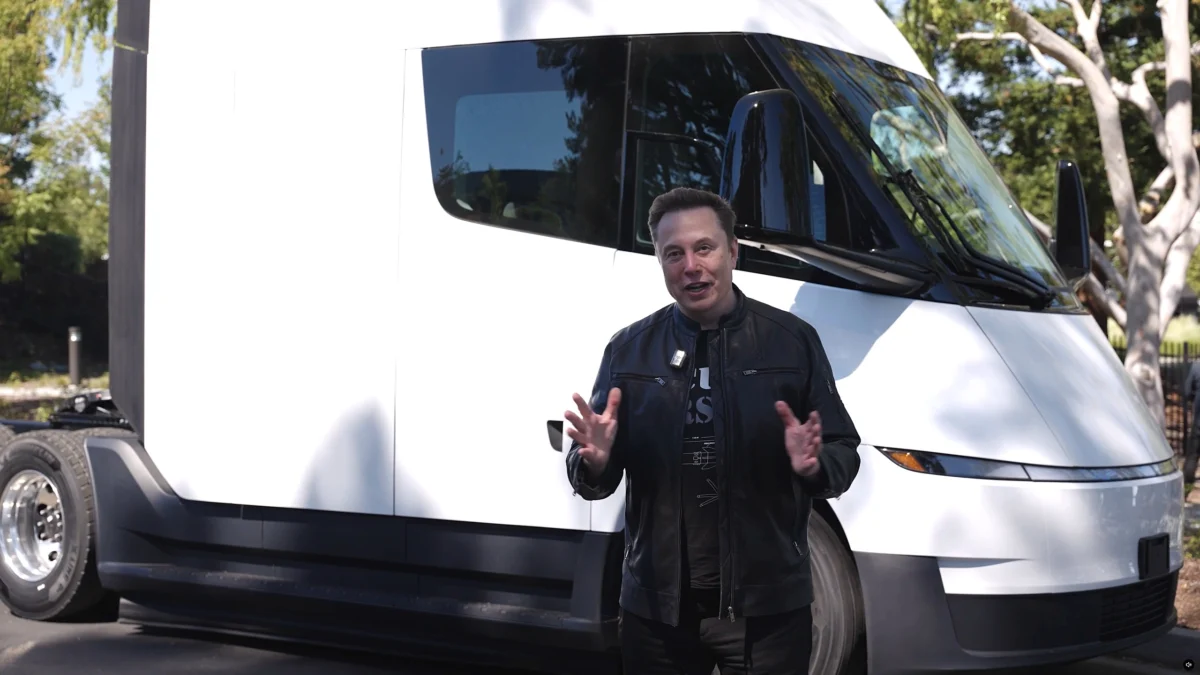
In a definitive move to reshape the global logistics landscape, Tesla has officially transitioned its Class 8 electric Semi truck from limited-fleet pilot programs to high-volume manufacturing. The Austin-based electric vehicle giant confirmed during its third-quarter earnings report that its Nevada factory is now fully primed for mass production, boasting an installed annual manufacturing capacity of 25,000 units. This development marks a pivotal inflection point for Tesla’s commercial division as it prepares to aggressively scale deliveries across North America and chart a path for its European debut in 2027.
A New Era of Heavy-Duty Logistics
For years, the promise of the Tesla Semi—a sleek, aerodynamic, and high-performance electric heavy-duty truck—was viewed by many industry analysts as a futuristic concept. However, the company’s recent confirmation of volume production at its Nevada facility signals that the "engineering story," which has been hidden under the cab for years of testing, is finally ready for the open road.
During the company’s third-quarter earnings call, CEO Elon Musk emphasized that the production start was a key milestone for the quarter. "We also began production of the Tesla semi-truck in Q3, our Class 8 heavy-duty truck," Musk noted. This transition is not merely about volume; it is about proving the economic viability of electric freight. By leveraging proprietary battery and powertrain technology, Tesla is positioning the Semi as a direct, cost-effective replacement for diesel-powered long-haul trucks.
Chronology: From Concept to Commercial Scale
The journey of the Tesla Semi has been characterized by a methodical, if sometimes protracted, development cycle:
- 2017 Unveiling: Elon Musk reveals the Semi prototype, promising revolutionary range and performance figures that many skeptics deemed impossible.
- 2022 Initial Deliveries: After multiple delays, Tesla begins initial deliveries to pilot customers, most notably PepsiCo, to test the vehicle in real-world, high-intensity logistics environments.
- 2024 Scaling Efforts: Tesla initiates significant hiring at its Nevada facility, signaling an intent to expand the factory’s footprint specifically for commercial vehicle assembly.
- September 2026 (IAA Transportation): Tesla’s head of the Semi program, Dan Priestley, announces plans for European customer demonstrations in early 2027, confirming the company’s international ambitions.
- Q3 2026 Earnings: Tesla confirms that the Nevada factory has reached a state of "high-volume" capacity, setting an annual ceiling of 25,000 units.
- Late 2027 Horizon: The company targets its first commercial customer deliveries in the European market, supported by a massive rollout of "Megacharger" infrastructure.
Supporting Data: Efficiency and Economic Advantage
Tesla’s argument for the mass adoption of the Semi relies heavily on the total cost of ownership (TCO). In the trucking industry, where margins are razor-thin and fuel costs account for the lion’s share of operating expenses, Tesla is banking on superior energy efficiency to disrupt the status quo.
According to technical specifications released in the Q3 earnings presentation, the top-tier variant of the Semi boasts a range of 500 miles while hauling a full gross combination weight (GCW) of 82,000 pounds. Perhaps more importantly, the truck achieves an energy consumption rate of 1.7 kWh per mile.
"That efficiency allows the Tesla Semi to use a third of the energy used by a comparable diesel truck to haul the same payload," Musk explained to investors. "In a transportation market where energy is one of the largest components of total cost per mile, this will provide a meaningful advantage to Tesla Semi operators."
While the company has not yet released the specific number of units delivered during the third quarter, the sheer scale of the 25,000-unit annual capacity is a clear signal to the freight industry that Tesla is moving past the "boutique" phase of vehicle manufacturing.
Financial Snapshot: Navigating a Complex Market
Tesla’s broader financial results for the third quarter of 2026 reflect a company in a state of massive capital reinvestment. While the Semi program is gaining momentum, the company’s overall financial performance remains sensitive to global economic conditions and heavy R&D spending.
- Revenue Stability: Total revenue for the quarter was $28.05 billion, remaining essentially flat compared to the $28.1 billion recorded in the same period last year.
- Earnings Pressures: Adjusted earnings per share (EPS) fell by 4% to 48 cents, while GAAP earnings saw a sharper decline of 44% to 22 cents per share.
- Operating Expenses: Costs rose significantly by 39% to $4.78 billion, a reflection of Tesla’s aggressive expansion into robotics, AI, and the scaling of the Semi and other manufacturing lines.
- Cash Position: Despite the increased spending, Tesla remains in a strong liquidity position, ending the quarter with approximately $45.45 billion in cash and cash equivalents.
This fiscal discipline is coupled with a revised capital expenditure guidance of $20 billion for the 2026 fiscal year, highlighting Tesla’s commitment to building out the infrastructure required for the "Next Gen" of transport, including the Semi’s charging ecosystem.
Official Responses and European Expansion
The strategy for entering the European market is notably distinct from Tesla’s North American rollout. Rather than attempting to stand up a European production facility immediately, the company will export trucks from its Nevada plant, at least initially.
Dan Priestley, who oversees the Semi program, clarified the strategy at the IAA Transportation conference in Germany. "What we’re working on right now is lining up customers that are highly interested in experiencing the truck through demonstrations in the first half of next year," Priestley said. By mid-2027, the focus will shift to delivering the first fleet units to European operators.
To support this, Tesla has announced an ambitious infrastructure plan: the deployment of over 100 "Megacharger" stalls in Europe by 2027. These stations are designed to deliver up to 1.2 megawatts of power per stall, addressing one of the primary hurdles for electric trucking—charging downtime.
Implications for the Freight Industry
The transition to volume production of the Tesla Semi has profound implications for the logistics sector:
1. The Challenge to Diesel Dominance
The trucking industry has long been tethered to diesel, primarily due to the convenience of refueling and the high energy density of liquid fuels. Tesla’s ability to prove the Semi’s efficiency at an 82,000-pound load is the "Holy Grail" of electric trucking. If the 1.7 kWh/mile efficiency holds up under diverse climate and terrain conditions, it forces fleet managers to reconsider their procurement cycles.
2. The ZET SCALE Factor
Tesla’s market penetration is already being aided by organized initiatives such as ZET SCALE (Zero-Emission Truck Shipper-Carrier Alliance Leading Electrification). Having been selected as the lead supplier for a 2,500-truck order, Tesla is essentially securing a guaranteed baseline of demand that mitigates the risks associated with scaling a new production line.
3. Charging as a Service
By building out the Megacharger network, Tesla is not just selling trucks; it is selling a closed-loop energy ecosystem. This "hardware-as-a-service" model mirrors the success of the Supercharger network for passenger vehicles, which effectively solved the "range anxiety" issue for consumers.
4. Competitive Response
Major manufacturers like Daimler, Volvo, and PACCAR (Peterbilt/Kenworth) are all aggressively pursuing their own electric heavy-duty portfolios. Tesla’s entry into high-volume production acts as a "starting gun" for this segment, likely accelerating the innovation cycle across the entire industry as legacy manufacturers scramble to match the range, efficiency, and digital integration of the Tesla platform.
Conclusion: A Long-Term Bet on Electrification
Tesla’s third-quarter report serves as a bridge between the company’s past as a disruptor of the passenger car market and its future as a dominant player in industrial transport. While the financial figures indicate a period of intense spending and compressed margins, the operational milestones—specifically the 25,000-unit capacity for the Semi—suggest that the long-term vision remains on track.
As the company prepares to cross the Atlantic with its product offering in 2027, the real test will be whether the Semi can maintain its performance metrics at scale. If Tesla can deliver on its promise of lower cost-per-mile while maintaining the uptime reliability required by commercial carriers, the Nevada-produced Semi could well become the standard-bearer for the next generation of global trade. The road ahead is paved with significant challenges, but the milestone of high-volume production is, in the words of the industry itself, the moment the heavy-duty sector finally shifted into gear.