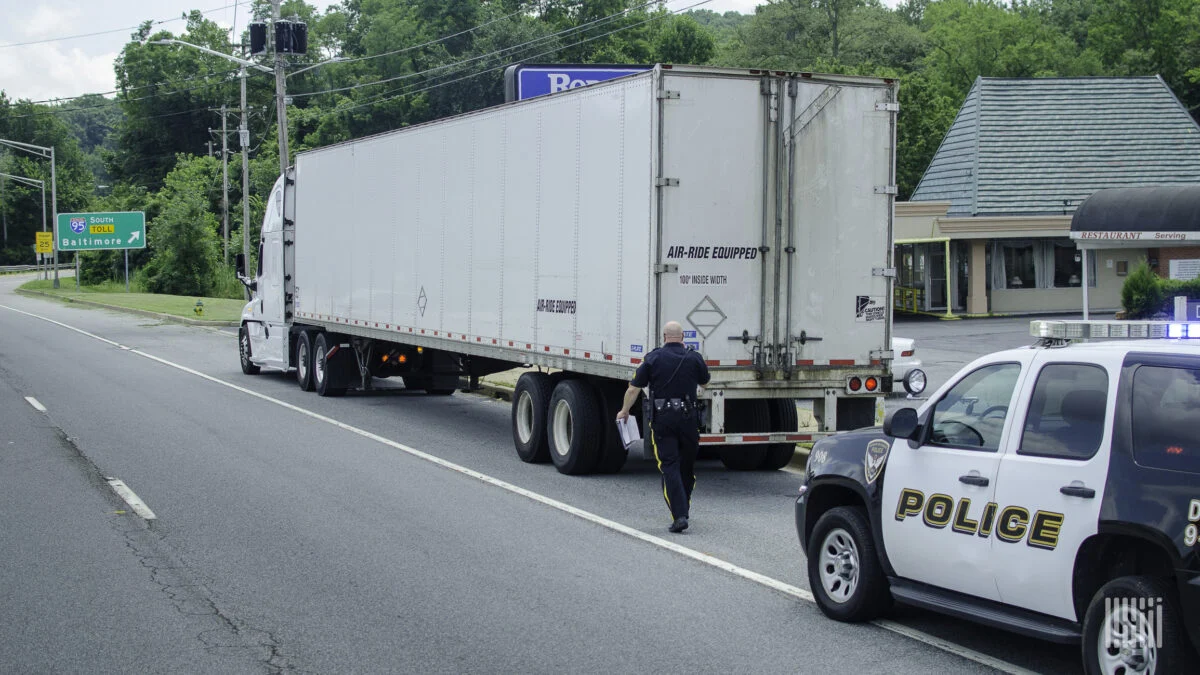
As the trucking industry navigates the first 24 hours of the 2026 International Roadcheck, a stark picture of compliance has emerged. Data aggregated by Search Carriers, which monitors live FMCSA inspection records, indicates that the initial phase of this year’s enforcement blitz has resulted in a disproportionately high rate of out-of-service (OOS) orders. With 1,580 inspections conducted across 1,417 distinct carriers on Day 1, the industry is grappling with 2,637 total violations and 496 OOS orders—a reality check that underscores the intensity of this year’s scrutiny.
Main Facts: The Statistical Landscape of Day 1
The headline figure from Day 1 is the 31.4% out-of-service rate. This metric, derived from a total inspection volume of 1,580, means that nearly one in every three trucks pulled over by enforcement officers was deemed unfit to continue operation until repairs were made or documentation was rectified.
This performance is significantly more aggressive than the historical benchmarks set during previous events. For context, the full-event Roadcheck in 2025 saw a vehicle OOS rate of 18.1% across 56,178 inspections. While the sample size of Day 1 is smaller, the surge in the OOS rate suggests that inspectors are being particularly thorough or that fleet maintenance and driver compliance have slipped during the preceding months. Every one of these 496 OOS orders has already been transmitted to the FMCSA’s Safety Measurement System (SMS), meaning carriers are seeing their CSA scores shift in real-time, with the potential for further volatility as Days 2 and 3 progress.
Geographic Density and Enforcement Hotspots
The Day 1 data reveals a clear concentration of enforcement activity. Three states—Pennsylvania, Kentucky, and New Jersey—accounted for 530 of the 1,580 total inspections. This "tri-state" cluster represents exactly one-third of the national inspection volume.
Pennsylvania led the nation with 217 inspections, followed by Kentucky (159) and New Jersey (154). Other notable activity centers included Oklahoma (89), Michigan (80), Alabama (71), Connecticut (70), Massachusetts (67), Nebraska (64), and Maine (54). These geographic patterns highlight a distinct focus on the Northeast corridor and the I-75/I-65 freight arteries. For carriers and dispatchers, this data is more than just a summary; it is an operational intelligence tool. Knowing that specific regions are experiencing high inspection densities allows fleet managers to sharpen their pre-trip discipline and potentially adjust routing to ensure that drivers are operating at the highest possible level of compliance.
The Worst Individual Violations: A Failure of Culture
Beyond the aggregate numbers, the Day 1 data highlights specific instances where compliance protocols completely broke down. The worst single inspection of the day, recorded in New Jersey, yielded 30 total violations, 28 of which were vehicle-related. This is not a case of a single blown bulb; it represents a systemic failure of maintenance management. A 30-violation inspection suggests that a vehicle was dispatched in a state of advanced mechanical degradation, ignoring multiple safety-critical systems.
Similarly, the OOS-specific data paints a grim picture. A Wyoming inspection resulted in 9 OOS conditions out of 20 total violations, while Kentucky and Massachusetts saw inspections resulting in 6 OOS orders apiece. On the driver side, the data is equally concerning. Four separate inspections—in Alabama, Kansas, and Massachusetts—logged 8 driver-specific violations in a single stop. These are not clerical errors or forgotten medical cards; they are cumulative failures involving credentialing, Hours-of-Service (HOS) logs, and Electronic Logging Device (ELD) compliance, pointing to a lax culture of oversight.
2026 Focus Areas: ELDs and Cargo Securement
The CVSA (Commercial Vehicle Safety Alliance) has designated two specific areas for heightened scrutiny in 2026: ELD tampering/falsification and cargo securement. These areas were chosen based on the overwhelming volume of violations seen in 2025.
ELD Compliance and the "Revoked Device" Risk
With 58,382 total violations for falsification of records of duty status in 2025, the ELD mandate remains a primary enforcement priority. Inspectors are currently cross-referencing logs against fuel receipts, toll records, and bills of lading. Any anomaly—such as "unidentified driving" events, edits without annotations, or location data mismatches—is triggering intensive secondary reviews.
Compounding this is the issue of revoked ELDs. The FMCSA has removed 27 devices from its registered list since January 2026. Carriers are urged to consult the public list at eld.fmcsa.dot.gov. Operating a device that has been revoked beyond the 60-day grace period is treated by the FMCSA as operating without an ELD, a move that guarantees an OOS order.
Cargo Securement: Beyond the Straps
Cargo securement accounted for over 34,000 violations in 2025, covering everything from unsecured freight to loose dunnage and tools. Inspectors are now using the "North American Standard Out-of-Service Criteria" to judge not just the quantity of securement, but the condition. Frayed webbing, rusted chains, and cracked anchor points are immediate grounds for an OOS order. The rule of thumb for drivers remains: if a piece of equipment—be it a tarp, a chain, or a pallet jack—is not secured, it is a violation.
Official Responses and Industry Implications
While the FMCSA has not released a formal "response" to the Day 1 data, the enforcement community has signaled that the increased scrutiny is intentional. The objective of Roadcheck is not to meet a quota but to identify the "worst of the worst." The higher OOS rates observed so far suggest that the strategy is working.
For the industry, the implications are profound. CSA scores are the currency of carrier viability. A high BASIC score in the HOS or Vehicle Maintenance categories can lead to increased insurance premiums, loss of broker contracts, and, in severe cases, FMCSA intervention or revocation of operating authority. Large carriers with dedicated compliance teams are already using real-time data to pivot their operations. The challenge remains for owner-operators and small fleets, who must act as their own compliance departments.
Strategic Advice for Days 2 and 3
The consensus among safety experts is that the "pre-trip" is no longer a formality—it is the frontline of defense against an OOS order.
For the Owner-Operator:
- Audit Your Logs: Search for unassigned driving time. These events are the first thing an inspector checks as a proxy for log manipulation. Annotate and resolve them immediately.
- The "Walk-Around" Protocol: Treat the walk-around as if you are the inspector. If you find a light out or a tire with low tread, fix it in the yard.
- Verify Equipment: Check every strap and chain for fraying. If you can move the load by hand, it is not secure enough.
For the Small Fleet Manager:
- Spot Audit Records: Perform a 8-day look-back on all active drivers. Focus on gaps in logs and unannotated edits.
- Device Audit: Ensure every truck is running a non-revoked ELD.
- Transparency: Use the FMCSA’s DataQs system to contest factual errors in inspection reports. If a violation is incorrect, it must be challenged immediately, as it is impacting your score from the moment of entry.
Conclusion: Compliance as a Competitive Advantage
As the 2026 Roadcheck continues, the data confirms that enforcement is not letting up. The high OOS rate on Day 1 serves as a stark warning to the industry: the standards are rigorous, and the inspectors are prepared. Carriers who view compliance as a burden are the ones most likely to be sidelined. Conversely, those who leverage the available data—checking their status against public records and ensuring their equipment is up to standard—will not only survive the blitz but will emerge with a stronger, more reliable reputation in the marketplace.
For the remainder of the event, the dashboard remains clear: the hotspots are known, the focus areas are defined, and the responsibility lies with every driver and dispatcher to ensure that when the next inspection occurs, the result is a clean bill of health, not an out-of-service order.