By Financial News Desk
January 8, 2026
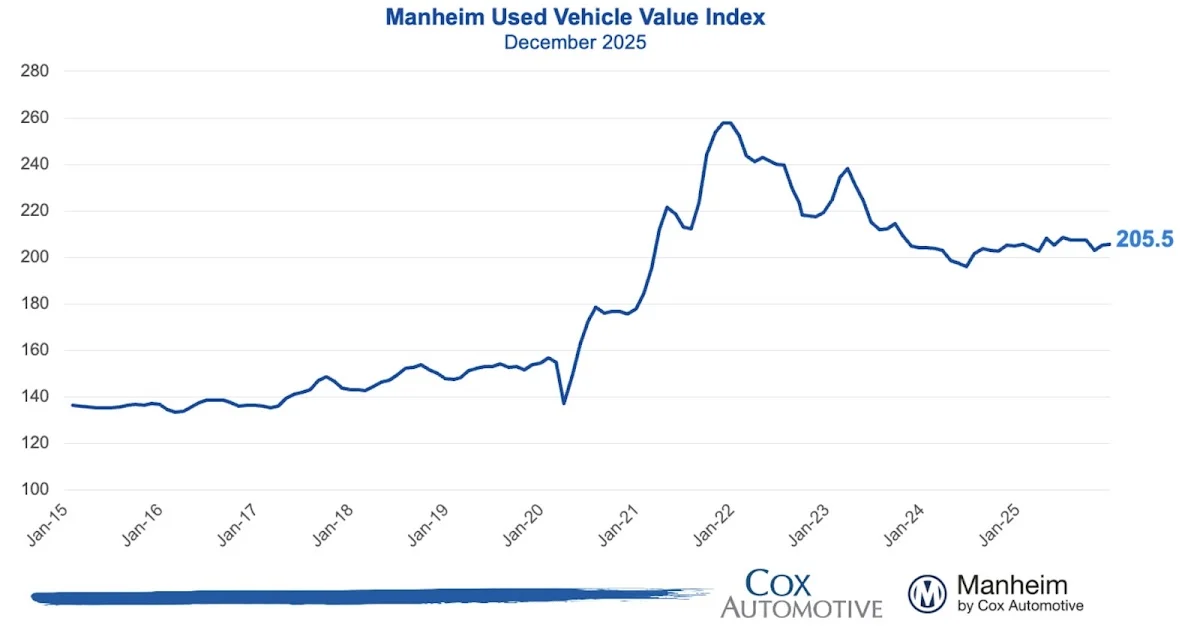
The automotive sector, a critical bellwether for the broader American economy, has concluded 2025 on a note of surprising stability. According to the latest data released today by Manheim Consulting, wholesale used vehicle prices saw a modest uptick in December, signaling a potential stabilization in a market that has spent the better part of the last three years in a state of volatile transition.
The Manheim Used Vehicle Value Index (MUVVI), the industry’s most widely cited benchmark for wholesale pricing, climbed to 205.5 in December. When adjusted for mix, mileage, and seasonality, this figure represents a 0.4% increase compared to December 2024. On a month-over-month basis, the index saw a slight rise of 0.1%, suggesting that while the market is not experiencing explosive growth, it has firmly moved away from the sharp deflationary pressures seen in previous quarters.
The State of the Market: Core Data and Trends
The Manheim Index is derived from millions of completed transactions at Manheim’s U.S. auctions, providing a comprehensive view of the wholesale market—the environment where dealers acquire inventory before it reaches the retail lot.
The 0.4% year-over-year increase is particularly significant when contextualized against the broader inflationary environment of 2025. Throughout the year, automotive analysts were tasked with predicting whether high interest rates and the saturation of the new vehicle market would lead to a wholesale price collapse. Instead, the data indicates a "soft landing" of sorts.
"The market has found a new equilibrium," notes the latest report from Manheim Consulting. While the rapid, pandemic-era price escalations have been fully corrected, the current valuation environment suggests that supply and demand have reached a state of relative parity. The minor 0.1% increase from November to December highlights a market that is largely insensitive to traditional year-end seasonality, perhaps due to shifting consumer demand patterns and a constrained supply of late-model, off-lease vehicles.
A Chronology of the 2025 Automotive Valuation Landscape
To understand the significance of December’s data, one must look back at the trajectory of the 2025 fiscal year. The year began with significant uncertainty, as lenders tightened credit standards in response to fluctuating delinquency rates.
- Q1 2025: The market began the year with cautious optimism. Wholesale prices showed resilience, buoyed by a shortage of three-year-old vehicles—the result of reduced new-car production volumes during the 2022 semiconductor crisis.
- Q2 2025: As interest rates remained elevated, retail demand softened. This created a "back-up" in the wholesale pipeline, as dealers became more selective about the vehicles they brought into inventory.
- Q3 2025: The industry saw a period of volatility. Increased fleet liquidations and a surge in trade-ins placed downward pressure on the MUVVI. Many analysts projected a steep year-end decline, but the market proved more stubborn than anticipated.
- Q4 2025: October and November served as months of consolidation. Dealers, facing a dearth of affordable entry-level vehicles, began bidding more aggressively on wholesale inventory to fill their lots for the holiday season.
- December 2025: The year concluded with a marginal rise, cementing the 0.4% year-over-year growth figure and defying predictions of a deeper market contraction.
Supporting Data: Dissecting the Index
The MUVVI is not merely a single number; it is a complex aggregate of vehicle segments. While the headline index rose by 0.4%, industry experts note that the performance was not uniform across all categories.
Segment Performance
Compact cars and small SUVs, which have been in high demand due to their fuel efficiency and lower price points, outperformed the luxury and full-size truck segments. As consumers grappled with the "affordability gap"—the disparity between average household income and the average transaction price of a new vehicle—the used wholesale market became the primary solution for the middle-market buyer.
Mileage and Condition Adjustments
A crucial component of the Manheim index is the adjustment for mileage and condition. Over the past 12 months, the average vehicle crossing the auction block has shown slightly higher mileage than in 2024. This reflects a trend of consumers holding onto their vehicles longer, delaying trade-ins, and effectively limiting the supply of "pristine" low-mileage vehicles. When the index is adjusted to account for this higher mileage, the true value of the underlying assets appears even stronger than the headline number suggests.
Official Industry Responses and Expert Commentary
Following the release of the report, analysts from major automotive financial houses have weighed in on what this means for the broader economic outlook.

"The fact that we are seeing positive year-over-year growth, even if it is fractional, is a testament to the floor established by current inventory constraints," says a lead analyst at a prominent automotive consultancy. "Dealers are not over-leveraged on inventory, and the wholesale market is no longer being flooded by ‘distressed’ sales."
However, not all feedback is universally optimistic. Some industry stakeholders point to the rising cost of reconditioning and transport as factors that may mask the true profitability of these wholesale acquisitions. "The 0.4% rise in price is a wholesale metric," one executive noted. "When you add in the logistics costs and the cost of capital to hold this inventory in a high-interest-rate environment, the margin for dealers remains razor-thin."
The sentiment among auction house operators is one of cautious stability. There is a general consensus that the "wild" fluctuations of the post-2020 era have largely subsided, replaced by a more predictable, albeit slower, market cycle.
Broader Economic Implications
The stability of wholesale used vehicle prices has significant ripple effects throughout the economy.
1. The Consumer Credit Landscape
Used vehicle loans represent a massive portion of the consumer credit market. With wholesale prices stabilizing, the collateral value of used vehicles remains predictable for lenders. This helps prevent a crisis in the subprime auto loan sector, as lenders can more accurately price risk when they have confidence in the resale value of the underlying asset.
2. Inflation and the CPI
The Bureau of Labor Statistics (BLS) tracks used vehicle prices as a key component of the Consumer Price Index (CPI). For most of 2024 and 2025, the "used cars and trucks" component of the CPI was a source of volatility. A flattening of these prices, as suggested by the Manheim data, is a welcome sign for policymakers at the Federal Reserve, who have been working to stabilize core inflation.
3. The New Vehicle "Halo Effect"
New vehicle sales are intrinsically linked to the trade-in value of the old vehicle. When wholesale used prices are healthy, consumers receive higher trade-in offers, which lowers the effective price of a new car purchase. By maintaining a 0.4% year-over-year increase, the wholesale market is providing a necessary "halo effect," making new car upgrades more accessible for a segment of the population that might otherwise have been priced out.
Future Outlook: Heading into 2026
As the industry pivots toward the first quarter of 2026, the focus shifts to the potential impact of interest rate policy and consumer sentiment. While the Federal Reserve has signaled a possible pivot in its monetary strategy, the effects of current rates will likely persist for at least another two quarters.
The Manheim Index suggests that we are entering a period of "normalcy." The extreme shortages of the pandemic era have been rectified, and the speculative bubbles have burst. Going forward, the wholesale market will likely be driven by fundamental metrics: the age of the average vehicle on the road, the rate of new car production, and the health of the labor market.
Investors and stakeholders should continue to monitor the MUVVI for signs of divergence between retail and wholesale activity. If wholesale prices continue to rise while retail demand remains flat, it could signal a squeeze on dealership margins. Conversely, if wholesale prices soften while retail demand stays robust, it could indicate an opportunity for increased profitability.
In conclusion, the December 2025 data serves as a reassuring signal that the automotive market has weathered the storm. With a 0.4% year-over-year increase, the wholesale used vehicle market is demonstrating the durability and systemic importance that make it a cornerstone of the American transportation economy. As we move into 2026, the watchword for the industry is stability—a welcome change after years of navigating unprecedented turbulence.