Introduction: Assessing the Streaming Giant’s Trajectory
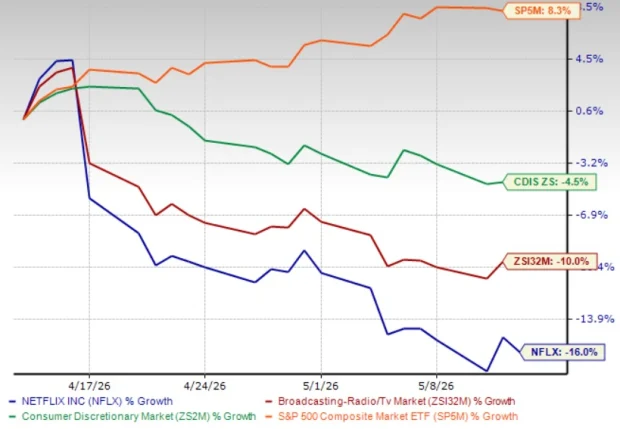
Netflix (NASDAQ: NFLX) has recently navigated a period of volatility, shedding approximately 16% of its market value over the past month. This contraction has caused the stock to underperform both the Zacks Broadcast Radio and Television industry and the broader Consumer Discretionary sector. For long-term investors, this downward trend prompts a critical evaluation: is the investment thesis for the global streaming leader cracking, or is this merely a manifestation of broader macroeconomic malaise and sector rotation?
A comprehensive analysis of the company’s first-quarter 2026 financial results, management’s forward-looking guidance, and an ambitious product roadmap suggests that Netflix’s underlying fundamentals remain robust. While the market may be reacting to short-term sentiment, the company’s transition into an advertising-supported powerhouse and its disciplined approach to capital allocation indicate a firm in command of its destiny.
The Financial Landscape: Q1 2026 Performance
Netflix kicked off fiscal 2026 with a performance that defied the skepticism of many market observers. The company reported first-quarter revenues of $12.25 billion, a 16% increase year-over-year. Even when accounting for foreign exchange fluctuations, the revenue growth remained a healthy 14%, comfortably surpassing internal company forecasts.
Operational Efficiency and Cash Flow
Operating income climbed to $3.96 billion, an 18% improvement over the previous year. Crucially, the company’s operating margin expanded to 32.3%, up from 31.7% in the first quarter of 2025. This expansion is a testament to the "operating leverage" that Netflix has been cultivating for years—the ability to grow revenue at a faster clip than its content and overhead costs.
Perhaps the most striking metric was free cash flow (FCF), which surged to $5.09 billion, up from $2.66 billion in the prior-year quarter—a staggering 91% increase. This financial strength provides the company with the flexibility to reinvest in its platform, return capital to shareholders, and navigate any potential economic headwinds with a fortified balance sheet.
The Advertising Engine: A New Growth Frontier
The most significant transformation in Netflix’s business model is the rapid scaling of its ad-supported tier. Priced at $8.99 per month in the United States, this tier has become the primary engine for subscriber acquisition. During the first quarter, the ad-supported option accounted for more than 60% of all new sign-ups in markets where the feature is available.

The advertiser base has responded in kind, expanding to over 4,000 clients—a 70% increase compared to the same period last year. This rapid adoption indicates that Netflix is successfully pivoting from a pure subscription-model business to a hybrid powerhouse that can capture value from both content-hungry consumers and budget-conscious brands. Regionally, the Asia-Pacific market proved to be a standout performer, with Japan leading the way in membership gains, signaling that the global appeal of the Netflix library continues to resonate across diverse cultural landscapes.
Guidance and Future Outlook
Despite the recent price volatility, management remains steadfast in its outlook for the remainder of the year. Netflix has reaffirmed its full-year 2026 revenue guidance of $50.7 billion to $51.7 billion, representing a growth trajectory of 12% to 14%. Furthermore, the company has maintained its operating margin target of 31.5%.
Strategic Capital Adjustments
A notable development in the financial outlook is the upward revision of free cash flow guidance to $12.5 billion, a significant jump from the initial $11 billion estimate. This adjustment is partly attributed to the after-tax benefits of a $2.8 billion termination fee stemming from the dissolution of a proposed Warner Bros. Discovery deal.
Looking toward the second quarter, Netflix projects revenues of $12.574 billion with an operating margin of 32.6%. The company anticipates that the rate of content amortization will decelerate in the second half of the year, which should serve as a tailwind for further margin expansion in the third and fourth quarters. Current consensus estimates place 2026 earnings at $3.60 per share, implying a 42.29% growth rate—a figure that suggests the current market pullback may be significantly mispricing the company’s earnings potential.
Lean Capital Structure and Shareholder Returns
Netflix has evolved from a company defined by high-cost debt to one characterized by financial discipline. The company closed the first quarter with $14.4 billion in gross debt against $12.3 billion in cash and cash equivalents, resulting in a net debt position of just $2.1 billion.
Management has been proactive in returning value to shareholders. Following the conclusion of the aforementioned Warner Bros. Discovery deal, Netflix resumed its share repurchase program, buying back 13.5 million shares for $1.3 billion during the first quarter. With $6.8 billion still available under the existing authorization, the company is well-positioned to continue supporting its stock price through buybacks.

Furthermore, the company’s asset-light infrastructure model and its commitment to a 1.1x cash content spend-to-amortization ratio ensure that growth is not being pursued at the expense of fiscal sanity. This balance between aggressive investment and capital preservation is a hallmark of a mature, blue-chip growth company.
Product Innovation: Beyond the Screen
Netflix is no longer just a streaming service; it is a technology platform. In March 2026, the company’s acquisition of InterPositive—an AI-driven filmmaking tools startup co-founded by Ben Affleck—signaled a long-term commitment to integrating artificial intelligence into the production workflow.
Engaging the Next Generation
In April 2026, the company launched Netflix Playground, a dedicated gaming app for children. Within weeks, it saw engagement from 10% of all kids’ profiles, with nearly half of these users accessing the service via mobile devices. This highlights Netflix’s ability to capture the attention of younger demographics, effectively building long-term brand loyalty.
Additionally, the rollout of a redesigned mobile experience—featuring a vertical video feed—is aimed at improving content discovery, mirroring the user interface success seen on social media platforms. These product updates have directly contributed to member engagement reaching an all-time high.
The Content Pipeline: The Competitive Moat
The strength of a streaming service is only as good as its library. Netflix’s content slate for the remainder of 2026 is formidable. High-profile releases such as Avatar: The Last Airbender (Season 2), Enola Holmes 3, and live sporting events like the Tyson Fury versus Anthony Joshua fight showcase the platform’s versatility.
Looking into 2027, the company is preparing for a major tentpole event with the release of Greta Gerwig’s Narnia: The Magician’s Nephew. By securing theatrical windows in IMAX before the streaming debut, Netflix is blending the prestige of the silver screen with the convenience of home streaming, a strategy that could redefine how global audiences consume big-budget entertainment.

Competition and Valuation: The Reality Check
While Netflix faces stiff competition from Amazon Prime Video, Disney+, and Apple TV+, the company’s scale remains its greatest competitive advantage. Amazon relies on the broader e-commerce ecosystem, and Disney continues to grapple with profitability headwinds in its streaming division. Meanwhile, Apple TV+ maintains a prestige-focused but relatively limited library.
From a valuation perspective, Netflix is not "cheap." With a forward 12-month price-to-sales ratio of 6.89X, it trades at a premium to the industry average of 4.04X. However, this premium is justified by the company’s superior margins, cash flow growth, and dominance in the advertising sector. While the Zacks Value Score of "D" may deter value-oriented investors, those focused on growth and market dominance will likely view the current valuation as a fair price for a market leader.
Conclusion: A Hold for the Long Term
The 16% dip in Netflix’s stock price appears to be a disconnect between market sentiment and fundamental performance. The company has demonstrated that it can grow revenue, expand margins, and generate massive free cash flow simultaneously—a rare feat in the current economic environment.
With a Zacks Rank #3 (Hold), the company is in a stable position. For existing shareholders, the long-term thesis remains intact, supported by a growing advertising business and a robust content pipeline that extends well into 2027. New investors, meanwhile, may find the current pullback a reasonable entry point, provided they are prepared for the inherent volatility of the streaming sector. Netflix remains a cornerstone of the modern entertainment landscape, and its ability to innovate and adapt continues to outpace its rivals.