
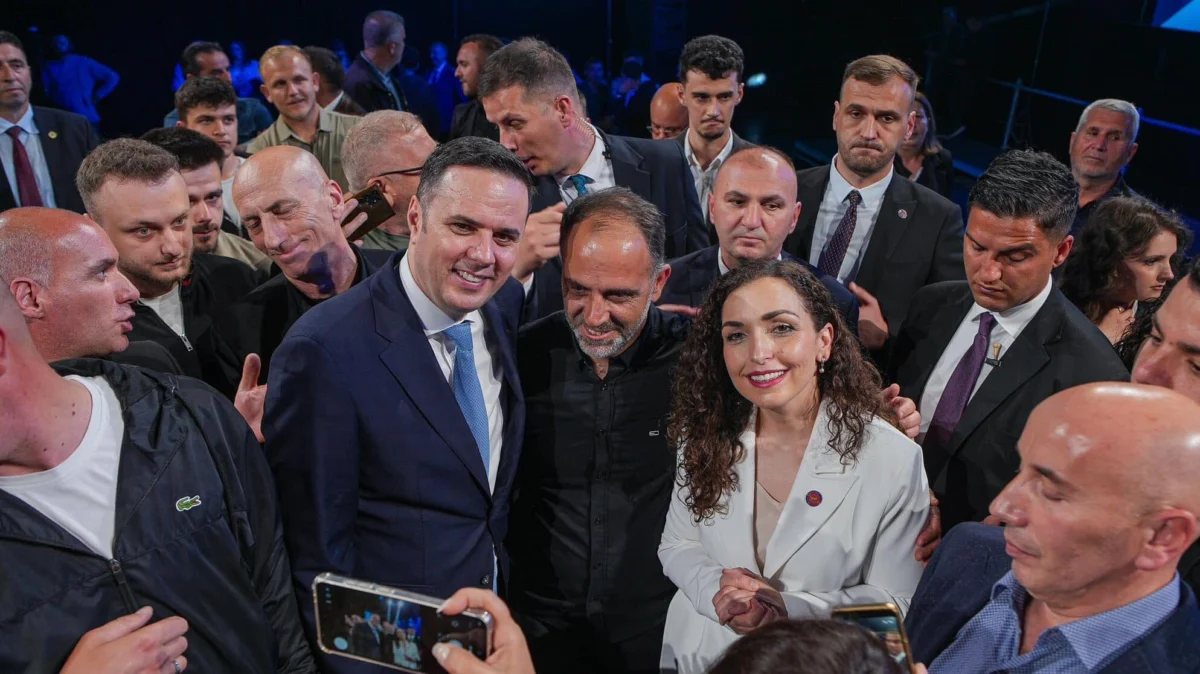
Pristina, Kosovo – May 10, 2026 – In a move that has sent ripples through Kosovo’s political establishment, former President Vjosa Osmani has officially rejoined the Democratic League of Kosovo (LDK). This homecoming, occurring six years after her acrimonious departure, marks a significant turning point for both Osmani and the LDK, a party that has been grappling with declining electoral fortunes. The decision signals a strategic realignment aimed at challenging the dominance of the ruling Vetëvendosje movement and potentially ushering in a new era for a nation constantly navigating its political and international identity.
Osmani’s return is not merely a personal reunion; it is a calculated political maneuver that positions her as a pivotal figure in the upcoming June 7th parliamentary elections. The LDK, which experienced a historic low of 13% in the December elections, desperately needs a surge in support, and Osmani, a charismatic and widely recognized figure, is seen as its potential savior. This resurgence is crucial for party leader Lumir Abdixhiku, whose leadership has been under scrutiny. Osmani’s endorsement could legitimize his efforts to reunite a fractured party and revitalize its electoral appeal.
The timing of Osmani’s return is particularly potent, coming amidst political turbulence and a series of snap elections. The upcoming vote will be the third in less than 16 months, highlighting a period of significant instability in Kosovo’s governance. Osmani’s rhetoric upon rejoining the LDK was clear: she positioned the party’s path as a continuation of the legacy of Ibrahim Rugova, the revered founding father of Kosovo and LDK, contrasting it sharply with what she described as the "chaotic" approach of Albin Kurti’s Vetëvendosje.
A Tumultuous Journey: From LDK Star to President and Back
Vjosa Osmani’s political trajectory has been anything but linear. Her re-entry into the LDK fold is the culmination of a complex and often dramatic journey, marked by strategic alliances, sharp political disagreements, and ultimately, a pragmatic re-evaluation of her political home.
2020: The Rise to Prominence and a Fractured Alliance
Osmani’s ascent in Kosovar politics was meteoric. A lawyer by profession, her career began in the office of then-President Fatmir Sejdiu, where she served as Chief of Staff. Her involvement in drafting Kosovo’s constitution laid the groundwork for her subsequent political career. She was elected as an LDK Member of Parliament and, in February 2020, shattered glass ceilings by becoming the first woman to hold the position of Speaker of the Assembly. In the general elections of that year, she garnered an impressive number of votes, exceeding 300,000, making her the most voted candidate in Kosovo.
Her prominence continued to grow. In November 2020, following the resignation of President Hashim Thaçi to face war crimes charges, Osmani assumed the role of Acting President. However, by this point, her relationship with the LDK had begun to fray. The party had previously blocked her bid for LDK leadership in 2015 due to tensions with then-Prime Minister Isa Mustafa. Despite this, in the 2017 general elections, Osmani demonstrated her electoral power by becoming the second most voted candidate for the LDK, even when ranked low on the party’s list.
In 2019, under public pressure, the LDK nominated her as their candidate for Prime Minister. However, she narrowly lost to Vetëvendosje. The real schism occurred in March 2020, during the COVID-19 pandemic. Osmani sided with Albin Kurti against her own party during a no-confidence motion against the government. When she refused to support an LDK-led cabinet in June, she was expelled from the party.
2021: Forging a New Path with Vetëvendosje and the Presidency
Following her expulsion, Osmani founded her own political party, Guxo. This new venture immediately formed a coalition with Vetëvendosje for the February 2021 elections. A month later, with Vetëvendosje in power, Osmani was elected President of Kosovo by the parliament. Her five-year term as President was marked by significant international engagement, including her participation in the Board of Peace of Donald Trump, an initiative that raised her profile but also drew criticism from those who questioned its impact on global peace.
2025-2026: The Rift with Kurti and the Return to LDK
The end of her presidential term saw a clear breakdown in the alliance between Osmani and Albin Kurti. Osmani expressed her desire to seek a second term as president, a move not supported by Vetëvendosje, which instead proposed its own candidate. When their candidate failed to secure parliamentary support, Osmani dissolved the parliament on March 5th, setting the stage for early elections. However, her decree was later invalidated by the Constitutional Court, which granted parliament an additional 34 days to elect a new president and avoid further elections.
Despite Vetëvendosje’s decisive victory in the December elections with 51% of the vote, Kurti’s party fell short of the required threshold for electing a president without opposition support. This political deadlock, coupled with Osmani’s perception that Kurti had "betrayed" Vetëvendosje voters simply to "eliminate" her as president, led to the irreparable rupture between them. Without Kurti’s backing or a strong party of her own, Osmani’s return to the LDK, a possibility that had been circulating for some time, became a viable and ultimately, a chosen path.
Osmani’s Vision: A Return to Rugova’s Legacy and a Stronger State
In her address to LDK supporters, Osmani articulated a clear vision for Kosovo’s future, drawing a stark contrast between her chosen path and that of the current government.
"Their path," she stated, referring to Albin Kurti and Vetëvendosje, "is a path that returns the country to elections every three months." This was a pointed criticism of the political instability and frequent electoral cycles that have characterized Kosovo in recent years.
In contrast, she presented an alternative: "The other path, the other path is the path of Rugova’s legacy. It is the path of a serious state. It is the path of strong alliances, of international respect." This invocation of Rugova, a figure deeply revered for his commitment to state-building, democracy, and international integration, serves as a powerful symbol for the LDK and a direct appeal to voters who yearn for stability and a clear direction.
Osmani emphasized a vision of Kosovo that is neither subservient nor isolated: "The path of Kosovo that never bows down, but also does not isolate itself. Kosovo’s path that was built by its people with the extraordinary support of our diaspora. And today, together with you, I have chosen this path. I have chosen this path to open a new chapter for Kosovo together." This statement underscores her commitment to a proactive and internationally engaged Kosovo, built on the foundation of its citizens and its diaspora.
The Electoral Calculus: Can Osmani Revitalize LDK?
The central question now facing Kosovo’s political landscape is whether Vjosa Osmani’s return to the LDK will translate into tangible electoral gains in the June 7th parliamentary elections. These elections, the third in under 16 months, come at a time when the LDK has hit a historic low, polling at just 13% in December.
Expert Analysis:
Belgzim Kamberi, Project Manager at the Institute for Social Policy "Musine Kokalari" in Pristina, believes the election results will be the ultimate determinant of Osmani’s impact. "The election results will determine the impact of Osmani’s return and for Lumir Abdixhiku as party leader, because they can legitimize his policy of ‘reunification’ of the party," Kamberi told BIRN.
Kamberi further elaborated on the potential for Osmani to regain political footing: "Osmani can gain new legitimacy in relation to the LDK, not only for the present, but also in relation to her past." This suggests that her return could serve to both mend past divisions within the party and re-establish her as a formidable political force.
Potential Challenges and Opportunities:
- Reuniting a Fractured Base: The LDK has struggled to maintain its traditional voter base. Osmani’s return offers an opportunity to energize disillusioned LDK supporters and attract new voters who may have been drawn to her independent political stance.
- Challenging Vetëvendosje’s Dominance: Vetëvendosje, while dominant, has faced criticism for its governance style and its perceived inability to secure Kosovo’s international standing. Osmani, with her experience as President and her emphasis on international alliances, is well-positioned to challenge this narrative.
- The "Osmani Factor" in Coalition Politics: Osmani’s presence on the LDK’s ticket could significantly influence post-election coalition dynamics. Political analyst Ylli Hoxha noted that her inclusion could make a potential coalition with Vetëvendosje more challenging. "The inclusion of Vjosa Osmani in the list of candidates makes a possible post-election coalition with Vetëvendosje more difficult," Hoxha stated, adding that it is "difficult to imagine Kurti returning the presidency to her." This suggests that Osmani’s return could inadvertently solidify a united opposition against Vetëvendosje, should coalition talks prove insurmountable.
- Defining Her Role within LDK: While her return is significant, the exact nature of Osmani’s role within the LDK remains to be seen. Political expert Arta Tahiri Beqa commented on the immediate future: "I think for the moment we cannot talk about Osmani’s inclusion within the party in any position. The elections are approaching quickly, and political forces must engage in maximizing votes." This indicates that immediate leadership roles might be secondary to the imperative of electoral success.
The Road Ahead: Navigating Post-Election Realities
The strategic implications of Vjosa Osmani’s return to the LDK extend beyond the immediate electoral contest. Her presence has undoubtedly injected new energy into the party, but it also brings with it the complexities of past political battles and the uncertainties of future alliances.
As Kamberi aptly put it, "It seems the focus will be more on the election results than on any post-election policy." This pragmatic assessment highlights the immediate priority for both LDK and Vetëvendosje: achieving a strong electoral outcome. For Lumir Abdixhiku, securing a good result will serve as a crucial validation of his leadership and his strategy of "reunification." Similarly, for Albin Kurti, the election outcome will be a referendum on his tenure and his party’s vision for Kosovo.
The LDK, under Abdixhiku, faces the considerable challenge of translating Osmani’s renewed popularity into votes. The party must navigate its internal dynamics and present a unified front to voters. The question of whether Osmani will assume a formal role within the LDK leadership remains open, with analysts suggesting that immediate electoral priorities might overshadow such discussions. "Every return must go through specific procedures, not on an ad-hoc basis as usually happens with political parties here. Nevertheless, it is up to the LDK to decide," Tahiri Beqa observed, underscoring the party’s autonomy in defining Osmani’s future within its ranks.
Ultimately, Vjosa Osmani’s return to the LDK is a bold gambit designed to reshape Kosovo’s political landscape. Whether this homecoming leads to a resurgence for the LDK, a stronger opposition force, or a more complex and unpredictable political future, remains to be seen. The upcoming June 7th elections will undoubtedly be a pivotal moment in this unfolding narrative.