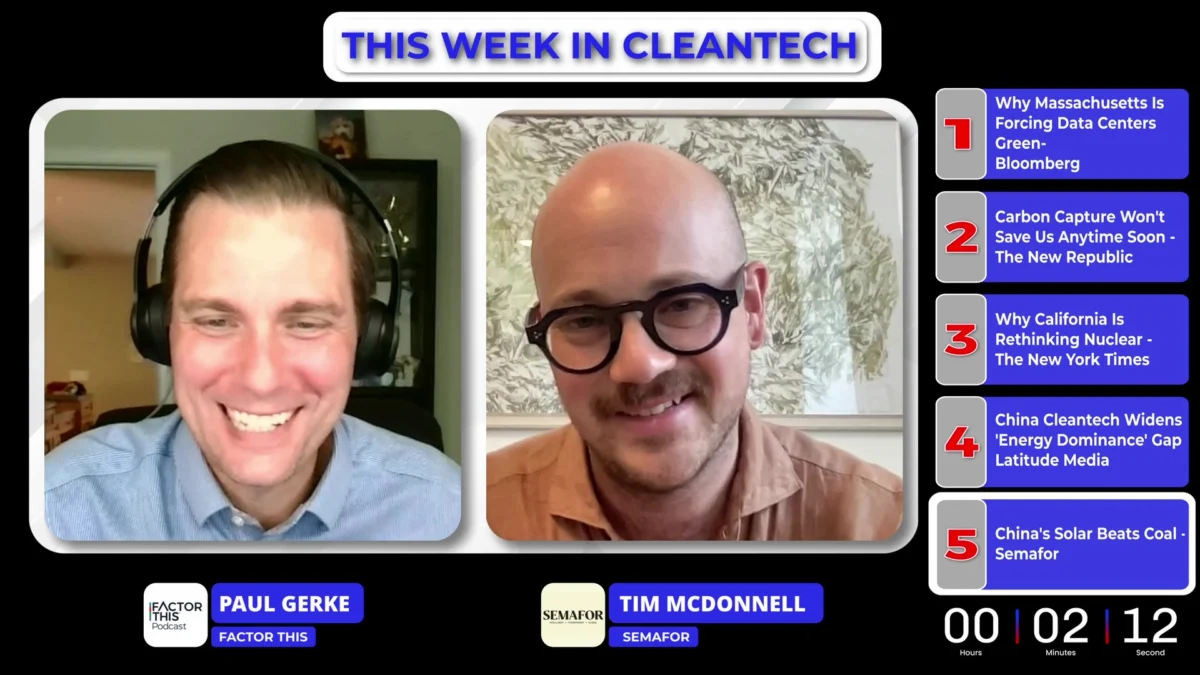
The global energy landscape is undergoing a tectonic shift, marked by rapid decarbonization, aggressive regulatory intervention, and a surprising resurgence of nuclear energy. As the world grapples with the increasingly urgent reality of the 1.5°C climate threshold, the latest edition of This Week in Cleantech—hosted by industry veterans Paul Gerke of Factor This and Mike Casey of Tigercomm—illuminates a sector in flux. Featuring insights from Tim McDonnell of Semafor, the podcast serves as a gateway to understanding how the pillars of the global economy are being rewired.
The State of the Industry: Main Facts and Emerging Leaders
The clean energy transition is no longer a peripheral concern; it has become the central engine of industrial strategy. Nowhere is this more evident than in the rise of startup innovation. This week’s "Cleantecher of the Week," Kofi Asante, founder and CEO of Bluecore Energy, exemplifies the bold, high-stakes nature of modern climate tech.
Just two months after emerging from stealth mode, Bluecore Energy has secured an oversubscribed $50 million seed round. The startup’s mission is as ambitious as its funding is rapid: the deployment of small modular nuclear reactors (SMRs) mounted on floating, mobile barges. By bypassing the need for fixed land sites, Bluecore aims to deliver clean, consistent baseload power directly to ports and industrial hubs. This modular approach addresses one of the most significant bottlenecks in the energy transition—siting and permitting—while providing a scalable solution for carbon-intensive maritime and industrial infrastructure.
Chronology of a Changing Energy Order
The past week has highlighted a series of critical inflection points that define our current trajectory:
- The China Milestone: In a historic development, solar energy has officially surpassed coal as China’s leading power source by installed capacity. This represents a decade of unparalleled investment, transforming the nation from a coal-reliant industrial giant into the world’s leading producer and consumer of renewable technology.
- Regulatory Tightening in the U.S.: On Tuesday, Massachusetts Governor Maura Healey signed an executive order establishing strict oversight for data centers, requiring developers to secure their own clean energy procurement before initiating construction.
- The Nuclear Reversal: California, historically a stronghold of anti-nuclear sentiment, is moving toward a historic pivot. The state legislature and Governor Gavin Newsom are now actively exploring the extension of the Diablo Canyon power plant and considering the repeal of a 50-year-old moratorium on new nuclear reactors.
- The Global Emissions Reality Check: A sobering report from the UN Environment Program has warned that the world remains on a collision course with a 2.6°C warming scenario, underscoring the limitations of current carbon capture technologies.
Supporting Data: Analyzing the Energy Gap
The data suggests a world caught between exponential progress and existential risk.
China’s Export Dominance
A comprehensive report from the energy think tank Ember reveals the sheer scale of China’s "energy dominance" strategy. In the first half of 2026, clean energy technology exports accounted for 6.6% of all Chinese exports—a staggering $140 billion. This figure has more than doubled from 2.7% in 2020. China’s ability to meet 100% of its power demand growth through clean energy, even as its total consumption hit a record 10.4 trillion kilowatt-hours, signals a decoupling of economic growth from carbon emissions that few analysts predicted a decade ago.
The Carbon Capture Deficit
The United Nations’ recent assessment offers a more sobering perspective. To stabilize temperatures at the 1.5°C target, the world requires the sequestration of 15 to 24 gigatonnes of CO2 annually by 2100. Currently, global removal efforts—dominated by forest management and tree planting—account for only 2.2 gigatonnes. Engineered carbon capture remains in its infancy, contributing a negligible fraction of this total, proving that technological "fixes" cannot yet replace the urgent need for emissions reduction.
Official Responses and Policy Shifts
Massachusetts: Protecting the Grid
Governor Maura Healey’s executive order reflects a proactive approach to the "data center explosion." With the rise of AI and high-performance computing, energy demand from server farms is skyrocketing. Massachusetts, which has traditionally faced higher energy and real estate costs, is positioning itself to avoid the capacity crunches seen in other states. Under the new rules, any data center with a peak demand exceeding 25 megawatts must undergo rigorous local review and prove it will not burden the existing grid with fossil-fuel dependence. If they fail to secure renewable power, they are mandated to contribute to a dedicated fund to support local ratepayers.
California: The Nuclear Renaissance
The narrative in California is shifting from "phase-out" to "lifeline." The federal government has signaled its support for this transition, recently providing $271 million from the Department of Energy to assist with the Diablo Canyon plant, with an additional $1.1 billion potentially available. For a state that once viewed nuclear power as an environmental liability, the necessity of meeting a 100% clean electricity mandate by 2045 has necessitated a pragmatic re-evaluation.
Implications: The Geopolitics of Energy
The convergence of these events reveals profound implications for the global order.
The Strategic Value of Renewables
Tim McDonnell, speaking on This Week in Cleantech, emphasized that China’s rapid solar buildout is as much about national security as it is about climate. By reducing its reliance on imported oil—a necessity highlighted by regional instability and the ongoing impact of global conflicts—Beijing is insulating its economy from energy price shocks and supply chain vulnerabilities. As solar now makes up nearly one-third of China’s total installed capacity, the country has created a buffer that allows it to power its energy-hungry AI and manufacturing sectors with domestic, carbon-free energy.
The "Fixed Site" Problem and Innovation
The success of startups like Bluecore Energy highlights the growing pains of traditional energy infrastructure. As data centers and industrial ports struggle to connect to aging, centralized grids, the demand for decentralized, "plug-and-play" energy solutions is surging. The ability to deploy modular reactors on floating platforms effectively turns a site-selection problem into a logistics challenge, a pivot that may redefine how urban coastal hubs achieve carbon neutrality.
A Reality Check on Climate Goals
The UN report serves as a definitive warning against complacency. While the progress in China and the policy shifts in the United States demonstrate that the transition is accelerating, the math of the climate crisis remains unforgiving. Engineered carbon capture, while essential for long-term stabilization, is currently nowhere near the scale required to bridge the gap between our current path and our climate goals.
Conclusion: Toward a Realistic Transition
The events of this week illustrate a complex, multi-layered energy transition. We are seeing the rise of a new "clean-industrial" power in China, a pragmatic return to nuclear power in the West, and the emergence of agile, well-funded startups willing to innovate outside the confines of traditional infrastructure.
However, the overriding lesson remains the urgency of the scale-up. Policy guardrails—like those implemented in Massachusetts—are becoming essential to ensure that the infrastructure of the future is built sustainably. Simultaneously, the global community must reconcile the vast gap between the promise of emerging technologies and the hard data provided by climate scientists. As Paul Gerke and Mike Casey continue to document in their podcast, the path to 2045 will be paved by those who can navigate the intersection of political will, technological breakthrough, and the cold, hard realities of global energy demand.
As we look toward the remainder of the year, the focus will likely remain on whether these regional and corporate efforts can coalesce into a global momentum capable of outpacing the warming trend. Whether it is through the modular nuclear ambitions of Bluecore Energy or the massive infrastructure shifts within China, the world is clearly done waiting for a transition; it is now actively constructing it.