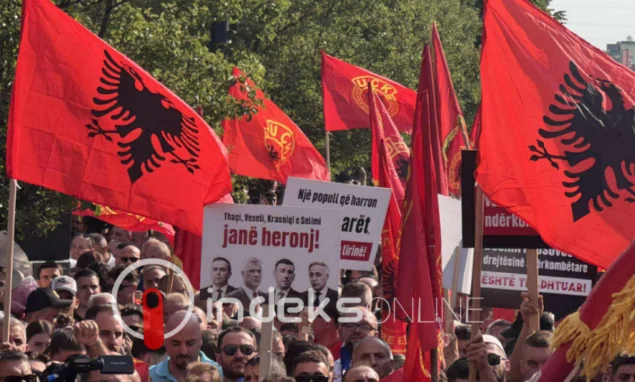
Tirana, Albania – October 24, 2026 – Albania’s capital, Tirana, was plunged into chaos this afternoon as a large-scale opposition protest escalated into violent clashes between demonstrators and police. The unrest, centered initially on the main boulevard, culminated in intense confrontations in Skanderbeg Square, leaving at least one police officer severely injured by a Molotov cocktail and raising serious questions about political stability and the nation’s European integration prospects.
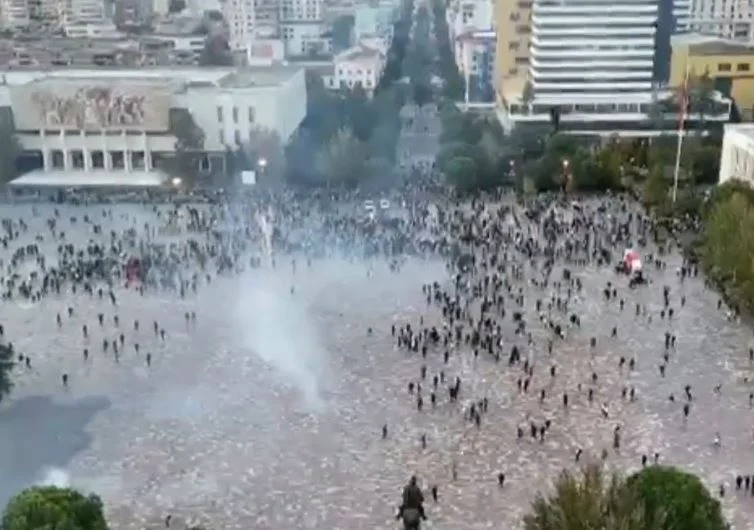
The events unfolded rapidly, with initially peaceful gatherings devolving into a scene of tear gas, projectiles, and masked individuals engaging in direct confrontation with law enforcement. Exclusive drone footage obtained by ABC News captured the dramatic escalation, providing an aerial perspective of the unfolding violence that has shocked the nation and drawn international concern.
Main Facts
On Friday, October 24, 2026, a planned opposition protest in Tirana, intended to voice grievances against the government, spiraled out of control. Thousands of demonstrators gathered, initially focusing on the main boulevard, but confrontations quickly ensued. Police deployed tear gas to disperse the crowd, pushing a significant portion of the protesters towards Skanderbeg Square, the city’s central plaza. Here, the situation took a violent turn as masked individuals, reportedly armed with sticks and Molotov cocktails, engaged directly with riot police. The most severe incident involved a Molotov cocktail striking a police officer, who was immediately engulfed in flames and sustained significant injuries. The protest, characterized by its destructive nature, has sparked widespread condemnation and ignited a national debate on the boundaries of political expression and the rule of law. The timing of such a violent display also casts a shadow over Albania’s ongoing efforts towards European Union accession, a process frequently emphasized by both domestic and international actors as crucial for the country’s democratic development.
Chronology of Chaos
The day began with an air of anticipation as various opposition factions called for a major demonstration against the incumbent government. The protest was framed as a response to perceived corruption, economic stagnation, and what the opposition termed a "slide towards authoritarianism."
Initial Gathering and March
By early afternoon, thousands of protesters began converging on the main boulevard of Tirana, near government buildings. The atmosphere was charged but initially contained within the bounds of a typical large-scale demonstration. Chants against the government echoed through the streets, accompanied by banners and flags. Opposition leaders addressed the crowd, delivering impassioned speeches criticizing the administration and demanding its resignation. Security forces, including riot police, were deployed in significant numbers, forming cordons around key government institutions, anticipating potential attempts to breach security lines.
Police Intervention and Tear Gas Deployment
As the afternoon wore on, the mood grew increasingly tense. Reports from the ground indicated that a segment of the crowd began to push against police barricades on the boulevard, attempting to advance towards the Prime Minister’s Office. In response to these perceived breaches and to prevent further escalation, police made the decision to deploy tear gas. Thick plumes of smoke rapidly enveloped the boulevard, causing widespread panic and discomfort among the demonstrators. Many scattered, coughing and with burning eyes, seeking refuge in side streets. This initial dispersal tactic, while effective in clearing the immediate area, also fragmented the protest, pushing pockets of more determined or aggressive individuals into new locations.
Escalation and Violence in Skanderbeg Square
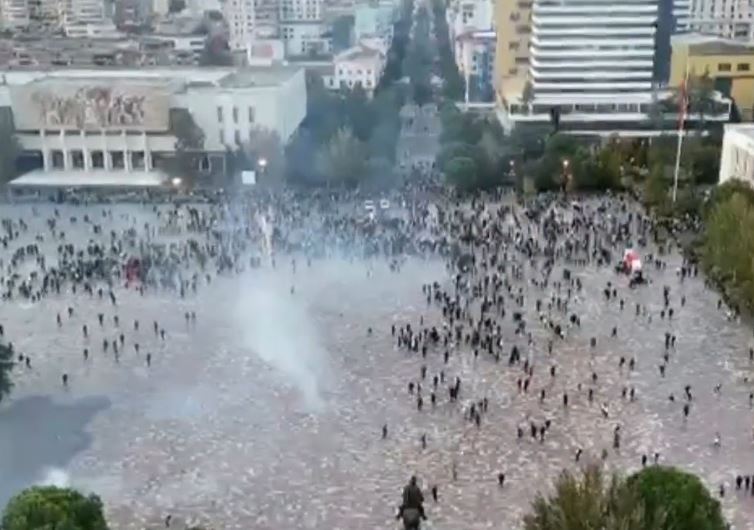
The dispersal on the boulevard inadvertently redirected a significant number of protesters, including more radical elements, towards Skanderbeg Square. It was here that the protest mutated from a confrontational demonstration into outright street violence. Drone footage provided by ABC News clearly showed groups of masked individuals, some wielding sticks, converging in the square. These individuals appeared organized and intent on confrontation. They began to hurl various projectiles at the police lines, including stones, bottles, and alarming Molotov cocktails.
The most egregious act of violence occurred when one such incendiary device struck a police officer directly, setting him ablaze. The officer, whose identity has not yet been fully released, was seen collapsing as colleagues rushed to extinguish the flames. This incident marked a critical point in the escalation, demonstrating a clear intent to inflict serious harm on law enforcement personnel. The square transformed into a battleground, with police responding with further tear gas volleys and, in some instances, batons, attempting to repel the onslaught and apprehend those responsible for the attacks. The sounds of sirens, shouts, and explosions filled the air, replacing the earlier chants of protest.
Aftermath and Damage Assessment
By late evening, police forces had largely managed to regain control of Skanderbeg Square and the surrounding areas. The immediate aftermath revealed a scene of significant damage and disruption. Burn marks scarred the cobblestones where Molotov cocktails had landed, debris littered the streets, and some public infrastructure, including benches and streetlights, showed signs of vandalism. Several vehicles parked nearby were also reportedly damaged. Medical teams were observed attending to injured individuals, both police and protesters, though official figures on total casualties were still being compiled. The immediate focus shifted to restoring order, clearing the damage, and initiating investigations into the violence, particularly the attack on the police officer. The events of October 24, 2026, will undoubtedly leave a lasting imprint on Tirana’s urban landscape and its political discourse.
Supporting Data and Context
The violence witnessed in Tirana is not an isolated incident but rather a symptom of deeper political and social tensions simmering beneath the surface of Albanian society. To understand the gravity of these events, it is crucial to place them within the broader context of the nation’s political landscape, historical precedents, and its aspirations for European integration.
Context of Political Tensions
Albania has a history of passionate, and at times volatile, political protests, often fueled by deep divisions between the ruling party and the opposition. The current climate is particularly fraught, characterized by allegations of widespread corruption, concerns over the judiciary’s independence, and persistent economic challenges despite government claims of progress. The opposition, fragmented yet determined, frequently accuses the government of authoritarian tendencies, suppressing dissent, and failing to deliver on promises of prosperity and good governance. These grievances, amplified by a polarized media landscape, create fertile ground for public discontent. The recent ABC News poll, which asked: "Opposition violence versus European integration: How should the government react?", directly reflects the dilemma facing the nation. It highlights the perceived tension between the right to protest and the imperative to maintain stability, especially when violence threatens to derail national objectives like EU membership.
Tactics and Perpetrators
The use of masked individuals and Molotov cocktails signifies a deliberate escalation beyond conventional protest tactics. Such methods are often associated with extremist elements or groups intent on provoking confrontation and chaos. The drone footage, a powerful tool in modern journalism, provided undeniable evidence of these individuals operating within the larger protest. This raises critical questions about who these masked individuals are, whether they are organized, and if they are connected to specific political factions. Their presence suggests either a pre-planned strategy to incite violence or the infiltration of the protest by groups seeking to exploit the unrest for their own agendas. The targeting of police with incendiary devices moves the protest beyond simple civil disobedience into acts of serious criminal assault, demanding a robust investigation to identify and prosecute those responsible.

Casualties and Damage Assessment
The most immediate and concerning casualty of the protest was the police officer severely injured by a Molotov cocktail. His condition remains critical, and the incident has galvanized public and political opinion against the use of such extreme violence. While official numbers are still being compiled, initial reports suggest several other individuals, both police and protesters, sustained minor to moderate injuries from tear gas exposure, projectiles, and scuffles. The material damage to public property, including street furniture, pavement, and possibly nearby commercial establishments, is also substantial, adding to the cost of the unrest and requiring significant public funds for repairs. The long-term psychological toll on those directly involved, particularly the injured officer and eyewitnesses to the violence, should also not be underestimated.
Eyewitness Accounts and Media Coverage
Eyewitnesses described a terrifying scene as the protest turned violent. "It started peacefully, but then the tear gas came, and everything changed," recounted Ana K., a resident living near Skanderbeg Square. "Suddenly, there were these masked men, throwing things. I saw the officer catch fire. It was horrifying. This isn’t how things should be solved." Another demonstrator, who wished to remain anonymous, stated, "We came to protest peacefully, but the police provoked us. Then some people got angry, and it just got out of hand."
ABC News’s drone footage played a pivotal role in capturing the full scope of the escalation, offering an objective, birds-eye view of the events that ground-level cameras might have missed. This footage, widely circulated, served as crucial evidence, informing both public perception and subsequent investigations. The immediate and widespread media coverage, both domestic and international, underscored the severity of the events, putting Albania under a spotlight at a sensitive juncture in its political development.
Official Responses
The violent protest triggered immediate and varied reactions from key political actors and international observers, each framing the events through their own lens.
Government Statement
The government swiftly condemned the violence, particularly the attack on the police officer. In a televised address late Friday evening, Prime Minister Edi Rama denounced the "barbaric acts" and "orchestrated violence" by what he termed "extremist elements incited by the opposition." He pledged a full and swift investigation, promising that "those who resorted to terror and tried to destabilize our nation will face the full force of the law." The government emphasized its commitment to protecting democratic processes but asserted that violence would not be tolerated. Ministers echoed these sentiments, highlighting the damage to Albania’s image and its European aspirations. The government also reiterated its commitment to dialogue but stressed that it could not negotiate under the threat of violence.
Police Statement
The Albanian State Police issued a statement detailing their actions, emphasizing their mandate to maintain public order and ensure the safety of citizens and public property. They confirmed the deployment of tear gas as a necessary measure to disperse an unruly crowd that was attempting to breach security perimeters. A spokesperson confirmed the severe injury of an officer and stated that several arrests had been made, with investigations ongoing to identify and apprehend all individuals involved in the violent acts. The police leadership called for calm and urged citizens to distance themselves from violent elements, reiterating their professionalism and restraint in the face of aggression. They also expressed solidarity with their injured colleague and vowed to ensure justice.
Opposition Statement
The main opposition parties, while condemning the attack on the police officer, largely placed the blame for the escalation on the government and police. Opposition leader Lulzim Basha stated that the government’s "provocative actions and heavy-handed response" had inflamed an already tense situation. He accused the government of "sending agent provocateurs" to discredit the legitimate demands of the protesters. While distancing the mainstream opposition from the masked individuals and Molotov cocktails, Basha maintained that the core grievances driving the protest were valid and that the government’s failure to address them was the root cause of the unrest. He called for an independent investigation into both the police’s actions and the identity of the masked perpetrators, suggesting a conspiracy to undermine the opposition movement.
International Reactions
The European Union Delegation in Tirana issued a statement expressing "serious concern" over the violence and calling on all parties to exercise restraint and engage in constructive dialogue. They emphasized the importance of peaceful protest within democratic norms and stressed that violence has no place in a country aspiring to EU membership. The U.S. Embassy also urged calm and a thorough investigation, reaffirming its support for Albania’s democratic institutions but cautioning against actions that could undermine stability. Human rights organizations, both domestic and international, called for adherence to international standards regarding the use of force by police and the protection of protesters’ rights, while also condemning acts of violence by demonstrators.
Implications
The violent protest in Tirana carries profound implications for Albania’s domestic political landscape, its relationship with the international community, and critically, its long-term objective of full integration into the European Union.
Impact on Domestic Politics
The events of October 24 have deepened the already existing political polarization in Albania. The government is likely to use the violence to delegitimize the opposition, portraying them as irresponsible and dangerous. This could lead to a hardening of positions, making any constructive dialogue even more challenging. The opposition, meanwhile, faces the difficult task of condemning the violence while still advocating for its cause, risking accusations of hypocrisy or tacit approval if it fails to clearly distance itself from the extremist elements. This incident could also empower hardliners within both the government and opposition, potentially leading to a more confrontational political style. Public trust in institutions, already fragile, could further erode, and the potential for future, perhaps even more violent, protests remains a significant concern, creating a cycle of unrest and repression.
Effect on European Integration
Perhaps the most significant long-term implication relates directly to Albania’s European integration trajectory. The poll question – "Opposition violence versus European integration, how should the government react?" – encapsulates this dilemma perfectly. Such scenes of violent street clashes, attacks on police, and political instability send a negative signal to Brussels and EU member states. Concerns about the rule of law, democratic maturity, and political stability are paramount for accession candidates. Episodes of severe unrest can delay progress on crucial reforms, damage the country’s international reputation, and fuel skepticism among those EU members already hesitant about enlargement. The EU has consistently emphasized that a stable political environment and adherence to democratic principles are non-negotiable prerequisites for membership. This protest risks setting back Albania’s accession timeline, potentially for years, by raising doubts about its readiness to meet these fundamental criteria.
Social Cohesion and Public Opinion
The violence also exacerbates divisions within Albanian society. While many condemn the destruction, underlying grievances persist, and public opinion is likely to be split on who bears primary responsibility for the escalation. Some will blame the government for its perceived authoritarianism and economic failures, while others will condemn the opposition for inciting violence and allowing extremism within its ranks. This further fracturing of public opinion can undermine social cohesion, making it harder to forge national consensus on critical issues. The image of Albania as a stable, forward-looking nation working towards a European future is damaged, replaced by one of internal strife and potential chaos. The fear of repeated violence could also deter foreign investment and tourism, impacting the country’s economic recovery.

Security Concerns and Future Measures
In the immediate aftermath, there will be increased security measures in Tirana and potentially other major cities. Police tactics will be scrutinized, and there may be calls for reform, both in terms of crowd control and intelligence gathering to prevent such escalations. The government may also consider stricter regulations on public gatherings, potentially limiting the scope for future protests. However, such measures, if perceived as authoritarian, could further inflame tensions and be seen as an infringement on democratic rights, creating a dangerous feedback loop. The incident highlights the need for a comprehensive strategy to address political grievances peacefully, strengthen law enforcement capabilities responsibly, and ensure that political discourse, however passionate, remains within the bounds of democratic principles.
The events of October 24, 2026, serve as a stark reminder of the fragile balance between political expression and public order. As Albania navigates its complex path towards European integration, the imperative for political leaders to de-escalate tensions, foster dialogue, and unequivocally reject violence has never been more critical. The eyes of both the nation and the international community remain fixed on Tirana, awaiting a clear demonstration of commitment to stability and democratic values.