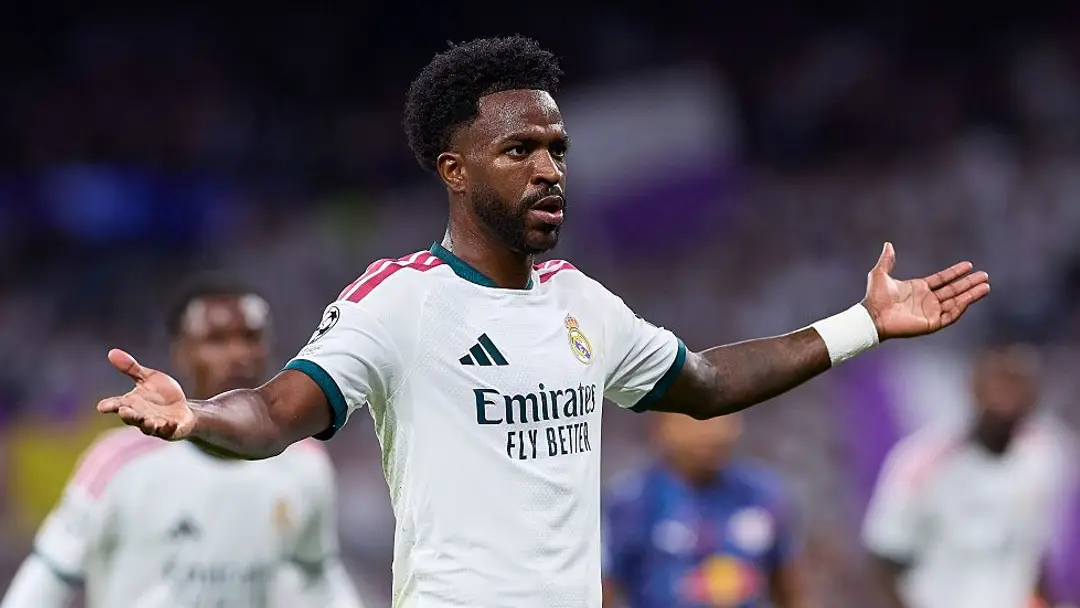
Madrid, Spain – The hallowed grounds of the Santiago Bernabéu, usually a stage for breathtaking individual brilliance, witnessed a night of profound concern on October 22nd, 2026. While Real Madrid secured a dominant 4-1 victory over RB Leipzig in a crucial UEFA Champions League group stage encounter, the jubilation was tempered by the performance of one of their brightest stars: Vinicius Junior. The Brazilian winger, celebrated globally for his electrifying pace and audacious dribbling, endured a deeply uncharacteristic evening, leaving fans and pundits alike questioning the trajectory of his current form.
This latest outing has intensified a growing narrative of struggle surrounding the 26-year-old, prompting widespread debate about his role, confidence, and future under the exacting gaze of manager José Mourinho. The victory against Leipzig, while securing three vital points, inadvertently cast a harsh spotlight on Vinicius, whose statistical output and overall impact painted a stark picture of a player grappling with immense pressure.
Main Facts: A Night of Disquiet at the Bernabéu
The match against RB Leipzig, billed as a challenging fixture against a formidable German side, ultimately unfolded as a comfortable win for the reigning European champions. Goals from Kylian Mbappé, two from an unlikely source, and a late strike sealed a convincing result. Yet, the post-match discussions quickly gravitated away from the scoreline and towards the periphery of Real Madrid’s attack.
The Leipzig Encounter: A Victory Overshadowed
From the outset, the anticipation for Vinicius Junior’s performance was palpable. Fans yearned for his signature bursts of acceleration, his fearless challenges against defenders, and his ability to unlock rigid defenses with a flick of the boot. However, what transpired over 70 minutes was a stark departure from the Vinicius of old. His touches were tentative, his decision-making appeared hesitant, and the creative spark that defines his game was conspicuously absent. The overall team performance, buoyed by the prolific Kylian Mbappé and the surprising dynamism of substitute Yan Diomande, managed to paper over the cracks left by Vinicius’s subdued display.
A Dribbling Drought: The Uncharacteristic Performance
The most striking and statistically damning aspect of Vinicius Junior’s night was the complete absence of attempted dribbles. In a player whose reputation is built upon his unparalleled ability to beat defenders in one-on-one situations, registering zero attempted take-ons is not merely a dip in form; it is an anomaly that speaks volumes about a deeper issue. This statistic, perhaps more than any other, encapsulated the Brazilian’s struggle to impose himself on the game. His usual avenues of attack seemed blocked, not just by Leipzig’s disciplined defense, but by an apparent lack of conviction in his own abilities. Furthermore, his passing was less incisive than usual, and his defensive contributions, while present, lacked the intensity often seen when he is fully engaged.
Mourinho’s Decisive Intervention and the Rise of Others
The inevitable moment arrived in the 70th minute when José Mourinho, known for his ruthless pragmatism and unwillingness to carry underperforming players, signaled for Vinicius to be replaced. The substitution was met with a mixed reception from the Bernabéu crowd; a smattering of whistles mingled with polite applause, a clear indication of the fans’ growing frustration, yet still an underlying hope for their once-untouchable star.
The immediate impact of the change was undeniable. Yan Diomande, a relatively fresh face in the Real Madrid senior squad, entered the fray and instantly injected pace, directness, and creativity. Within minutes, Diomande delivered a pinpoint assist for Kylian Mbappé, showcasing the kind of decisive attacking play that had been missing from Vinicius’s performance. Later, Diomande capped his impressive cameo with a goal of his own, solidifying his claim for more minutes and, perhaps, intensifying the pressure on Vinicius. Mbappé, meanwhile, continued his scintillating form, effortlessly demonstrating the clinical edge and consistent threat that top-tier wingers are expected to provide. The contrast could not have been starker: one star fading, another shining brightly, and a promising newcomer seizing his moment.
Chronology: From Pre-Match Expectations to Post-Match Scrutiny
The story of Vinicius Junior’s current struggles is not a sudden eruption but a gradual build-up, culminating in the Leipzig match.
Pre-Match Aura: High Hopes and Mounting Pressure
Entering the 2026/2027 season, expectations for Vinicius Junior were astronomical. Fresh off a stellar campaign where he registered career-high numbers in goals and assists, he was widely regarded as one of the world’s premier attacking talents, a guaranteed starter, and a key architect of Real Madrid’s recent successes. The summer transfer window saw him heavily linked with various lucrative endorsement deals, further cementing his status as a global icon. However, the early weeks of the current season had seen glimpses of uncharacteristic inconsistency. While still contributing occasionally, the explosive, game-changing moments had become fewer and further between. Whispers had begun in the sports media about a potential "sophomore slump" or the added pressure of playing alongside a superstar like Kylian Mbappé, who naturally commands a significant share of the attacking spotlight. Mourinho, in his pre-match press conferences, had publicly backed Vinicius, emphasizing the team’s collective responsibility, but privately, sources indicated a desire for more consistent end-product from the Brazilian.

The Match Unfolds: A Tale of Frustration
The first half against RB Leipzig saw Vinicius stationed predominantly on the left wing, his preferred flank. Despite Madrid’s attacking prowess, Vinicius struggled to get into rhythm. Early attempts to take on his marker were either easily stifled or resulted in misplaced passes. There were moments where he held onto the ball for too long, allowing defenders to recover, and other instances where he released it too quickly, sacrificing potential opportunities. His movement off the ball, usually a hallmark of his intelligent play, seemed less purposeful. He often found himself isolated, receiving the ball with multiple defenders already in position, making his task even more daunting. The crowd, initially patient, began to murmur with each unsuccessful foray or lost possession. The collective anxiety in the stands mirrored the visible frustration on the player’s face.
The Substitution: A Turning Point
As the second half progressed, Vinicius’s performance showed no signs of improvement. Mourinho, known for his decisive, often ruthless, tactical shifts, had clearly seen enough. The decision to replace a player of Vinicius’s stature, especially when the team was already comfortably ahead, underscored the severity of his slump. The sight of his number going up on the electronic board, combined with the lukewarm reception from the home crowd, was undoubtedly a difficult moment for the Brazilian. It wasn’t just a substitution; it felt like a statement, a clear indication that current form, not past reputation, dictates playing time under Mourinho.
Post-Whistle Reverberations: Fan Reactions and Media Frenzy
The final whistle brought relief for the team but ignited a storm of debate online and in the stands regarding Vinicius. Social media platforms were awash with analyses of his performance, ranging from concern and sympathy to harsh criticism. Hashtags questioning his form trended globally, and sports radio call-ins were dominated by discussions about his future. Journalists in the post-match press conference, while acknowledging the team’s victory, persistently probed Mourinho about Vinicius’s performance and the implications of his substitution. The narrative was clear: the win was celebrated, but Vinicius Junior’s individual struggle had become the defining storyline of the night.
Supporting Data: Quantifying the Decline and Contextualizing the Challenge
Beyond the immediate visual assessment, statistical analysis further underscores the depth of Vinicius Junior’s current predicament.
Statistical Anomaly: Beyond Zero Dribbles
The "zero dribbles attempted" statistic is a stark departure from his career averages. In the preceding 2025/2026 season, Vinicius averaged an astounding 5.7 successful dribbles per 90 minutes, with an attempt rate of over 10. His ability to consistently bypass defenders was not just a highlight reel feature but a fundamental aspect of Real Madrid’s attacking strategy, often creating space for teammates and drawing fouls in dangerous areas. Comparing this to his recent performances, where he has averaged closer to 2 successful dribbles per game over the last five matches, indicates a significant drop-off. His shot conversion rate has also dipped, and his key passes per game have fallen from an average of 2.1 last season to 0.8 in the current campaign. These numbers are not merely a blip; they suggest a systemic issue affecting his overall offensive output and confidence.
Tactical Considerations: Mourinho’s System and Vinicius’s Role
José Mourinho’s arrival at Real Madrid brought with it a renewed emphasis on defensive solidity, tactical discipline, and ruthless efficiency. While undoubtedly designed to maximize the team’s collective strength, some analysts suggest that Mourinho’s more structured approach might be inadvertently stifling Vinicius’s natural flair. Historically, Vinicius has thrived in a more fluid, expressive system, where he is given significant creative license. Mourinho’s demands for specific defensive responsibilities and adherence to positional discipline might be weighing heavily on a player who relies on instinct and improvisation. While Mbappé, with his more direct and clinical style, has seamlessly integrated, Vinicius’s game, which is often about the journey of the dribble as much as the destination, may require a different type of tactical freedom. The question arises whether Mourinho’s system can accommodate the unbridled creativity of Vinicius or if the player must adapt to a more constrained role.
Historical Parallels: The Weight of the White Shirt
The pressure on any player donning the white shirt of Real Madrid is immense, but for an attacking talent, it is amplified exponentially. The club’s history is littered with examples of brilliant players who have, at various points, struggled to cope with the expectations. From the early careers of legends like Raúl to the mid-career slumps of Galacticos, the Bernabéu crowd is famously demanding. Vinicius’s situation echoes past instances where individual form has dipped, leading to intense scrutiny. The difference now is the age of social media, where every touch, every mistake, is dissected in real-time. This historical context serves as a reminder that even the most talented players are not immune to the unique psychological challenges of playing for Real Madrid, and a period of introspection and resilience is often required to emerge stronger.
The Psychological Toll: Pressure Cooker Environment
The dip in statistical output and tactical effectiveness is undeniably linked to a psychological struggle. The very essence of Vinicius Junior’s game—his confidence to take on defenders, his audacity to attempt the unexpected—is fueled by a positive mental state. When that confidence wavers, the entire edifice of his playing style begins to crumble. The increasing murmurs from the crowd, the critical headlines, and the constant comparison to other high-performing teammates like Mbappé and Diomande, all contribute to a pressure cooker environment. This mental burden can manifest as hesitation, overthinking, and a reluctance to take risks, leading to a vicious cycle of poor performance and eroding self-belief. It’s a critical juncture where mental fortitude will be as important as technical skill in his journey back to form.
Official Responses: Navigating the Narrative
In times of crisis, official responses from the club, manager, and player become crucial in shaping the public narrative and demonstrating a united front.

José Mourinho’s Stance: Managerial Insight and Strategy
Following the Leipzig match, José Mourinho addressed the media with his characteristic blend of pragmatism and veiled challenge. "Vinicius is an incredibly talented player, and we all know what he is capable of," Mourinho stated, his tone measured. "But talent alone is not enough at this level. There are moments when a player needs to adapt, to understand the demands of the team, and to fight for his place. Yan [Diomande] came on and showed exactly the kind of directness and impact we need. This is a competition. Everyone must be at their best, or others will get their opportunity." Mourinho’s comments, while acknowledging Vinicius’s talent, were a clear message: no player is indispensable, and performance dictates selection. It was a classic Mourinho tactic – to publicly challenge a player, hoping to spark a reaction and a return to form, while simultaneously praising a younger, hungrier alternative.
Vinicius Junior’s Silence: A Player’s Internal Battle
True to his usual demeanor, Vinicius Junior remained silent publicly after the match. No social media posts, no interviews, only the stoic walk off the pitch. This silence, however, speaks volumes. It suggests a player processing disappointment, perhaps engaging in an internal battle to reconcile his perceived performance with his own high expectations. Sources close to the player indicate that he is deeply frustrated but determined to overcome this period. His body language on the pitch has often conveyed a sense of bewilderment, suggesting a struggle to understand why his usual tricks are not working. This internal struggle, away from the microphones, is often the most challenging aspect of a slump for a top athlete.
Club Support: A United Front?
Real Madrid, as an institution, has historically been adept at managing public relations around its star players. While there has been no official club statement regarding Vinicius’s form, behind the scenes, the club is likely engaged in a multi-faceted approach. High-ranking club officials are expected to offer support, ensuring the player feels valued despite his dip in form. The club’s medical and psychological support teams would also be on standby, ready to offer assistance should it be required. The goal is to project an image of unwavering support, protecting the player’s long-term value and fostering an environment conducive to his recovery. However, the club’s ultimate loyalty is to success, and persistent underperformance, even from a beloved star, will eventually lead to difficult decisions.
Agent’s Perspective: Protecting the Asset
Vinicius Junior’s agent, Togon Carvalho, has also maintained a low profile, avoiding inflammatory statements. However, in private conversations with select media outlets, Carvalho reportedly emphasized the player’s dedication and commitment to Real Madrid. "Vinicius is a professional who lives and breathes Real Madrid," Carvalho was quoted as saying, "Every player goes through difficult moments. He is working harder than ever to return to his best, and he has the full support of his teammates and the club." The agent’s role in such situations is to protect his client’s image and long-term career prospects, assuring stakeholders of his commitment while subtly deflecting excessive criticism.
Implications: The Road Ahead for Player and Club
The current situation with Vinicius Junior carries significant implications for both the player’s career trajectory and Real Madrid’s tactical future.
For Vinicius Junior: Reclaiming Form and Future Prospects
For Vinicius, the immediate future is a critical juncture. His ability to navigate this period will define the next chapter of his career. He faces the daunting task of rediscovering his confidence, potentially adapting his game, and proving to Mourinho and the Bernabéu faithful that he can still be a decisive player. This might involve a period on the bench, a humbling experience for a player of his standing, but one that could offer perspective and renewed hunger. His long-term future at Real Madrid, while currently secure given his contract, could become subject to speculation if his struggles persist deep into the season. A recovery of form is not just about individual performance; it’s about validating his status as a world-class talent and silencing the growing doubts. This period will test his mental resilience, tactical adaptability, and sheer willpower.
For Real Madrid: Tactical Flexibility and Squad Management
Real Madrid, under Mourinho, faces a challenge of squad management and tactical flexibility. The emergence of Yan Diomande and the consistent brilliance of Kylian Mbappé provide alternative attacking options, but Vinicius, at his best, offers a unique dimension. The club must decide whether to continue investing significant minutes in Vinicius in the hope of his resurgence, or to prioritize current form and give more opportunities to others. This decision impacts team chemistry, morale, and potentially the club’s transfer strategy in future windows. If Vinicius’s struggles continue, Real Madrid might find themselves in the market for another high-profile winger, a scenario that would have been unthinkable just a year ago. Mourinho’s management of this situation will be a litmus test of his ability to handle star players and maintain squad harmony amidst intense competition.
The Bernabéu Faithful: Patience, Expectation, and Unwavering Support
The fans of Real Madrid, while demanding, are also fiercely loyal. They have witnessed countless players overcome adversity to etch their names into club folklore. The divided reaction to Vinicius’s substitution reflects a complex mix of frustration with current performance and an enduring belief in his talent. The challenge for the supporters is to balance their high expectations with the understanding that even the greatest players experience slumps. Ultimately, the Bernabéu faithful will play a crucial role in Vinicius’s recovery. Their unwavering support, rather than continued whistles, could provide the psychological boost he needs to rediscover his electric form and once again ignite the magic that once made him one of the most exciting players in world football. The coming weeks and months will reveal whether Vinicius Junior can turn this period of difficulty into a testament to his resilience, or if this marks a more permanent shift in his standing at the mighty Real Madrid.