TIRANA, Albania – In a pivotal legislative session that underscored the ruling Socialist Party’s formidable parliamentary strength, the Albanian Kuvendi (Parliament) has officially approved a new territorial and administrative reform. The vote, held amidst intense debate and significant political anticipation, saw 85 deputies cast their ballots in favor, effectively redrawing the map of local governance across the nation. This far-reaching reform aims to streamline administrative structures, enhance efficiency, and optimize public service delivery, marking a significant milestone in Albania’s ongoing efforts to modernize its state apparatus.
The parliamentary session, which culminated in the decisive vote, served as a crucial "test of numbers" for the Socialist Party, which successfully demonstrated its internal cohesion and ability to pass major legislative initiatives. The reform, which retains the existing 12 counties (qarqe), introduces a reconfigured landscape of 46 municipalities (bashki), 71 constituent cities (qytete), and 387 administrative units (njësi administrative). This restructuring will lead to the merger of several smaller municipalities into larger, more administratively robust entities, while also elevating the status of six previously administrative zones to full-fledged cities.
The passage of this reform is not merely an administrative reshuffle; it carries profound political implications, reflecting the government’s commitment to decentralization and improved local governance, even as it faces criticism regarding the process and potential impacts on local autonomy.
I. Main Facts: A New Chapter for Local Governance
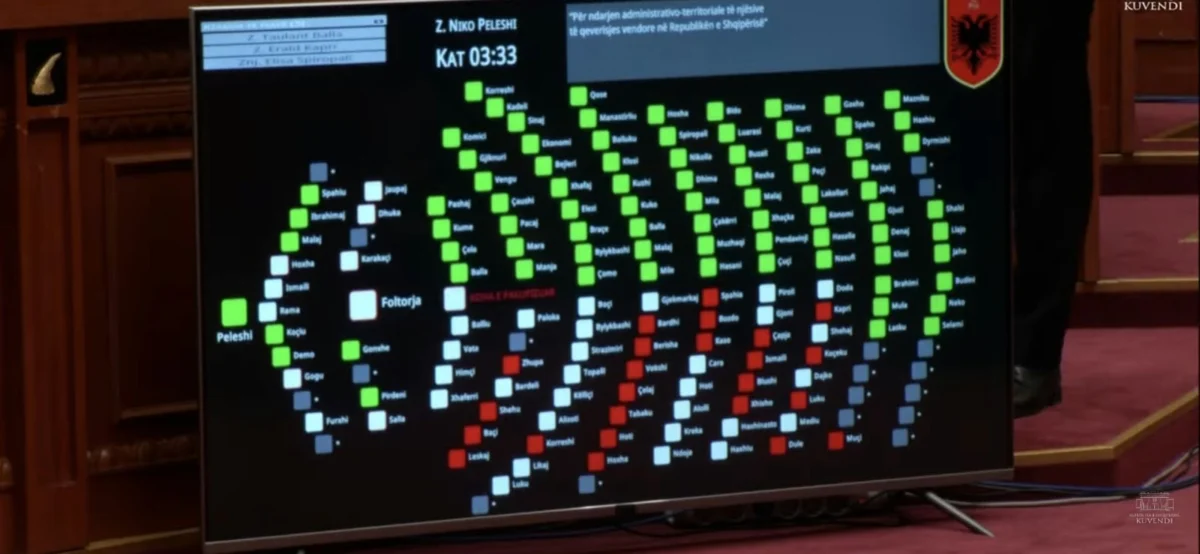
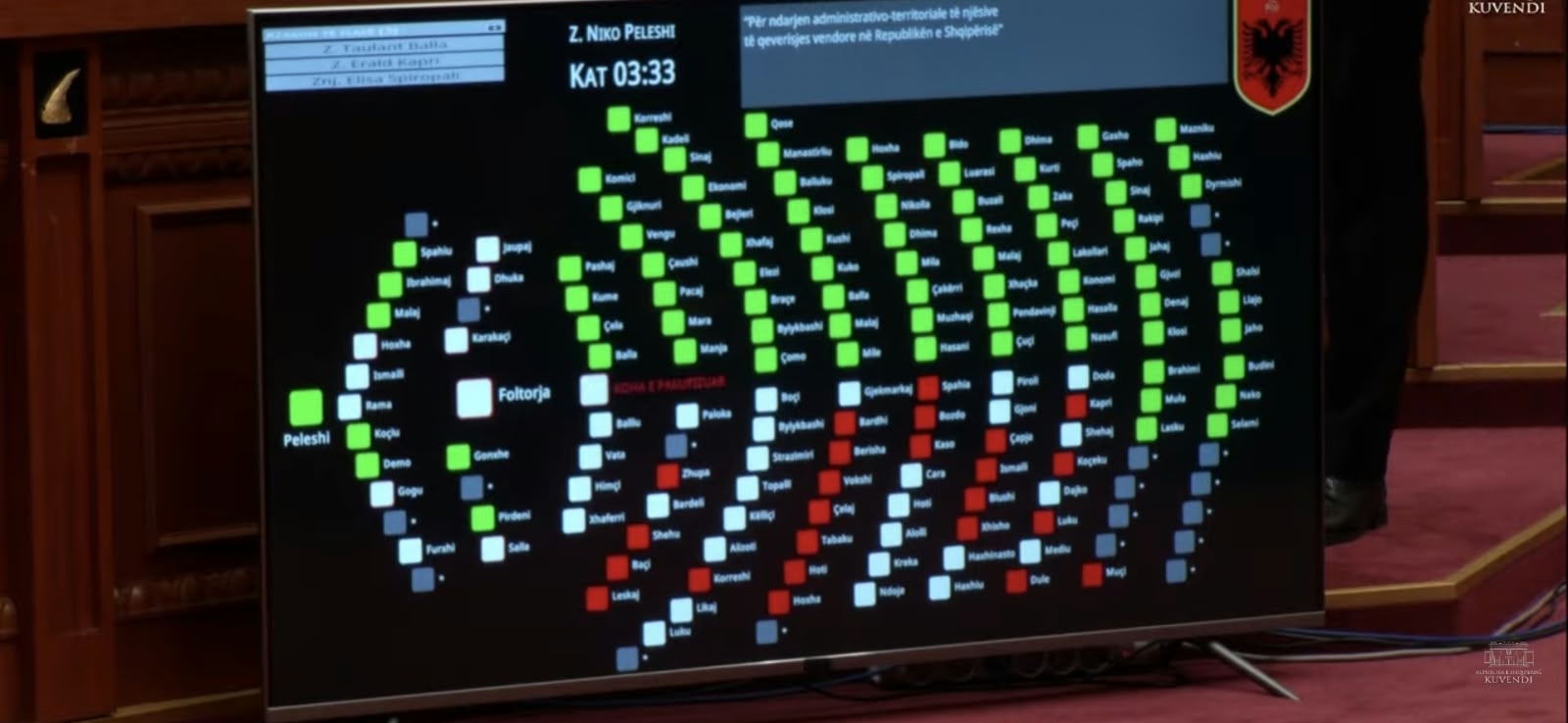
On a day that will undoubtedly be remembered in Albania’s recent political history, the Kuvendi cast its vote, decisively approving the new territorial-administrative reform. The legislative act, spearheaded by the ruling Socialist Party, passed with a clear majority, signaling a significant shift in how local governance will operate across the country. A total of 85 votes were registered in favor of the reform, comprising 82 deputies from the Socialist Party and three from the Social Democratic Party, highlighting a unified front on this critical issue. This numerical strength enabled the government to overcome opposition challenges and push through a reform package that has been years in the making.
The core of the reform revolves around a consolidation of local administrative units. While the 12 existing counties will remain untouched, the structure below this regional tier is set for a substantial overhaul. The number of municipalities will be reduced to 46, a significant decrease from the previous count, implying a series of mergers aimed at creating larger, more capable local government bodies. Complementing this, the reform designates 71 constituent cities, an increase that includes six newly elevated urban centers, and maintains 387 administrative units, which typically represent former communes or smaller towns within the new municipal boundaries.
This consolidation is envisioned by its proponents as a strategic move to foster greater administrative efficiency, reduce operational costs, and improve the quality and accessibility of public services for citizens. By merging smaller, often resource-constrained municipalities, the government aims to create stronger administrative hubs capable of attracting investment, managing larger budgets, and implementing more comprehensive development projects. The "test of numbers" passed by the Socialist Party during this vote was not just about legislative victory; it was a demonstration of the party’s capacity to maintain discipline and unity on a policy that is expected to reshape the everyday lives of millions of Albanians. For the opposition, particularly the Democratic Party, the vote underscored their current numerical disadvantage in Parliament, limiting their ability to block or significantly alter government-backed initiatives.
II. Chronology of the Reform: From Concept to Legislation
The territorial-administrative reform in Albania is not an overnight initiative but the culmination of a protracted process spanning several years, driven by a recognized need for more efficient local governance and alignment with European standards.
A. Genesis of the Initiative
The seeds of the current reform were sown years ago, rooted in a broader national strategy for decentralization and good governance. Albania, like many post-communist states, inherited an administrative structure that often proved inefficient, fragmented, and disproportionate to its demographic realities and economic needs. Previous attempts at reform had yielded incremental changes, but a more comprehensive overhaul was increasingly deemed necessary. The primary stated objectives of this latest initiative were multifaceted: to enhance the quality and accessibility of public services, reduce administrative costs through economies of scale, foster local economic development by creating stronger administrative centers, and improve the overall financial sustainability of local government units. The government, often with input from international organizations and experts on decentralization, spearheaded these discussions, framing the reform as essential for Albania’s modernization and its path toward European Union integration. Early discussions focused on the benefits of larger municipalities, which could better manage infrastructure projects, attract foreign investment, and provide a wider range of services that smaller units struggled to deliver.
B. Legislative Process and Debates
The journey from initial concept to parliamentary approval was marked by extensive, and at times contentious, debate. The legislative process typically commenced with the drafting of initial proposals by specialized working groups within relevant ministries, often the Ministry of Interior or a dedicated Ministry for Local Government. These proposals would then undergo a period of public consultation, though the extent and effectiveness of such consultations often became a point of contention between the government and civil society organizations. Following this, the draft law would move to the relevant parliamentary committees, such as the Committee on Legal Affairs, Public Administration and Human Rights, and the Committee on Economy and Finance. Here, detailed scrutiny, amendments, and cross-party discussions would take place.
Throughout this period, the reform generated significant controversy. The opposition parties consistently voiced concerns about the methodology used for the new territorial division, alleging political motivations behind certain mergers and boundary changes. They often argued that the reform lacked sufficient local input, could lead to the disenfranchisement of peripheral communities, and would centralize power rather than truly decentralize it. Conversely, the government maintained that the reform was based on objective criteria, including population density, geographical contiguity, economic viability, and the capacity for service delivery. They emphasized that the existing structure was unsustainable, with many small municipalities struggling to provide even basic services due to limited financial and human resources. The debates in Parliament were often heated, reflecting the high stakes involved in redrawing administrative boundaries, which directly impacts electoral districts, local power structures, and resource allocation.
C. The Final Vote
The climactic moment arrived with the parliamentary vote. The session was closely watched, not just for the outcome but for the internal dynamics within the ruling coalition. The fact that 85 deputies voted in favor, including three Social Democrats alongside 82 Socialists, underscored the government’s solid majority and its ability to rally support for its agenda. Notably, the votes of deputies like Sinaj and Braçe were highlighted as evidence of internal democratic processes within the Socialist Party, yet ultimately demonstrating a unified stance on this critical reform. Perhaps even more telling was the "pro" vote from Spiropali. Despite her previously reported disagreements or "usual compositions" (hartimeve të saj të zakonshme) with the party leadership, particularly since her removal from government by Prime Minister Rama, her vote in favor of the reform indicated a strong alignment on core party policy when it came to major legislative acts. This unity, even from members who might have expressed dissent on other issues, was a powerful message about the party’s discipline and its determination to see the reform through. The opposition, despite their vocal criticisms, ultimately lacked the numbers to prevent the reform’s passage, with no defections from their ranks, further emphasizing the Socialist Party’s legislative dominance.
III. Supporting Data and Analysis: The New Map of Albania
The approved territorial reform fundamentally reconfigures the administrative geography of Albania, aiming for a more efficient and responsive system of local governance. This section delves into the specifics of these structural changes and the underlying rationale.
A. Structural Changes in Detail
The reform maintains Albania’s 12 existing counties (qarqe), which serve as regional administrative divisions. However, the most significant changes occur at the municipal level. The number of municipalities (bashki) has been reduced to 46, a consolidation achieved through a series of mergers. This reduction is expected to create larger, more demographically and economically viable administrative units. Within these new municipalities, 71 constituent cities (qytete) will function as urban centers, a number that has been expanded by granting city status to six new areas. The 387 administrative units (njësi administrative) largely represent former communes or smaller localities that are now integrated into the larger municipal framework, maintaining a local point of contact for citizens.
The specific mergers outlined in the reform are particularly illustrative of its intent:
- Fushë-Arrëz to Pukë: Both located in the mountainous north, this merger likely aims to consolidate resources and population in a region characterized by sparse settlement and emigration. Pukë, as a more established center, is expected to absorb Fushë-Arrëz, potentially improving service delivery in a challenging geographical area.
- Klos to Mat: Situated in the central-eastern part of the country, this merger could be driven by the need to create a more cohesive administrative unit around the Mat River basin, potentially for better resource management and agricultural development.
- Rrogozhinë to Kavajë: These municipalities are in the western coastal lowlands. Merging them likely seeks to capitalize on Kavajë’s proximity to the coast and its growing economic potential, creating a larger entity for urban planning and tourism development.
- Dimal and Poliçan to Berat: Located in the south-central region, the merger of Dimal and Poliçan into Berat, a historic city and regional hub, is aimed at strengthening the administrative and economic weight of the Berat county. This could facilitate better management of cultural heritage and agricultural resources in the surrounding areas.
- Patos to Fier: Both in the southwestern plain, this merger appears designed to create a larger industrial and agricultural hub around Fier, a major city in Albania. Patos, with its oil industry connections, could benefit from integration into a broader economic strategy led by Fier.
- Divjakë to Lushnjë: In the central-western lowlands, this merger connects Divjakë, known for its lagoon and natural park, with Lushnjë, an important agricultural and commercial center. This could foster integrated development strategies for tourism, agriculture, and environmental protection.
- Selenicë to Vlorë: Selenicë, known for its bitumen mines, is merged with the major coastal city of Vlorë. This move likely aims to integrate the industrial economy of Selenicë with the larger port and tourism economy of Vlorë, potentially attracting more diversified investments.
- Maliq to Korçë: Maliq, in the southeastern agricultural plain, merges with Korçë, a major regional city. This consolidation is geared towards strengthening Korçë’s role as an agricultural processing and cultural center, leveraging Maliq’s agricultural output.
- Këlcyrë to Përmet: Both in the southeastern mountainous region, this merger aims to consolidate resources in a less populated area, potentially focusing on eco-tourism and agricultural development around the Vjosa River.
- Memaliaj to Tepelenë: These southern municipalities are merged to create a more robust administrative unit in a region known for its historical significance and natural beauty.
- Libohovë to Gjirokastër: Libohovë, a historic town, is integrated into the larger Gjirokastër municipality, a UNESCO World Heritage site and regional center. This could enhance the management of cultural tourism and regional development initiatives.
- Cërrik and Belsh to Elbasan: Both located near the central city of Elbasan, these mergers aim to strengthen Elbasan’s metropolitan area, facilitating urban planning, industrial development, and improved infrastructure connections across the region.
- Përrenjas to Librazhd: In the eastern mountainous region, this merger seeks to create a more viable administrative unit, potentially focusing on cross-border cooperation with North Macedonia and sustainable development of natural resources.
Furthermore, the reform grants city status to six new areas: Kastrat, Bushat, Ulzë, Krastë, Milot, and Golem. This elevation typically comes with increased administrative autonomy, greater access to development funds, and an enhanced capacity to attract investment, reflecting their growing demographic and economic significance.
B. Rationale Behind the Reform
The rationale underpinning this sweeping reform is multi-layered, encompassing economic, administrative, and social objectives.
- Economic Arguments: A primary driver is the pursuit of economies of scale. Smaller municipalities often struggle with limited budgets, making it difficult to fund essential infrastructure projects, attract investment, or provide competitive public services. Larger municipalities, with consolidated tax bases and greater administrative capacity, are expected to be more financially sustainable. They can better manage public procurement, negotiate development projects, and create more attractive environments for businesses, ultimately contributing to local economic growth and job creation.
- Administrative Arguments: The reform aims to streamline bureaucracy and improve administrative efficiency. By reducing the number of administrative units, the government expects to minimize duplication of services, simplify administrative procedures, and enhance coordination between different levels of local government. This is projected to lead to better governance, more coherent policy implementation, and a more effective allocation of resources. Improved data collection and management are also anticipated in larger, better-equipped administrations.
- Social Arguments: Proponents argue that the reform will lead to improved service delivery for citizens. Larger municipalities are theoretically better positioned to offer a wider range of high-quality public services, including education, healthcare, social welfare, waste management, and urban planning. While there are concerns about accessibility for remote communities, the overall vision is to ensure that all citizens, regardless of their location, have access to a baseline of modern public services. The creation of larger, more diverse municipalities can also foster a stronger sense of regional identity and cooperation.
- Alignment with European Standards: Albania’s aspirations for EU membership necessitate a robust and efficient public administration. Many European countries have undergone similar territorial reforms to optimize local governance structures. This reform is seen as a step towards aligning Albania’s administrative framework with best practices in the EU, particularly concerning decentralization, fiscal autonomy of local units, and citizen participation.
C. Political Dynamics and Party Cohesion
The successful passage of the reform highlighted significant political dynamics within the Albanian Parliament. The Socialist Party’s ability to garner 82 votes from its own ranks, along with the support of three Social Democrats, demonstrated a remarkable level of internal discipline and unity on a policy deemed crucial by the leadership. This "test of numbers" was not merely about reaching a majority; it was about projecting an image of a cohesive governing force capable of implementing its agenda without significant internal dissent.
The votes of deputies like Sinaj and Braçe, acknowledged in the original report as demonstrating "internal democracy but unified vote," underscore the party’s capacity to manage diverse views while maintaining a common front on critical legislation. Even more telling was the support from figures like Spiropali, who, despite having had public disagreements with Prime Minister Rama and being removed from government positions, ultimately voted in favor of the reform. This suggests that while individual members may voice concerns or hold differing opinions on certain issues, the party line on fundamental reforms often prevails, reflecting a strong leadership and party discipline. This cohesion is vital for a government attempting to enact significant structural changes.
Conversely, the vote also illuminated the "relative value" of the Democratic Party’s opposition. While the opposition remained united in its stance against the reform, with no defections, their numerical inferiority in Parliament rendered them unable to block its passage. This outcome underscores the challenges faced by opposition parties in Albania when confronted with a strong parliamentary majority, limiting their direct legislative influence and often relegating them to a role of vocal critique rather than decisive action. The dynamics surrounding this vote therefore offer a snapshot of the current balance of power in Albanian politics and the strategic capabilities of the ruling party.
IV. Official Responses and Stakeholder Reactions
The approval of the territorial reform has naturally elicited a range of responses from across the political spectrum, civil society, and the public, reflecting both optimism for the future and apprehension about potential challenges.
A. Government and Ruling Party’s Stance
Immediately following the vote, government officials and leaders of the Socialist Party were quick to laud the reform as a historic achievement and a crucial step forward for Albania. Prime Minister Edi Rama, or other relevant ministers, likely emphasized that the new administrative map is designed to serve citizens better, reduce bureaucracy, and unlock greater development potential at the local level. They would have reiterated the reform’s alignment with European best practices and its role in strengthening democratic governance. Official statements would highlight the anticipated benefits: increased efficiency in public service delivery, enhanced financial sustainability for municipalities, and a more strategic approach to regional development. The government would likely present the reform as a pragmatic solution to the long-standing issues of fragmented and under-resourced local government units, asserting that the new, larger municipalities will have the capacity and resources to tackle complex challenges, attract investment, and provide a broader array of high-quality services to their constituents.
B. Opposition’s Critique
In stark contrast, the Democratic Party and other opposition forces vehemently criticized the reform, both during the parliamentary debates and in their post-vote reactions. Their arguments typically centered on several key points:
- Lack of genuine consultation: The opposition frequently accused the government of rushing the reform and failing to engage in meaningful dialogue with local communities, experts, and political stakeholders. They argued that the process was top-down and politically motivated rather than genuinely aimed at improving governance.
- Political gerrymandering: A significant concern raised by the opposition was that the new administrative divisions were designed to consolidate the ruling party’s political power, particularly ahead of future local and general elections. They alleged that boundary changes were drawn to favor the Socialist Party in specific regions, rather than based on objective administrative or demographic criteria.
- Disenfranchisement and loss of identity: Critics argued that merging smaller municipalities could lead to a loss of local identity, diminish citizen participation, and make local government less accessible for residents in more remote areas. They feared that larger administrative units would be less responsive to the specific needs of diverse communities.
- Potential for administrative chaos: The opposition warned of significant administrative challenges during the implementation phase, including difficulties in merging different administrative cultures, harmonizing regulations, and integrating staff, which could lead to initial disruptions in public services. They often proposed alternative models that focused on strengthening existing units rather than radical consolidation.
C. Civil Society and Expert Opinions
Reactions from civil society organizations and local governance experts have been mixed. Many experts acknowledge the theoretical benefits of territorial consolidation, such as improved efficiency and economies of scale, especially in a country with numerous small, financially weak municipalities. Organizations advocating for good governance and decentralization often support the principle of creating more viable local units.
However, many also expressed reservations about the specific implementation and the process itself. Concerns frequently raised included:
- Insufficient data and analysis: Questions were often posed regarding the transparency of the data and criteria used to justify specific mergers.
- Capacity building: Experts emphasized the critical need for significant investment in capacity building for the new, larger municipalities to ensure they can effectively manage their expanded responsibilities. This includes training staff, developing new administrative procedures, and upgrading technological infrastructure.
- Citizen engagement: There was often a call for more robust mechanisms for citizen engagement and participation in the new, larger administrative units to prevent a sense of disconnect between local government and the populace. Some NGOs feared that the reform could inadvertently centralize power at the municipal level, moving it further away from citizens.
- Financial implications: While cost savings are projected in the long term, experts also pointed out that the initial phase of mergers could incur substantial costs related to severance packages, infrastructure integration, and administrative harmonization.
D. Public Reaction
Public reaction to such reforms is typically varied and often localized. In areas where municipalities are being merged, residents may express a mix of emotions. Some might welcome the promise of improved services and infrastructure, believing that a larger, more powerful municipality will be better equipped to address their needs. Others, particularly in smaller towns or villages slated for merger, might express apprehension about losing their distinct local identity, fear of being marginalized within a larger entity, or concerns about diminished access to local administrative services. There could be protests or expressions of discontent from communities feeling that their voices were not adequately heard during the reform process. Conversely, in areas that gain new city status or become central to a larger municipality, there might be a sense of optimism and anticipation for increased investment and development. The true public sentiment will likely become clearer as the implementation of the reform begins to unfold across the country.
V. Implications and Future Outlook: A Transformed Landscape
The approval of Albania’s new territorial reform marks the beginning of a complex and transformative period for local governance. Its implications will resonate across administrative, financial, political, and social spheres for years to come.
A. Administrative and Financial Impact
The immediate administrative challenge will be the monumental task of merging existing municipal administrations. This involves harmonizing diverse organizational structures, integrating staff, standardizing administrative procedures, and consolidating assets and liabilities. The process will require extensive training for civil servants, the development of new internal regulations, and potentially significant IT system overhauls. Managing the transition without disrupting essential public services will be critical. There will inevitably be initial costs associated with this restructuring, including potential severance packages for redundant staff, relocation expenses, and investments in new infrastructure for consolidated municipal centers. However, the long-term financial projections typically highlight potential cost savings through economies of scale, reduced overhead, and more efficient use of resources. The new municipalities, with larger tax bases, are expected to have greater fiscal autonomy and be better positioned to attract external funding and manage local budgets more effectively, leading to improved financial sustainability and potentially a reduction in reliance on central government transfers.
B. Political Landscape
The reform is poised to significantly alter Albania’s political landscape, particularly at the local level. By reducing the number of municipalities, the reform consolidates political power and influence into fewer, larger administrative units. This could lead to more intense competition for mayoral and council positions in the new municipalities, as these roles will command greater resources and authority. The changes in municipal boundaries could also influence future electoral outcomes, potentially shifting political balances in certain regions. The ruling Socialist Party’s strong show of unity in passing this reform might strengthen its image as a decisive governing force capable of implementing its agenda, potentially bolstering its support in upcoming local and general elections. For the opposition, the challenge will be to adapt to the new administrative map, organize effectively within the larger municipalities, and articulate a compelling vision for local governance that resonates with citizens in the newly formed entities. The reform might also inadvertently foster a sense of disenfranchisement in communities that feel their local representation has been diluted, potentially leading to new forms of local political activism.
C. Service Delivery and Citizen Impact
The ultimate success of the reform will be judged by its impact on service delivery and the everyday lives of citizens. Proponents argue that larger municipalities will be better equipped to provide higher quality and more diverse public services, ranging from waste management and urban planning to social welfare and cultural initiatives. With increased financial capacity and professional expertise, the new municipalities could invest more in infrastructure, education, healthcare facilities, and public spaces. However, there is a risk of initial disruption during the transition period. Citizens in merged areas, especially those in more remote villages, might face challenges in accessing municipal offices and services if these become centralized in a distant urban hub. The effectiveness of the reform will depend heavily on the ability of the new administrations to maintain accessibility, establish efficient outreach programs, and ensure that the needs of all constituent communities are met. The reform’s long-term success hinges on whether it genuinely leads to tangible improvements in public services and fosters a greater sense of belonging and participation among citizens.
D. Broader Governance Context
This territorial reform is an integral part of Albania’s broader governance agenda and its strategic path towards European Union integration. Modernizing local administration, enhancing efficiency, and strengthening decentralization are key requirements for EU accession. The reform reflects a commitment to creating a more effective and accountable public administration, which is fundamental to good governance and the rule of law. Lessons from previous territorial reforms in Albania, and from similar processes in other European countries, will be crucial during the implementation phase. These lessons often highlight the importance of clear communication, robust capacity building, sustained financial support, and continuous monitoring and evaluation. The long-term vision for local self-governance in Albania, as shaped by this reform, is one of more resilient, fiscally sound, and citizen-oriented municipalities that are capable of driving local development and contributing effectively to the nation’s progress towards its European aspirations. The coming years will be critical in demonstrating whether this ambitious administrative restructuring truly delivers on its promise of a more prosperous and efficiently governed Albania.