The landscape of European e-commerce is undergoing a radical transformation, driven not by traditional search-engine-based marketplaces, but by the immersive, algorithm-led world of social commerce. TikTok Shop, the retail arm of the viral video platform, has cemented its position as a powerhouse in the UK, with projections indicating it will reach a staggering €5 billion in gross merchandise value (GMV) by the end of 2025.
According to fresh data from the German e-commerce intelligence provider ECDB, this meteoric rise highlights a fundamental shift in consumer behavior. Shoppers are increasingly moving away from passive "search and buy" models toward discovery-driven "see and buy" experiences. As the platform continues its aggressive expansion across the continent, the data reveals a clear picture of a market dominated by the UK’s early adoption, followed by a rapid, synchronized scaling effort across the European Union.
Main Facts: The UK as the European Anchor
The United Kingdom remains the undisputed flagship for TikTok Shop in Europe. Since its pioneering launch in the region in 2021, the platform has successfully integrated itself into the daily habits of British consumers. The scale of this operation is significant: more than 300,000 British small-to-medium enterprises (SMEs) are now leveraging the platform to reach customers.
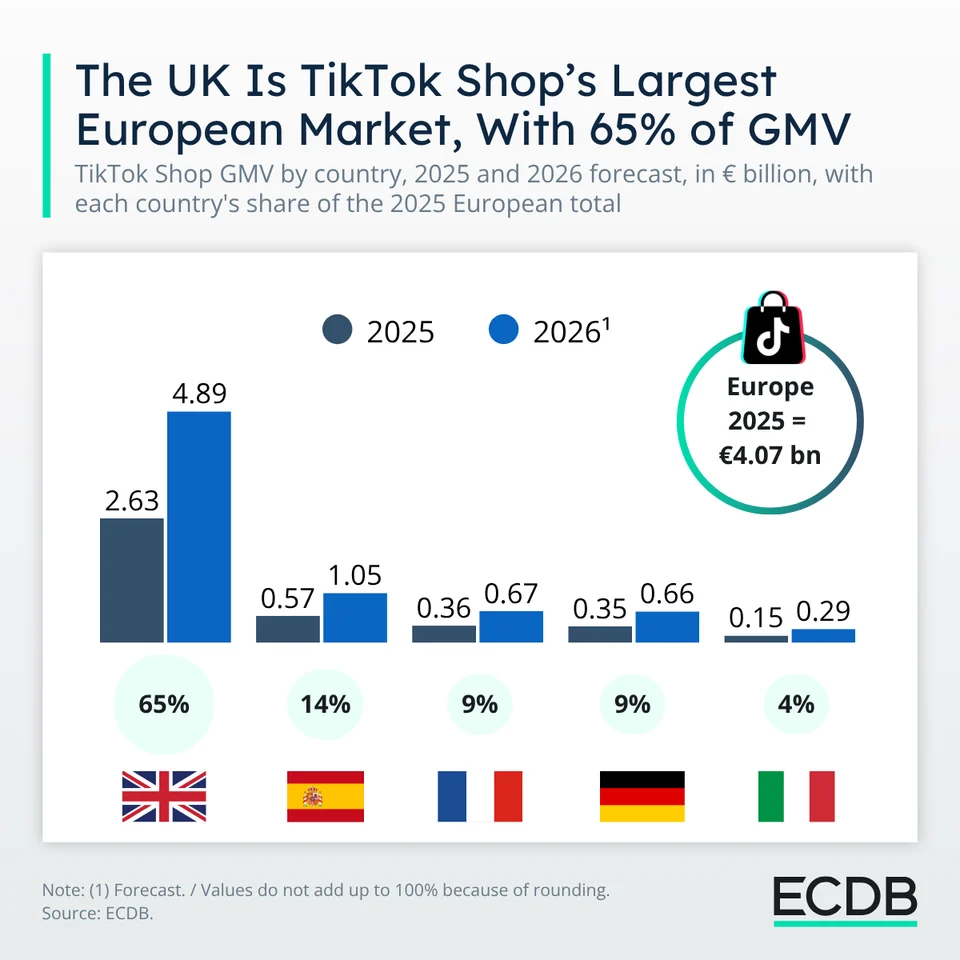
This concentration of activity has created a substantial lead over other European nations. Last year, the UK accounted for a massive 65 percent of all European spending on TikTok Shop, generating a GMV of €2.63 billion. While other nations are catching up, the UK’s status as a mature market—combined with a high propensity for online spending—has allowed it to function as the blueprint for TikTok’s continental strategy.
A Chronology of Continental Expansion
TikTok Shop’s growth trajectory has been characterized by a phased rollout, transitioning from a localized UK experiment to a comprehensive pan-European marketplace.
- 2021: The UK Launch: TikTok Shop debuts in the United Kingdom, serving as the primary testing ground for social commerce logistics, influencer-led sales, and consumer trust.
- Late 2024: The Strategic Pivot: The platform expands into Spain and Ireland, signaling a move toward broader European integration.
- March 2025: The Triple Launch: In a major push for market share, TikTok Shop launches simultaneously in France, Germany, and Italy. These markets immediately began contributing to the European ecosystem, with Spain maintaining its position as the second-largest market after the UK.
- June 2025: Benelux and Beyond: The platform enters the Netherlands, Belgium, Poland, and Austria, marking the solidification of its footprint in Central and Western Europe.
- September–October 2025: Bridging the Gap: A pilot program for cross-border sales between the EU and the UK begins on September 21, with a full rollout scheduled for October 19. This initiative is designed to remove friction for merchants looking to scale beyond their domestic borders.
Supporting Data: Comparative Market Performance
Data provided by ECDB offers a granular look at the state of the market in 2024, providing a baseline against which current 2025 growth is measured.
Spain currently holds the position of the second-largest European market, accounting for roughly 14 percent of total European spend, or €570 million. This performance is notable given the relatively short period the feature has been active in the region. France and Germany, despite being larger economies, followed with €360 million and €350 million respectively—each representing approximately 9 percent of the European share. Italy completes the top-tier list with €150 million, or 4 percent of the market.
Perhaps the most compelling insight from the latest projections is the uniformity of growth. Despite the varying levels of maturity across these markets—with the UK having a years-long head start—ECDB forecasts that every market will experience a similar growth rate, effectively doubling their respective GMVs in 2025. This suggests that the "TikTok effect" is not dependent on the age of the market, but rather on the platform’s ability to replicate its algorithm-driven engagement model regardless of linguistic or cultural borders.
Official Perspectives and Operational Shifts
While TikTok has kept specific internal revenue targets private, the rollout of the "Sell Across Europe" initiative provides a clear indication of their corporate strategy. By evolving into a pan-European marketplace, TikTok is effectively streamlining the supply chain for its merchants.

The introduction of cross-border functionality between the EU and the UK is arguably the most critical development in the platform’s infrastructure. By allowing sellers to move goods across the post-Brexit regulatory divide, TikTok is positioning itself as a legitimate competitor to established logistics-heavy marketplaces like Amazon. For the average SME, this means that a viral video produced in a studio in London can now be monetized in real-time by a consumer in Berlin or Madrid, with the platform handling the complex logistics of the transaction.
Market analysts note that this is a "platform-as-a-service" play. TikTok is not merely providing a storefront; it is providing the advertising, the discovery, the payment processing, and the cross-border logistics. This vertical integration is what allows them to achieve such aggressive growth rates even in highly competitive, saturated e-commerce environments like Germany and France.
Implications: The Future of European E-commerce
The implications of these figures are profound for the broader retail industry.
1. The Decline of Passive Search
Traditional e-commerce platforms rely on the "intent-based" model: a customer knows what they want, searches for it, and buys it. TikTok Shop is disrupting this by creating "impulse-based" commerce. By inserting products into the entertainment stream, TikTok creates demand where it might not have existed seconds prior.
2. The Power of the "Creator Economy"
The success of the platform is intrinsically linked to its creator base. Unlike traditional marketplaces that rely on high-quality product photography, TikTok Shop thrives on authentic, often raw, user-generated content. This "humanized" selling approach is proving to be far more effective at converting younger demographics than traditional digital advertising.
3. Challenges and Regulatory Hurdles
Rapid growth often invites scrutiny. As TikTok Shop expands, it faces the dual challenge of scaling its logistics network to meet demand while adhering to the European Union’s strict Digital Services Act (DSA). Ensuring that products sold across borders meet safety and tax compliance standards will be the primary hurdle for the platform as it attempts to maintain its current momentum.
4. Competitive Pressure on Incumbents
Established European retailers and e-commerce giants now face a dual-front war. They are losing ad spend to TikTok’s powerful marketing engine, and they are losing sales volume to the platform’s integrated shopping feature. If the 2025 growth projections hold true, the "TikTok Shop factor" will become a permanent fixture in the quarterly earnings reports of every major European retail brand.
Conclusion
The data provided by ECDB paints an unambiguous picture: TikTok Shop is no longer a peripheral player in European retail. With the UK serving as a successful proof-of-concept and the subsequent expansion across the EU, the platform has successfully transitioned from a social media curiosity to a vital component of the continent’s digital economy.
As the platform moves toward the end of 2025, the focus will likely shift from market entry to market consolidation. With cross-border capabilities now live, the real test will be whether TikTok can maintain its high-growth trajectory while managing the logistical and regulatory complexities of a truly unified European marketplace. For now, the trends suggest that the future of shopping in Europe is not just digital—it is social, viral, and increasingly TikTok-led.