In the high-stakes arena of modern e-commerce, the prevailing narrative has long been one of aggressive scaling: more headcount, more office space, and ever-increasing marketing budgets. The goal, traditionally, was to capture market share at the expense of bottom-line efficiency. However, a growing cohort of highly successful store owners is proving that this conventional wisdom is not just outdated—it is actively harming profitability.
By prioritizing operational leanness and aggressive tax optimization, these entrepreneurs are discovering that success is often better measured by what you keep, rather than what you gross.
The Main Facts: Challenging the "Scale at All Costs" Mentality
The traditional e-commerce growth model—the "Scale-up or Die" philosophy—often masks a dangerous reality: the dilution of profit through bloat. Consider the case of a business owner who previously managed a 35-person team. Despite solid revenue figures, the business suffered from thin profit margins and overwhelming management overhead.

The turning point for this owner came when he radically restructured his business model. By transitioning to a fully remote operation, outsourcing fulfillment to a 3rd Party Logistics (3PL) provider, and replacing full-time roles with a streamlined team of eight contractors and one employee, the transformation was immediate. His revenue remained stable, but his profitability surged to record highs, and his stress levels plummeted.
This is not an isolated anomaly. It is a fundamental shift in how successful digital businesses are now being architected. The "profit paradox" is simple: as a business grows in complexity, it often loses its agility. By stripping away non-core functions, owners are finding that smaller, specialized teams are vastly more effective than bloated, traditional departments.
A Chronology of Operational Evolution
The evolution toward leaner operations typically follows a distinct, three-stage trajectory:

- The Accumulation Phase: In the early stages, founders often hire to solve problems. Every bottleneck—shipping, customer service, basic bookkeeping—is met with a new hire. This is the stage where the "more revenue equals more people" myth takes hold.
- The Friction Phase: As the team hits the 20-to-30-person mark, communication overhead begins to stifle productivity. The founder transitions from being a business owner to a full-time human resources manager. Profit margins begin to compress as payroll and infrastructure costs outpace revenue growth.
- The Optimization Phase: The final, and most critical, phase involves the "hard calls." Owners conduct an honest audit of their business, identifying which processes are core to their brand’s competitive advantage and which are merely "cost centers." This is where the pivot to remote work, 3PL adoption, and contractor-heavy staffing occurs.
Supporting Data: Operational Leanness vs. Marketing Cleverness
When analyzing data across hundreds of e-commerce stores, the expected differentiator for success—marketing prowess—often falls short. Many analysts assumed that Return on Ad Spend (ROAS) and sophisticated SEO strategies would separate the high-performers from the struggling businesses.
The research tells a different story.
The Metrics of Success
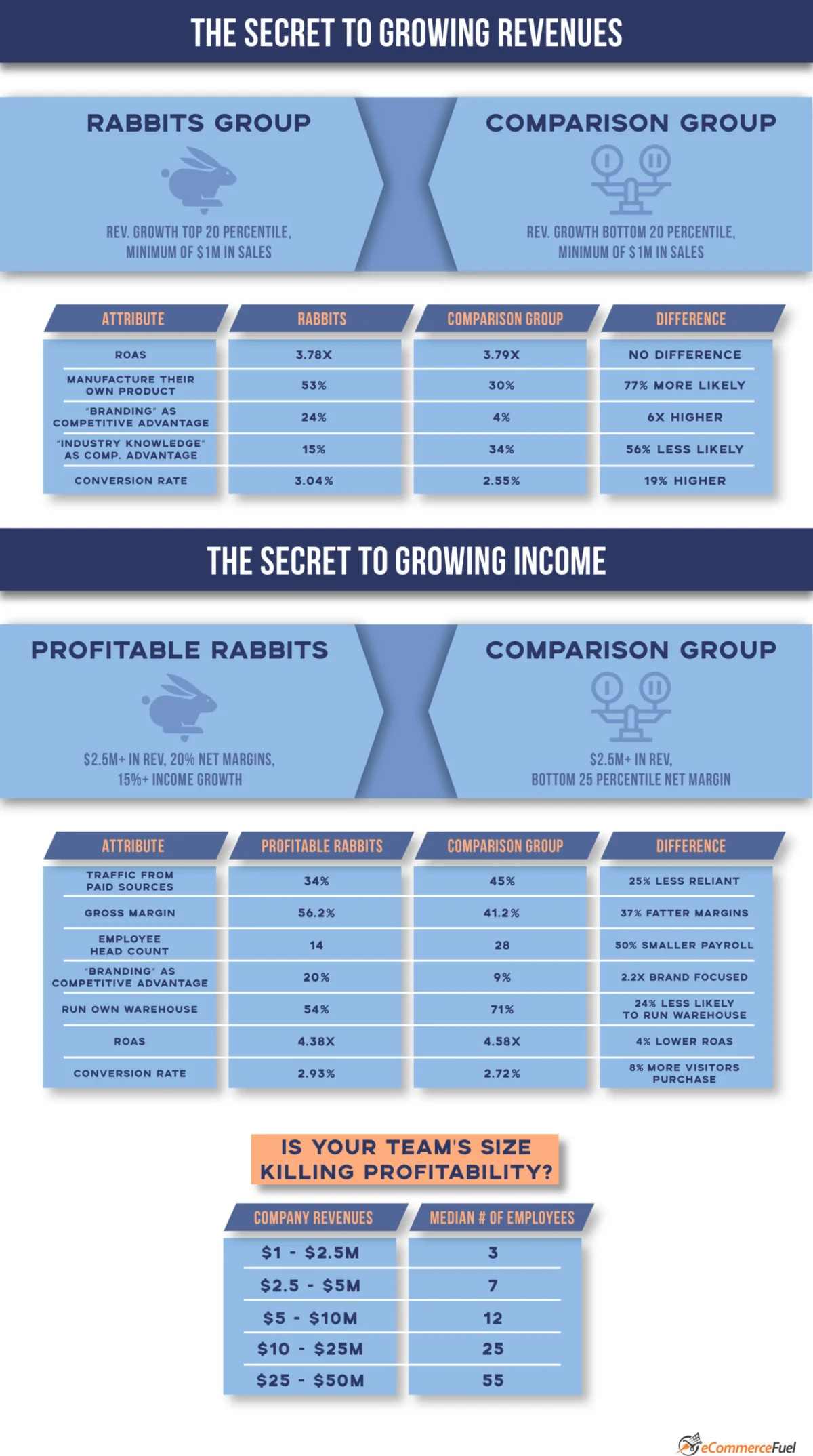
- Payroll Efficiency: The most profitable stores surveyed operated with roughly 50% of the payroll costs of their less-profitable counterparts.
- Outsourcing: High-performers were 25% more likely to utilize 3PL services, recognizing that logistics is rarely a core competency of a retail brand.
- Traffic Diversification: Top-tier performers were 25% less reliant on paid advertising channels, favoring brand equity and organic reach over the "rented" audiences of social media platforms.
These data points suggest that operational excellence is a more sustainable moat than marketing cleverness. While a viral ad campaign can drive a short-term spike, a lean operational structure creates a resilient foundation that can withstand market volatility and economic downturns.

The Broad Implications: Lean Means More Than Just Headcount
"Staying lean" is frequently misinterpreted as a call for mass layoffs. In practice, however, true leanness is an audit of every dollar leaving the business.
The Overhead Audit
Modern overhead is often invisible. It exists in the form of:
- Physical Real Estate: Expensive office leases that were viewed as status symbols in 2019 now stand as liabilities in a post-pandemic, remote-first world.
- SaaS Bloat: Small, recurring monthly subscriptions that accumulate unnoticed. A $50 tool here and a $200 subscription there can aggregate into thousands of dollars in wasted annual spend.
- Operational Friction: Processes that are done "in-house" simply because "that’s how we’ve always done it," rather than because it provides a competitive advantage.
The litmus test for any expenditure is: Is this core to the brand’s value proposition? If a company sells specialized apparel, the design team is core. The warehousing and fulfillment? That is a commodity service that can, and should, be outsourced to experts who can perform the task at scale with greater efficiency.

The Uncomfortable Truth: Proactive vs. Reactive Leadership
The most successful entrepreneurs share a defining trait: the willingness to have difficult conversations before they are forced to. Most business owners wait for a recession or a cash-flow crisis to cut costs. Proactive leaders, however, conduct "pre-mortem" analyses. They ask themselves: If I had to cut 25% of my operating costs tomorrow, what would go?
By answering this question proactively, they identify roles that were hired out of convenience rather than necessity, and they identify habits that are masquerading as strategy. This is not about being "cheap"—it is about being intentional with resources.
The Second Unsexy Lever: Strategic Tax Management
Beyond operational efficiency, the second, often ignored lever of profitability is tax strategy. Taxes are frequently treated as a fixed, unavoidable cost of doing business. This is a costly misconception.

A comparison of two businesses with identical $2.5 million revenue streams reveals a startling $54,000 annual disparity in net income—a gap driven entirely by tax strategy. While Owner A pays $75,000, Owner B pays only $21,000.
Key Pillars of Tax Optimization
- Aggressive Profit Sharing: Utilizing retirement vehicles beyond standard 401k limits to shield income.
- Appreciated Asset Donations: Donating stock that has gained value to charity avoids capital gains tax while providing a full fair-market-value deduction.
- The Family Employment Strategy: Legally employing children for actual work allows for deductible business expenses that can then be invested into tax-advantaged Roth IRAs for the children’s future.
- Inventory Donations: A massively underutilized tool in e-commerce, donating slow-moving or obsolete inventory to charity at fair market value provides a significant deduction compared to liquidating at a loss.
The Role of the Professional: Why "Fine" Accountants Cost You Money
The reason these opportunities remain invisible is that there is no single "Tax Dashboard" for a business. Financial data is scattered across personal returns, business filings, and brokerage accounts.
Most business owners have a "fine" accountant. A fine accountant is technically proficient; they ensure filings are accurate and deadlines are met. However, a fine accountant is reactive. They process the numbers you give them. A strategic advisor, conversely, is proactive. They understand your business model, ask the difficult questions, and bring ideas to you before the tax year ends.

If your CPA is not coming to you with proactive suggestions to improve your after-tax outcome, you are likely leaving significant capital on the table.
Conclusion: The Path Forward
The obsession with top-line revenue metrics like ROAS and CAC has created a generation of founders who are busy but not necessarily wealthy. True success is found in the unglamorous work of streamlining operations and managing the tax burden.
Better marketing is an excellent goal, but it is not the only way to grow. For the business owner looking to scale sustainably, the most effective path is often to stop focusing on how much more they can sell, and start focusing on how much more they can keep. By embracing operational leanness and demanding more from their financial advisors, entrepreneurs can build businesses that are not only larger but significantly more profitable and far less stressful to manage.